Quick Answer: Cooling tower failures like stuck fill valves, basin overflow, and poor cycling waste 5,000 to 50,000+ gallons daily while driving up treatment costs and energy bills. Real-time monitoring with automated alerts catches these problems within minutes of occurrence, reducing water loss by 15-40% and preventing the multi-thousand-dollar repairs that follow neglected equipment.
The Department of Energy’s cooling tower management best practices address common operational issues including fill valve failures and overflow conditions.
Why Cooling Tower Problems Cost More Than You Think
Your cooling tower runs 24/7. For most facilities, that means it operates 8,760 hours a year. In that time, a single malfunctioning component doesn’t just waste water—it compounds waste through cascading operational failures.
A stuck fill valve might seem like a minor issue. But when the fill valve won’t close properly, the basin overfills. Overflow drains thousands of gallons to sewer. To replace that water, your makeup water increases. With increased makeup water comes increased chemical treatment. Higher water consumption means higher sewer charges. If your facility is metered, overfill events alone can cost $500-$2,000 per incident.
The real problem: most facility teams don’t know these failures are happening. They find out after the fact—from the water bill, or worse, when the equipment stops working entirely.
Problem #1: Stuck Fill Valves and What They Actually Cost
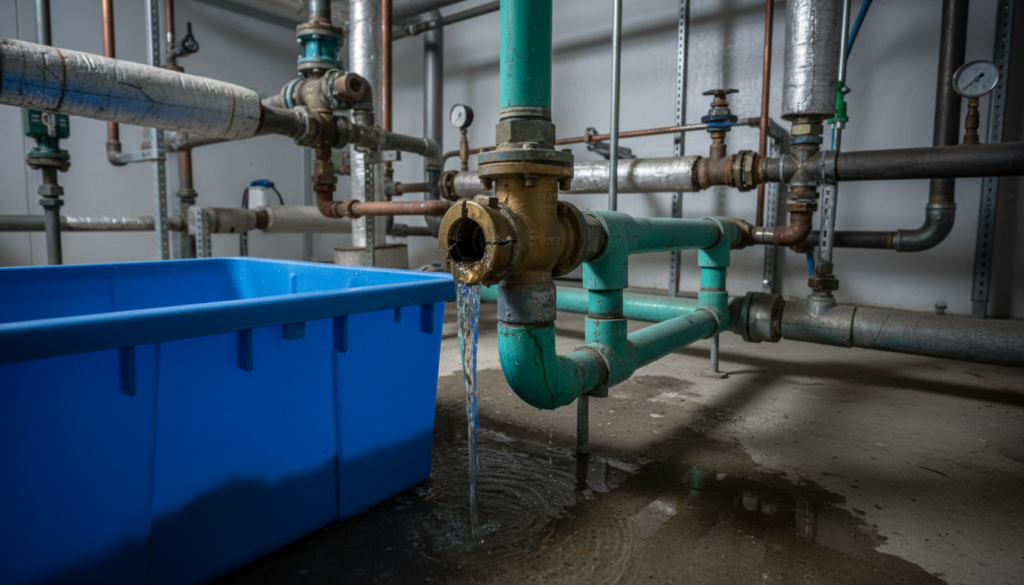
Fill valves are the mechanism that meters water into the cooling tower basin. A solenoid-operated fill valve opens when water is needed and closes when the basin reaches the correct level. When a fill valve sticks in the open position, water keeps flowing into the basin indefinitely.
This happens for several reasons: sediment buildup from poor water quality, mineral scaling in hard water environments, or mechanical failure of the solenoid. Once it sticks, your basin overflows at the overflow line, and the water goes straight to the drain.
What Happens When Fill Valves Stick
- Constant basin overflow. Water level stays at or above the overflow threshold, draining continuously to sewer.
- Loss of cycle concentration. The cooling tower can’t maintain proper water concentration because fresh water keeps diluting the basin.
- Chemical imbalance. Treatment chemicals don’t accumulate properly, reducing cooling efficiency and increasing corrosion risk.
- Increased makeup demand. The system demands more water to compensate, inflating your water bill.
- Energy penalty. The tower operates less efficiently, requiring longer runtime or higher fan speed to achieve target temperatures.
Real Costs: The Numbers
A 100-ton cooling tower with a stuck fill valve can overflow 5,000-10,000 gallons per day. Over a month, that’s 150,000-300,000 gallons of unnecessary water loss. At typical municipal water rates (around $5-8 per 1,000 gallons) plus sewer charges (another $4-6 per 1,000 gallons), that’s a monthly cost of $1,350-$4,200 in wasted water and sewer fees alone—before accounting for additional chemical treatment.
If the stuck valve goes undetected for three months, your facility has already lost $4,000-$12,600. The fill valve itself costs $200-$600 to replace. The real cost is the time before you notice.
Problem #2: Basin Overflow and Runaway Water Loss
Basin overflow can occur for reasons beyond a stuck fill valve. Overflow is the safety mechanism that prevents water from rising above a certain level. When it’s working correctly, it’s barely noticeable. When overflow occurs regularly, something is wrong with your system balance.
What Causes Basin Overflow
- Stuck fill valve. The most common culprit.
- Plugged or malfunctioning float switch. If the float switch that signals “basin is full” gets stuck or corroded, the fill valve never receives the signal to stop.
- Oversized makeup water pump. If your pump delivers more water than the tower can accommodate, overflow becomes chronic.
- Improper basin level setting. If the overflow line is set too high or the float switch is misaligned, water rises past the proper level.
- Drift loss underestimation. If your tower loses more water to drift (airborne droplets) than expected, the float switch activates to refill, overfilling the basin before realizing the additional loss.
The result is always the same: water exits through the overflow line to the sewer, and your system becomes unstable.
The Detection Problem
Here’s the challenge with overflow detection: unless you’re standing at the cooling tower and physically watching it, you won’t see it happening. Many facilities discover overflow only when they conduct an annual water audit or notice a spike in the water bill. By that point, thousands of gallons have been lost.
Manual inspection every week can catch overflow, but it’s labor-intensive and unreliable. Facility teams have dozens of priorities. Checking cooling towers often gets deferred.
Problem #3: Poor Cycling of Concentration
Cycles of concentration (CoC) is a critical cooling tower metric. It measures how many times the mineral and salt content in your cooling water is concentrated compared to your makeup water. A cooling tower operating at 3 cycles means the dissolved minerals in your basin water are 3 times higher than in the makeup water.
Why does this matter? Because higher cycles mean you use less makeup water and less chemical treatment to maintain the same cooling performance. A tower running at 4 cycles is significantly more efficient than one running at 2 cycles.
What Causes Low Cycling
- Excessive makeup water. If your system is refilling the basin too often, you dilute the mineral concentration.
- Uncontrolled blowdown. If blowdown (the deliberate drainage of concentrated water) is oversized or happens too frequently, you’re draining minerals faster than they can accumulate.
- Unmeasured leaks. Small leaks in pipework or basin drains force the system to add more makeup water, diluting concentration.
- Overflow losses. As discussed above, overflow prevents concentration from building.
- Inadequate water treatment. If you’re not controlling scaling and corrosion properly, minerals precipitate out of solution instead of staying dissolved, reducing effective concentration.
The Water Waste Impact
A cooling tower operating at 2 cycles instead of 3.5 cycles can waste 20-30% more water annually. For a medium-sized facility running a 100-ton tower continuously, that difference translates to 500,000-1,000,000 gallons of wasted water per year.
The problem compounds: lower cycles also mean more chemical treatment (because you’re using more makeup water with no benefit), and more blowdown (because you’re dumping minerals that never accumulated in the first place). Facility teams often respond by increasing treatment chemicals, which actually makes the problem worse by preventing concentration from building further.
Traditional maintenance doesn’t catch this. You’d need water quality testing (conductivity, alkalinity, chloride) to measure cycles, and most facilities test quarterly or annually at best. By then, months of inefficient operation have already occurred.
Problem #4: Drift Loss Beyond Normal Parameters
Drift is the mist of water droplets that escape from the cooling tower into the air. Every cooling tower loses some water to drift—it’s inherent to the design. Manufacturers typically rate drift loss at 0.001 to 0.005 percent of the total water circulating through the tower with modern high-efficiency drift eliminators.
For a 100-ton tower with a 3 GPM per ton flow rate (300 GPM total circulation), normal drift loss is just 0.003 to 0.015 GPM. That’s acceptable and factored into your cooling strategy.
But when drift eliminators become fouled—clogged with algae, mineral scale, or debris—drift loss can spike to 0.5 percent or higher. Suddenly, instead of losing a fraction of a GPM to drift, you’re losing 1.5 GPM or more.
Symptoms of Excessive Drift
- Higher makeup water demand than design specs. You’re constantly refilling the basin because water is escaping as mist.
- Unexplained increases in water consumption. Your meter reading climbs even though cooling load is normal.
- Visible mist plume from the tower. Excessive drift is often visible as a thicker, more persistent mist or fog around the cooling tower.
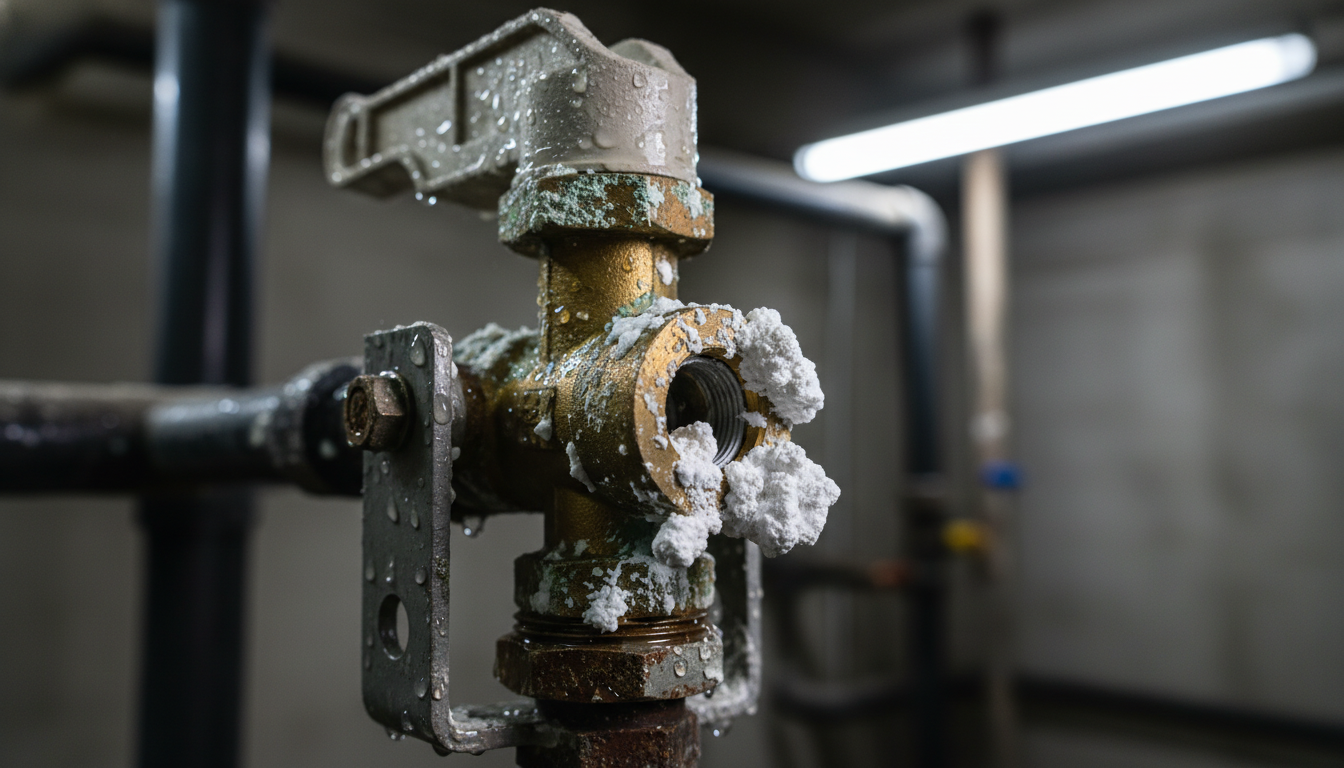
- Water on equipment near the tower. Drift deposits water and minerals on nearby surfaces, leaving white mineral residue.
- Poor cycle concentration. The constant makeup water dilutes basin minerals faster than they can concentrate.
Drift loss that goes undetected for months can waste 50,000-200,000+ gallons per year, depending on tower size and the degree of fouling.
How Real-Time Monitoring Catches These Problems Automatically
The difference between scheduled maintenance and predictive monitoring is the difference between reactive and proactive. Scheduled maintenance asks, “When should we check the tower?” Predictive monitoring asks, “What is the tower doing right now?”
Automated Alerts for Stuck Fill Valves
Real-time monitoring systems continuously measure basin water level using float switches, ultrasonic sensors, or pressure transducers. When a fill valve sticks open, the basin level rises above the setpoint and stays there. Within seconds, the monitoring system detects the condition and triggers an alert.
Instead of a three-month delay before discovery, your team is notified immediately. You can dispatch a technician to close the valve manually or schedule a repair within hours. This single alert can save $1,000-$3,000 in water loss.
Automated Alerts for Basin Overflow
When basin level monitoring detects that water is flowing over the overflow line, the system immediately identifies the problem. The monitoring logic can distinguish between a brief overflow (normal operation) and persistent overflow (equipment failure). Sustained overflow triggers an alert, allowing your team to investigate the root cause before more water is lost.
Automated Alerts for Poor Cycling
Advanced monitoring systems integrate water quality sensors (conductivity probes) that measure the mineral concentration in the basin in real-time. The system calculates cycles of concentration automatically by comparing basin conductivity to makeup water conductivity. When cycles drop below your efficiency target, the system alerts you.
This allows you to respond within hours instead of waiting for a quarterly water test. You might adjust blowdown settings, investigate for leaks, or review your makeup water strategy. Early intervention prevents weeks of inefficient, water-wasting operation.
Automated Alerts for Excessive Drift
When makeup water demand increases beyond design expectations (while cooling load remains constant), it signals potential drift loss. The monitoring system tracks makeup water flow relative to design specifications. When makeup demand climbs 20-30% above baseline without corresponding increases in cooling load, the system alerts you to a potential drift eliminator fouling problem.
A technician can then inspect the drift eliminators and clean them if necessary. This preventive action stops excessive loss before it accumulates into major water waste.
The Value of Predictive Monitoring vs. Scheduled Maintenance
Traditional maintenance typically follows a schedule: inspect the cooling tower monthly, test water quality quarterly, and perform preventive maintenance seasonally. This approach assumes problems develop on a predictable timeline. They don’t.
A fill valve can stick on a Tuesday afternoon. If your scheduled inspection isn’t until next month, you lose weeks of water. A float switch can corrode overnight. A drift eliminator can become fouled during a single dust storm. Scheduled maintenance can’t catch these failures in time.
Real-Time Monitoring Covers What Scheduled Maintenance Misses
- Immediate detection of operational changes. The moment something goes wrong, you know about it.
- Data-driven diagnosis. Instead of guessing why water consumption is high, your monitoring system provides specific evidence: basin level, makeup water flow, cycles of concentration, drift rate.
- Reduced emergency repairs. Catching problems early means scheduled maintenance instead of emergency callouts. Scheduled repairs cost 30-50% less than emergency service.
- Optimized chemical treatment. When you track cycles in real-time, you can adjust treatment chemistry precisely. This reduces chemical waste and improves cooling efficiency.
- Compliance documentation. Real-time monitoring creates continuous records that satisfy regulatory requirements and support water conservation certifications.
For most facilities, real-time monitoring combined with scheduled maintenance delivers results neither approach can achieve alone.
Quantifying the Cost of Delayed Detection
Let’s model what delayed detection actually costs. Consider a 100-ton cooling tower operating at a facility in a region with water rates of $6 per 1,000 gallons and sewer rates of $5 per 1,000 gallons ($11 per 1,000 gallons combined).
Scenario: Stuck Fill Valve, One Month Undetected
- Water loss: 7,500 gallons per day average x 30 days = 225,000 gallons
- Water and sewer cost: 225,000 x $0.011 = $2,475
- Additional chemical treatment (increased makeup water): $300-500
- Energy penalty (reduced efficiency, extended run time): $200-400
- Repair labor (technician diagnosis, valve replacement): $400-800
- Total cost of one month’s delay: $3,575-$4,175
If real-time monitoring alerts you within 4 hours and you schedule repair for the next business day, your water loss is limited to approximately 25,000-30,000 gallons. Your total cost drops to $500-700 (water/sewer plus repair labor). You’ve saved $2,875-$3,675 by detecting the problem quickly.
Scenario: Low Cycles of Concentration Over Six Months
- Design operation: 3.5 cycles, 200 GPM makeup water average
- Actual operation: 2.2 cycles, 340 GPM makeup water average (due to undetected leak or oversized blowdown)
- Excess water: (340-200) = 140 GPM x 1,440 minutes per day x 180 days = 36,288,000 gallons over six months
- Water and sewer cost: 36,288,000 x $0.011 = $399,168
- Excess chemical treatment: $8,000-12,000
- Energy cost (extended run time to compensate for poor concentration): $5,000-8,000
- Total cost of six months’ delay: $412,168-$419,168
With real-time conductivity monitoring, you detect the cycling problem within days of onset. A technician investigates, finds the source (perhaps a small leak or misaligned blowdown valve), and corrects it. Your loss is limited to 100,000-150,000 gallons ($1,100-1,650 in water/sewer costs) plus investigation and repair labor ($500-1,500). Total cost: $1,600-$3,150. You’ve prevented $409,000-$417,568 in losses.
Drift and poor water treatment can create serious health risks; the CDC’s Legionella resources explain how cooling towers can spread waterborne illness if not properly maintained.
ASHRAE and DOE Standards on Cooling Tower Monitoring
ASHRAE Standard 188-2018 (Legionellosis: Risk Management for Building Water Systems) emphasizes the importance of cooling tower monitoring and maintenance. The standard recognizes that regular monitoring of water quality, temperature, and system operation is essential for both safety and efficiency.
The U.S. Department of Energy’s (DOE) Cooling Tower Efficiency Guide recommends continuous or frequent monitoring of key operational parameters including basin water level, makeup water flow, and water quality metrics. The DOE explicitly identifies real-time monitoring as a cost-effective strategy for reducing cooling tower water consumption.
Equipment manufacturers, including those listed in the Cooling Technology Institute (CTI) directory, recommend monitoring systems that track basin level, makeup water demand, and drift loss. These recommendations reflect decades of field experience with cooling tower failures and their consequences.
The Post-Detection Workflow: From Alert to Resolution
Real-time monitoring isn’t just about detection. A complete system automates the workflow from alert to resolution.
Step 1: Alert Generation (Immediate)
The monitoring system detects an anomaly and sends alerts to facility managers via email, SMS, or push notification. The alert includes the specific condition (e.g., “Basin level high – possible stuck fill valve”) and timestamp.
Step 2: Data Validation (Within 15 Minutes)
The system continues monitoring to confirm the condition. A single high reading might be normal operation. Sustained abnormal readings confirm a true problem worth investigating.
Step 3: Root Cause Guidance (Within 1 Hour)
Advanced monitoring systems don’t just flag problems—they provide diagnostic information. If basin level is high and makeup water flow is normal, the system might conclude the problem is the float switch or overflow line. If basin level is high AND makeup water flow is high, the fill valve is the likely culprit.
Step 4: Maintenance Dispatch (Within 24 Hours)
Your facility manager has confidence in the diagnosis and can schedule a technician visit. Because the problem is confirmed and its likely cause is identified, the technician arrives prepared with the right tools and replacement parts. Repair time drops from hours of troubleshooting to 30-60 minutes of focused work.
Step 5: Post-Repair Verification
After repair, the monitoring system confirms that the condition has been resolved. Basin level returns to normal. Water loss stops. Cycles of concentration begin rebuilding. Your facility manager has proof that the repair was successful, documented for maintenance records.
Integration with Water Sustainability Goals
Many facilities operate under water conservation mandates or sustainability targets. Real-time cooling tower monitoring supports these goals by providing the data and insights needed to reduce water consumption continuously.
When you detect and prevent operational failures like stuck fill valves and poor cycling, you’re directly supporting water conservation. Additionally, the data from real-time monitoring allows your team to optimize blowdown rates, adjust chemical treatment to maximize cycles, and identify other efficiency opportunities that scheduled maintenance alone cannot reveal.
This is particularly valuable for facilities pursuing certifications like LEED, WELL, or industry-specific water efficiency programs. Real-time monitoring provides the documentation needed to demonstrate continuous improvement in cooling tower water management.
Why Your Facility Needs Monitoring Right Now
If your cooling tower is operating without real-time monitoring, you’re running blind. You might be losing water to stick fill valves, basin overflow, poor cycling, or excessive drift right now, and you won’t know until the water bill arrives.
Each day of operation without monitoring is a day of potential loss. The average facility can save 15-40% of cooling tower water consumption by implementing monitoring and responding to alerts promptly. For a facility with annual cooling water consumption of 5 million gallons, that’s 750,000 to 2,000,000 gallons of recoverable savings annually.
The cost of real-time monitoring is typically recovered within 6-12 months through water savings alone. After that period, it becomes pure savings—plus the additional benefits of extended equipment life, improved energy efficiency, and reduced emergency repairs.
Getting Started: Evaluate Your Cooling Tower Today
The first step is understanding your current baseline. How much water is your cooling tower actually consuming? At what cycles of concentration is it operating? What’s your current drift rate? Are there signs of overflow, leaks, or other problems you’ve overlooked?
If you would like to find out whether your facility qualifies, RPM offers a free evaluation with no obligation. Get your free evaluation.
During this evaluation, we’ll assess your cooling tower’s current condition, identify operational inefficiencies, and estimate your potential savings with real-time monitoring. We’ll provide a specific action plan tailored to your facility’s configuration and operational needs.
Key Takeaways
- Stuck fill valves, basin overflow, poor cycling, and excessive drift are common cooling tower problems that waste thousands to hundreds of thousands of gallons annually.
- These problems often go undetected for weeks or months because facility teams lack real-time visibility into cooling tower operation.
- Real-time monitoring systems detect these failures within minutes, triggering automated alerts that allow quick response.
- Early detection can save $1,000-$500,000+ per incident, depending on problem severity and duration.
- Predictive monitoring complements scheduled maintenance by catching problems that develop between inspections.
- ASHRAE, DOE, and equipment manufacturers all recommend real-time monitoring as a best practice for cooling tower efficiency and safety.
- Implementation cost is typically recovered within 6-12 months through water savings alone.
Your cooling tower is one of your facility’s largest water consumers. The problems discussed in this post are not speculative—they’re happening at facilities across the country every day. The difference between a facility that controls water waste and one that doesn’t is visibility. Real-time monitoring gives you that visibility.
For detailed information on how real-time monitoring works at your facility, see our guide on how RPM’s water monitoring system catches hidden problems. To understand the broader context of cooling tower water loss, read about cooling tower water loss as a hidden operational cost and how much water cooling towers typically waste.
If your facility has sub-metering or is pursuing sewer credits, our guide to sub-metering and sewer credits shows how monitoring efficiency improvements can directly improve your bottom line.
Ready to Find Out What You Could Save?
RPM Water Equity Solutions helps commercial facilities recover money lost to sewer billing assumptions. If your building has a cooling tower, chiller, or any system where water doesn’t return to the sewer, you may be overpaying every month.
Request your free assessment today and find out how much you could recover.
