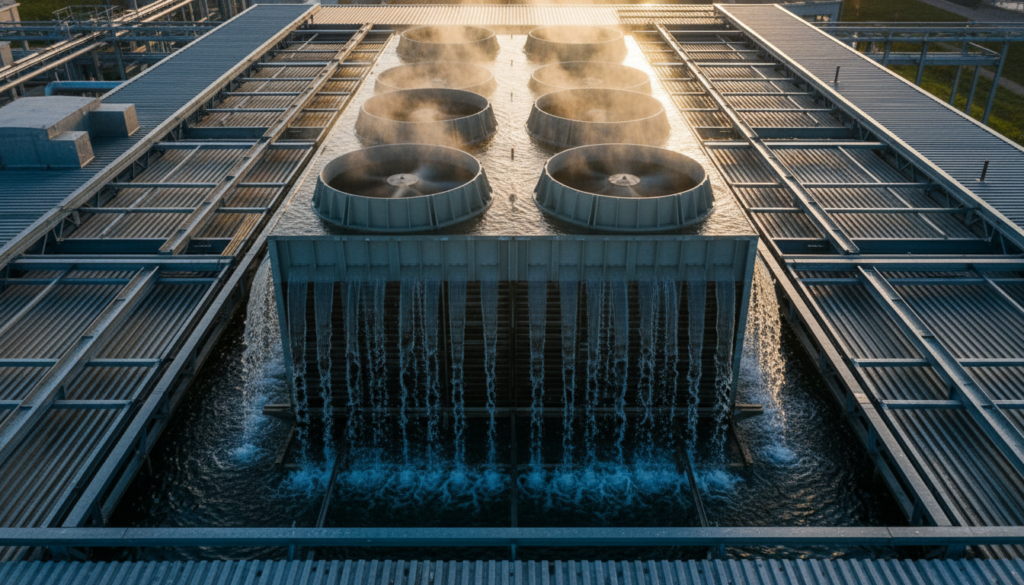
This evaporated water is exactly what qualifies for billing relief. Learn how in our complete guide to evaporation credits.
Quick answer for busy professionals:
Every facility manager knows cooling towers use water. Few realize how much, or what that water costs beyond the supply charge.
Cooling towers are the workhorses of commercial HVAC. They reject heat from building systems by evaporating water, a process that is both highly effective and highly consumptive. A single commercial cooling tower can process hundreds of thousands of gallons per month. The water that leaves the tower through evaporation, drift, blowdown, and occasional overflow never enters the sanitary sewer system, but the utility bill rarely reflects that fact.
The billing side of this equation matters too. See how utility billing assumptions differ from reality for commercial buildings.
The result is a structural mismatch between how water is used and how sewer charges are calculated. Most utilities assume that every gallon of water delivered to a facility exits as wastewater. For buildings with cooling towers, that assumption can overstate sewer volumes by 20 to 40 percent. Over the course of a year, the financial impact adds up quietly and consistently, often without anyone on the facility team realizing the extent of the overpayment.
The challenge is that most facility teams never see this cost broken out on their utility bill. Sewer charges appear as a single line item calculated from total water consumption. There is no line for “sewer charges on water that evaporated from your cooling towers.” The overcharge is real, but it is invisible unless you know where to look.
What Cooling Towers Actually Do
Cooling towers are heat rejection devices. They remove heat from a building’s chilled water loop by exposing warm water to ambient air, causing a portion of that water to evaporate. The evaporation process absorbs heat energy, cooling the remaining water so it can be recirculated through the system.
This is not a minor side effect. Evaporation is the primary mechanism by which cooling towers work. According to the U.S. Department of Energy, cooling towers consume approximately 1.8 gallons of water per hour per ton of cooling capacity during peak operation. For a 500 ton tower, that translates to roughly 15 gallons per minute of evaporation at full load. That is by design. Without evaporation, the cooling tower cannot do its job.
The water that evaporates leaves the system entirely. It becomes water vapor in the atmosphere. It does not flow to a drain, it does not enter the sewer system, and it does not pass through the utility’s wastewater treatment plant. Yet in most jurisdictions, the sewer charge on your utility bill treats that evaporated water as if it were discharged directly into the sewer.
Commercial cooling towers come in many sizes, from small rooftop units serving a single building to large industrial installations cooling data centers, hospitals, or manufacturing plants. Regardless of scale, the physics are the same: water is the cooling medium, and a significant portion of it is consumed in the process. The larger the tower, the larger the volume of water that never reaches the sewer.
This distinction between water consumed and water discharged is the foundation of cooling tower sewer credits, and it is why understanding your tower’s water loss matters financially, not just operationally.
The Four Paths Water Leaves a Cooling Tower
Water exits a cooling tower through four distinct paths. Each one has different characteristics, different volumes, and different implications for your utility bill.
[IMAGE: Diagram: Four water loss paths from a cooling tower with volume percentages (Evaporation 60-70%, Blowdown 20-30%, Drift <1%, Overflow variable), 1024×768]
Evaporation
Evaporation is the largest source of water loss and the entire reason the cooling tower works. As warm water cascades over the tower fill, a portion evaporates into the air stream, absorbing heat in the process. Evaporation typically accounts for 60 to 70 percent of total water loss from a cooling tower. This water leaves the system as vapor and never enters the sewer.
For a 500 ton tower operating during a typical cooling season, evaporation alone can account for 500,000 to 700,000 gallons per year. In warmer climates with longer cooling seasons, those numbers climb significantly.
Blowdown
Blowdown is the intentional discharge of water from the tower basin to control mineral concentration. As water evaporates, dissolved minerals remain behind and become more concentrated. If concentrations get too high, scale forms on heat exchange surfaces, reducing efficiency and potentially damaging equipment. Blowdown removes a portion of this concentrated water so it can be replaced with fresh makeup water.
Blowdown typically accounts for 20 to 30 percent of total water loss. Unlike evaporation, blowdown water does flow to a drain, usually to the sanitary sewer. This is an important distinction because blowdown is the portion of cooling tower water that legitimately should be billed as sewer discharge.
The ratio between evaporation and blowdown is governed by a metric called cycles of concentration. Higher cycles mean less blowdown relative to evaporation, which is generally more water efficient but requires careful chemical treatment. Most commercial towers operate between 3 and 6 cycles of concentration. The key point for billing purposes is that the difference between total makeup water and blowdown represents the volume that should not appear on your sewer bill.
Drift
Drift consists of small water droplets carried out of the tower by the air stream. Modern drift eliminators reduce this to a very small percentage of circulated flow, typically less than 0.005 percent of the recirculation rate. While drift volumes are small compared to evaporation and blowdown, they represent water that exits the system without reaching the sewer.
Overflow and Leaks
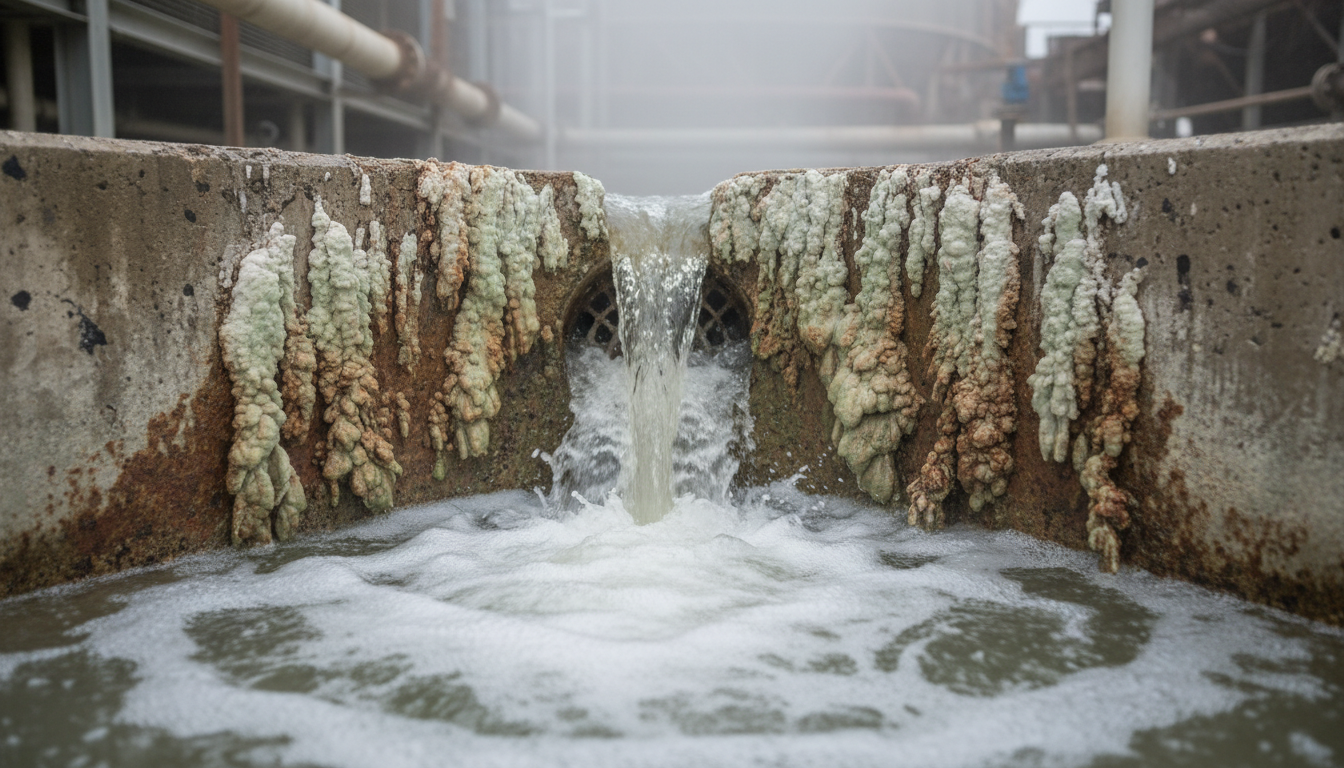
The fourth path is unintentional: overflow from the tower basin due to stuck fill valves, float valve malfunctions, or leaks in piping and basins. While these should not happen during normal operations, they are more common than most facility teams realize. A stuck fill valve can waste thousands of gallons per day, often without triggering any alarm if the system is not monitored. This water typically runs to a storm drain or the ground, not the sewer, adding to the volume of water billed incorrectly.
How Much Water a Typical Commercial Tower Uses
The volume of water a cooling tower consumes depends on several factors: tonnage, climate, hours of operation, and cycles of concentration. But even rough calculations reveal numbers that surprise most facility managers.
The American Society of Heating, Refrigerating and Air-Conditioning Engineers (ASHRAE) provides guidelines for estimating cooling tower water consumption, and the U.S. Department of Energy’s BMP 10 guidelines offer federal benchmarks for managing cooling tower water use. A common rule of thumb is that a cooling tower evaporates approximately 3 gallons per minute per 100 tons of cooling capacity at full load.
The following estimates assume 2,000 hours of annual cooling operation and 4 cycles of concentration.
These are conservative estimates. Facilities in hot, dry climates or those operating towers year round will see significantly higher consumption. A 1,000 ton tower in Phoenix or Dallas running 3,500 hours per year could consume 4 million gallons or more annually.
The critical number is the difference between total makeup water (what comes in) and blowdown (what goes to the drain). That difference, primarily evaporation plus a small amount of drift, is water your facility is paying sewer charges on that never entered the sewer system.
The Financial Impact
The financial impact of cooling tower water loss becomes clear when you apply local sewer rates to the volumes that should not be billed.
Sewer rates vary by utility, but commercial sewer charges commonly range from $5 to $15 per thousand gallons, with some metropolitan areas exceeding $20 per thousand gallons. Using a moderate rate of $8 per thousand gallons, the annual sewer overcharge for evaporated and drift water looks like this:
At higher sewer rates, these numbers scale proportionally. A 1,000 ton tower in a jurisdiction charging $15 per thousand gallons generates nearly $14,000 per year in sewer charges for water that was never discharged as wastewater. For facilities with multiple towers or higher operating hours, annual overcharges of $20,000 to $50,000 or more are common.
[IMAGE: Chart: Bar chart comparing metered water in vs. water to sewer, showing the overpayment gap, 1024×768]
These are recurring costs. The overcharge repeats every month, every year, for as long as the billing assumption goes uncorrected. Over a five year period, a midsize commercial facility can easily overpay $25,000 to $75,000 in sewer charges for water that evaporated from its cooling towers.
Many facility teams accept their utility bills at face value because the charges seem consistent month to month. Consistency, however, does not mean accuracy. A consistent overcharge is still an overcharge. The stability of the billing pattern is actually what makes this problem easy to correct once the data is in place: the savings are predictable, recurring, and durable.
How Monitoring Changes the Equation
Monitoring does more than support credit applications. A cooling tower that suddenly starts using 20 percent more water than its historical baseline is telling you something, whether it is a stuck valve, a chemical treatment issue, or a change in building load. Without monitoring, these signals go unnoticed until they become expensive problems. Tracking consumption patterns over time helps facility teams catch maintenance issues early, optimize water treatment programs, and avoid waste that serves no cooling purpose.
But the primary financial case for monitoring is the sewer credit itself. The gap between what your facility actually discharges and what your utility assumes can only be closed with metered data.
Submeters installed on the cooling tower makeup line and the blowdown line provide continuous, verifiable data on actual water use. The difference between the two readings represents evaporation, drift, and any other non-sewer losses. That measured difference becomes the documented basis for a sewer credit application.
Without monitoring, facilities are left relying on engineering estimates or manufacturer specifications, which many utilities will not accept or which produce less favorable credit calculations. Continuous metering provides the accuracy and auditability that utility programs require, and it often reveals additional issues such as stuck fill valves, excessive blowdown, or unexplained consumption spikes that represent opportunities for further savings.
Monitoring also ensures that credits remain valid over time. Many utility programs require periodic resubmission of data or ongoing proof that non-sewer volumes have not changed. Continuous monitoring makes compliance routine rather than a periodic scramble to gather historical data.
For a deeper look at what submetering involves and how the data supports credit applications, see our guide on submetering for sewer credits.
What a Cooling Tower Water Audit Looks Like
A cooling tower water audit evaluates how much water your system uses, where it goes, and whether you are paying more than you should on your sewer bill. The audit does not require any disruption to building operations and can typically be completed within a few weeks.
The process generally follows these steps:
1. Review existing utility data. Twelve months of water and sewer bills establish a baseline for total consumption and current sewer charges. This reveals the total amount of money flowing through the system and sets the context for potential savings.
2. Assess cooling tower equipment. A site visit evaluates tower tonnage, configuration, condition, metering infrastructure, and piping accessibility. This determines what monitoring equipment is needed and where it should be installed.
3. Evaluate local utility requirements. Sewer credit programs vary by jurisdiction. The audit identifies what your local utility requires for credit applications, including documentation standards, metering specifications, and submission timelines.
4. Estimate savings potential. Based on tower size, operating hours, local climate, and sewer rates, the audit produces an estimated range of annual savings. This estimate gives decision makers the information they need to evaluate whether moving forward makes financial sense.
5. Recommend a path forward. The audit concludes with a clear recommendation: whether monitoring and credit recovery make sense for the facility, what equipment would be required, and what the expected timeline looks like from installation to first adjusted bill.
For many facilities, the audit itself reveals that the savings opportunity is significantly larger than expected. Buildings that have operated for years without sewer credits are often paying thousands of dollars per year in avoidable charges simply because no one has quantified the gap between metered water and actual sewer discharge. The EPA’s WaterSense program for commercial buildings reinforces that regular water auditing is one of the most effective steps a facility can take.
The audit also frequently identifies operational issues beyond billing. Towers running at low cycles of concentration waste both water and treatment chemicals. Leaking basins or faulty valves add consumption that serves no cooling purpose. These findings create additional value beyond the credit program itself, improving both the financial and operational performance of the cooling system.
Getting Started
If your facility has commercial cooling towers and you have not investigated sewer credits, the financial opportunity is likely larger than you think. The process of evaluating your eligibility does not require capital investment, operational disruption, or commitment. It starts with understanding your current water use and what your utility charges for sewer service.
RPM Water Equity Solutions provides free assessments that analyze your water and sewer data, evaluate your cooling tower infrastructure, and estimate the savings available through a credit program. We handle the metering, documentation, utility coordination, and ongoing management so your team can focus on running the facility.
Ready to Find Out What You Could Save?
RPM Water Equity Solutions helps commercial facilities recover money lost to sewer billing assumptions. We handle the analysis, metering, documentation, and utility coordination so you don’t have to. All we need to get started is 12 months of water and sewer bills.
Request your free assessment today and we’ll show you exactly where you stand.
For more background on how sewer credits work and who qualifies, see our plain english guide to sewer credits. For a closer look at evaporation specifically and how it drives credit calculations, see our guide on evaporation credits explained.
