How to Qualify for Sewer Credits on Your Cooling Tower
Quick answer for busy professionals:
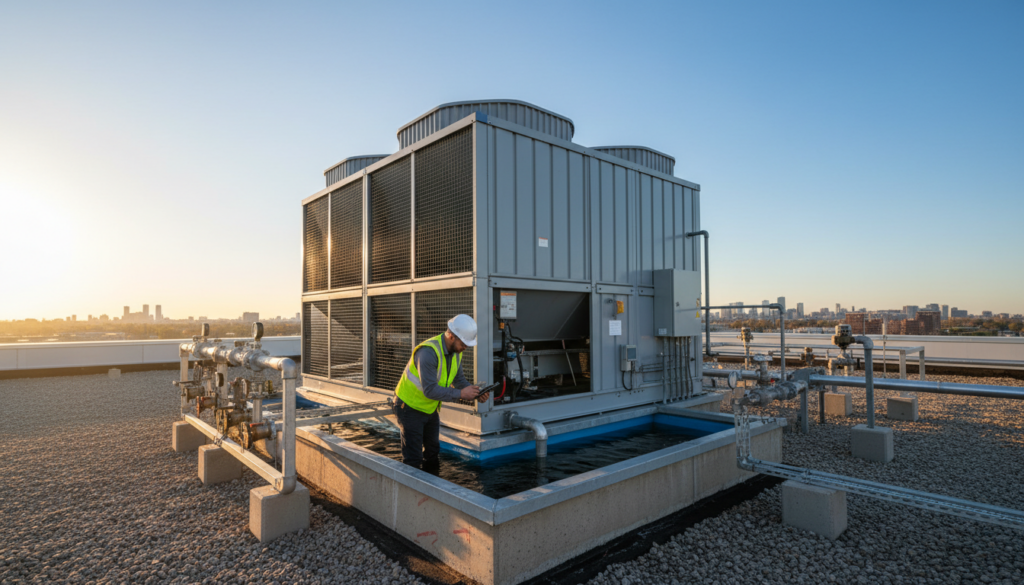
If you manage a commercial building with a cooling tower and have never looked into sewer credits, you are likely overpaying on your sewer bill every month. Cooling towers evaporate large volumes of water that never enter the sewer system, but your utility charges sewer fees on every gallon that passes through the water meter.
The DOE Federal Energy Management Program outlines best practices for cooling tower management that align with sewer credit requirements.
The question most facility managers ask after learning about sewer credits is straightforward: does this apply to my building? This post walks through the qualification criteria, common disqualifiers, and the steps to determine whether your facility is eligible. For a broader overview of how sewer credits work, see our plain english guide to sewer credits.
Basic Qualification Criteria
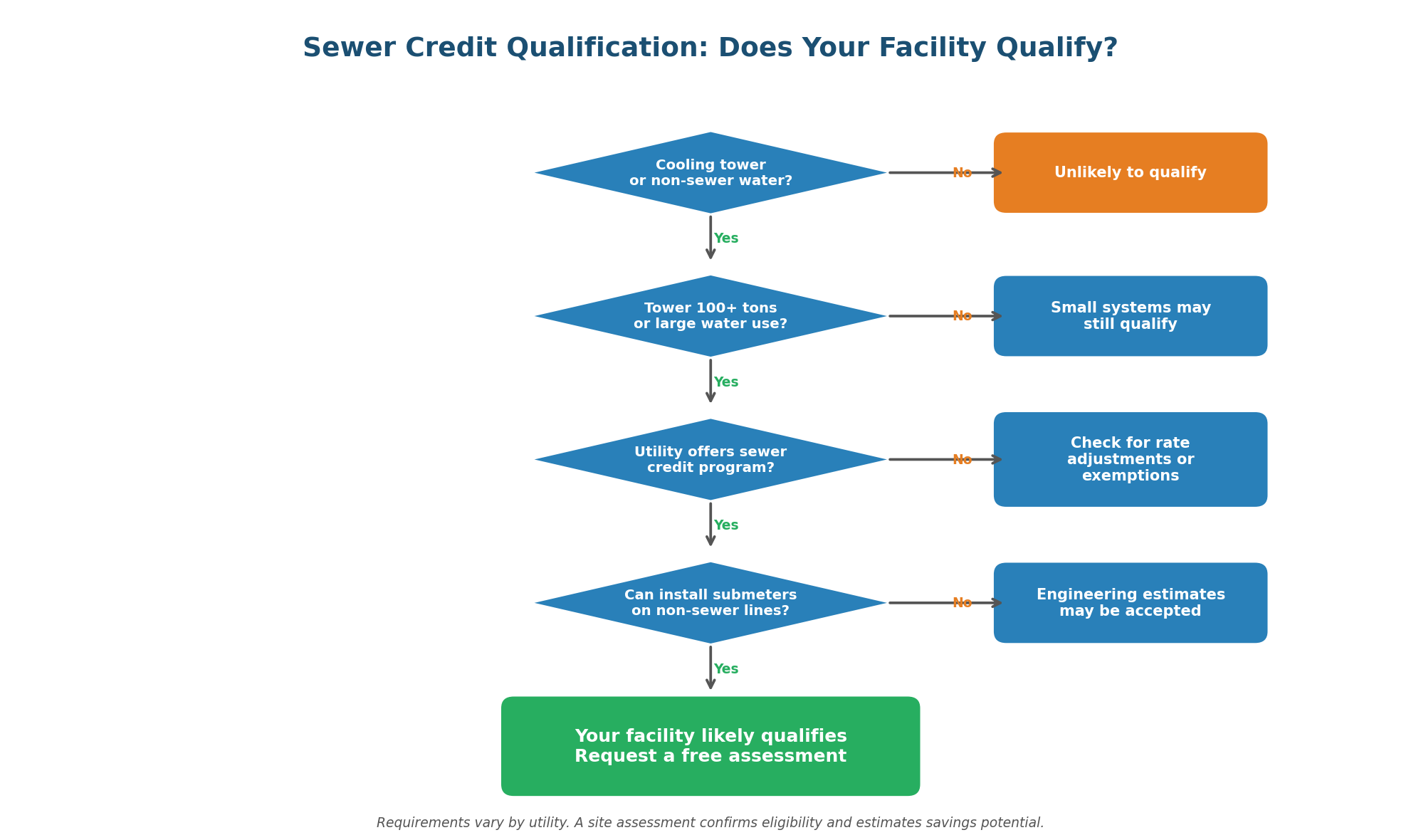
Sewer credit qualification is not a pass or fail test with a single threshold. It depends on several factors working together. That said, most facilities that meet the following criteria are strong candidates.
Cooling tower tonnage. Systems of one hundred tons or more typically produce enough evaporative water loss to justify the cost of metering and the administrative effort of applying. Larger systems generate proportionally greater evaporation credit requirements. A five-hundred ton system in a warm climate can lose one to three million gallons per year to evaporation, which at typical sewer rates translates to meaningful annual savings.
Water volume. The total volume of non-sewer water use matters more than any single equipment specification. A facility with a 200 ton cooling tower and significant irrigation may qualify just as readily as one with a 500 ton tower and no other non-sewer uses. The key metric is how many gallons bypass the sewer system each year.
Utility jurisdiction. The building must be located in a utility service territory that offers some form of sewer credit, sewer adjustment, or sewer exemption program. Many major U.S. utilities offer these programs, but the names, requirements, and procedures vary. Some utilities have well established programs with standard application forms. Others handle requests individually or have programs that are not widely publicized.
Metering feasibility. The non-sewer water lines must be accessible for submeter installation. For cooling towers, this means the makeup water line and blowdown line need physical space for meters. In most buildings, this is straightforward. In older buildings with tight mechanical rooms or unusual piping configurations, additional coordination may be required.
What Utilities Typically Require
While requirements vary by jurisdiction, most utility sewer credit programs share a common set of expectations.
A formal application. Most programs require a written application identifying the account, the building, the non-sewer water source, and the estimated volume of water that bypasses the sewer. Some utilities provide standard forms. Others accept letters with supporting documentation.
Submeter data. Utilities want quantitative proof, not estimates. The standard approach is to install submeters on the makeup water and blowdown lines of the cooling tower system. The difference between makeup and blowdown represents evaporated water, the volume that justifies the credit. For more detail on how submetering works, see our guide on documentation for sewer credits and submetering.
The EPA’s WaterSense program provides a framework for water conservation in commercial facilities.
Engineering support. Many utilities require an engineering analysis or water balance calculation that explains where the water goes. This typically documents the cooling tower’s operating parameters: tonnage, cycles of concentration, evaporation rate, and blowdown volume. The analysis shows that the metered difference between makeup and blowdown is consistent with the system’s design.
Meter specifications. Utilities often specify what type of meter is acceptable, what accuracy standard it must meet, and where it must be installed. Some require the meter to be installed by a licensed plumber. Others require utility inspection of the installation before data collection begins.
The documentation requirements may sound complex, but they follow a logical structure. A firm experienced in sewer credit programs can handle the entire process from site assessment through utility approval.
Common Disqualifiers and How to Address Them
Not every building with a cooling tower will qualify immediately. Understanding the common obstacles helps you plan around them.
The cooling system is too small. Systems under 50 tons may not produce enough evaporative loss to justify the cost of metering and application. However, if the building has other non-sewer uses (irrigation, boilers, process water), the combined volume may still make a credit program worthwhile.
The utility does not have a formal program. Some utilities do not publish a sewer credit program, but that does not necessarily mean credits are unavailable. In many cases, utilities will consider adjustment requests on a case-by-case basis when presented with documented evidence. A well-prepared application with metered data can open doors even where no formal program exists.
Piping is not accessible for metering. Older buildings sometimes have cooling tower piping that runs through walls, ceilings, or congested mechanical rooms where meter installation would be difficult or expensive. In these cases, alternative metering approaches or engineering estimates may be accepted by the utility, though metered data is always preferred.
The building has a separate irrigation meter. If irrigation is already on a dedicated meter that the utility excludes from sewer billing, that volume is already accounted for. The sewer credit opportunity in this scenario is limited to the cooling tower and any other non-sewer uses not already excluded.
Each of these situations is manageable. The key is understanding what the specific utility requires and developing a documentation strategy that addresses any gaps.

How Programs Differ Across Utilities
Sewer credit programs are administered at the local level. There is no federal or state standard governing how they work. This creates meaningful differences from one utility to the next.
Program names vary. What one utility calls a sewer credit program, another calls a sewer adjustment, a sewer exemption, a sewer fee refund, or a deduct meter program. The underlying concept is the same, but the terminology can make it difficult to find the right program without knowing what to search for.
Application processes differ. Some utilities have online application portals with clear instructions. Others require mailed applications with original signatures, utility inspector visits, or meetings with billing staff. The level of administrative effort varies significantly.
Data requirements vary. Some utilities accept 30 days of submeter data for an initial application. Others require 90 days or more. Some accept engineering estimates as a supplement to metered data. Others require metered data exclusively.
Renewal schedules differ. Some programs grant credits that renew automatically as long as metering data is submitted annually. Others require a new application every year, or every two years, or at the utility’s discretion. Understanding the renewal cycle is critical for maintaining credits over time.
According to the U.S. Environmental Protection Agency, water and wastewater utilities across the country are increasingly recognizing the importance of accurate billing. Many utilities have expanded or formalized their credit programs in recent years, making it easier for qualifying facilities to apply.
What the Application Process Looks Like
The path from initial inquiry to approved credit follows a predictable sequence, even though the details vary by utility.
Step 1: Savings assessment. Before investing in metering or documentation, evaluate whether the savings potential justifies the effort. This involves reviewing the building’s water consumption history, identifying non-sewer water sources, and estimating the volume that bypasses the sewer. A quick review of recent utility bills and building systems is usually enough to determine whether the opportunity is worth pursuing.
Step 2: Utility research. Identify the specific cooling tower sewer credits program available from your utility. Determine the application requirements, evaporation credit requirements by city, acceptable meter types, and any fees associated with the program. This step prevents wasted effort on documentation that does not meet the utility’s expectations.
Step 3: Meter installation and data collection. Install submeters that meet utility specifications. Collect data over the required period. The meters run continuously, recording the volume of water entering the cooling tower system and the volume discharged to the sewer. The evaporated volume is the difference.
Step 4: Documentation and submission. Prepare the application package: metered data summary, engineering analysis, site plan, equipment specifications, and any required forms. Submit to the utility per their process. This is where attention to detail matters. Incomplete or incorrectly formatted submissions get delayed or rejected.
Step 5: Review and approval. The utility reviews the submission, may request additional information or schedule an inspection, and ultimately approves or denies the credit. Approval timelines range from a few weeks to several months. Once approved, the credit is applied to future sewer bills.
How Long It Takes from Application to First Adjusted Bill
The total timeline from initial assessment to first adjusted bill typically ranges from three to nine months. The primary variables are the utility’s required data collection period, evaporation credit requirements by city, and their review timeline.
The data collection phase is usually the longest step. If the utility requires ninety days of metered data, that is three months before the application can even be submitted. Some utilities accept shorter initial periods, especially if engineering calculations supplement the metered data.
Utility review times vary from two weeks to four months depending on the jurisdiction and workload. Facilities in municipalities with established sewer credit programs, such as those described by the American Water Works Association, tend to process applications faster because the utility has a standardized workflow.
Once the credit is approved, the adjustment is typically applied to the next billing cycle. From that point forward, sewer charges are calculated on a reduced volume that reflects actual wastewater discharge.
What Ongoing Compliance Looks Like
Sewer credits are not a one-and-done benefit. Most programs require periodic revalidation, and maintaining compliance is essential to keeping credits active.
Most utilities require annual data submission: updated submeter readings, a summary of the non-sewer volume for the previous year, and in some cases a renewed application form. Some utilities also require periodic meter calibration or inspection.
Missing a compliance deadline is the most common reason credits lapse. When credits are suspended, the facility reverts to full sewer charges until documentation is resubmitted and reapproved. In some jurisdictions, the overpayment during the lapse period cannot be recovered retroactively.
This is where ongoing management becomes valuable. A monitoring program that tracks meter data continuously and flags compliance deadlines ahead of time prevents lapses before they happen. For more on how monitoring supports credit programs over time, see our post on utility billing assumptions vs reality.
Getting Started
Determining whether your cooling tower qualifies for sewer credits does not require a major commitment. A review of your building’s water consumption, cooling system specifications, and evaporation credit requirements by city can be completed quickly and will tell you whether the savings potential justifies moving forward.
The facilities with the strongest qualification profiles share three characteristics: cooling systems of one hundred tons or more, utility jurisdictions with established cooling tower sewer credits programs, and piping configurations that allow submeter installation. If your building has all three, sewer credit recovery is likely worth pursuing.
RPM Water Equity Solutions evaluates commercial facilities for sewer credit eligibility as part of a complimentary assessment. We review your utility data, assess your cooling tower systems, identify the applicable programs in your utility jurisdiction, and provide a clear estimate of savings potential. Request your free evaluation and we will tell you what we find.
Ready to Find Out What You Could Save?
RPM Water Equity Solutions helps commercial facilities recover money lost to sewer billing assumptions. If your building has a cooling tower, chiller, or any system where water doesn’t return to the sewer, you may be overpaying every month.
Request your free assessment today and find out how much you could recover.
