
Quick answers for busy professionals:
Every commercial building in America pays for sewer service. The charge appears on the monthly utility bill, calculated from a formula that has not changed much in decades. What most facility managers and finance teams do not realize is that the formula is built on an assumption that systematically overcharges buildings with non-sewer water uses.
The assumption is simple: your utility measures the water flowing into your building through the water meter and assumes the same volume flows out through the sewer. For a single family home, that is close enough to be fair. For a commercial building with cooling towers, boilers, irrigation, or process water, it can be off by 20 to 40 percent.
Cooling towers are the biggest source of non-sewer water loss. Our post on cooling tower water loss shows just how significant the gap can be.
This post explains why utilities bill the way they do, what the assumption gets wrong for commercial buildings, and exactly what it takes to correct it. If you have already read our post on how much you might be overpaying, this is the companion piece that explains the mechanics behind those numbers.
To see what these billing gaps actually cost, read our analysis of how much commercial buildings overpay for sewer.
Why Utilities Bill Sewer Based on Water Meter Readings
The billing model exists for practical reasons, not because utilities are unaware of its limitations.
Sewer flow is difficult and expensive to meter. Unlike clean water flowing through pressurized pipes, wastewater moves through gravity-fed lines that carry solids, grease, and variable flow rates. Metering this flow for individual billing accounts would require specialized equipment in sewer laterals, which would be costly to install, maintain, and read. Most utilities have concluded that the cost of universal sewer metering outweighs the benefit.
Water meters are already in place. Every commercial building already has a water meter that the utility owns and reads regularly. Using that same meter as a proxy for sewer volume is simple, consistent, and requires no additional infrastructure. From the utility’s perspective, it is the most cost-effective way to calculate sewer charges across thousands of accounts.
The assumption works for most residential accounts. In homes, nearly all water that comes in goes out through sinks, showers, toilets, and appliances. The gap between metered water and actual sewer discharge is small. Utilities built their billing systems around this residential reality, and the same methodology was applied to commercial accounts without adjusting for the fundamentally different ways commercial buildings use water.
According to the U.S. Environmental Protection Agency, commercial and institutional buildings account for approximately 17 percent of all publicly supplied water in the United States. A large share of that volume goes to systems that do not discharge to the sewer. The billing methodology does not distinguish between water that goes down a drain and water that evaporates from a cooling tower. That distinction is left to the building owner to document and prove.
What the Assumption Gets Wrong for Commercial Buildings
The gap between assumed and actual sewer discharge depends on what water-consuming systems a building operates. The more non-sewer water uses a facility has, the larger the gap.
Cooling towers are the largest single source of non-sewer water in most commercial buildings. They reject heat by evaporating water into the atmosphere. The evaporated volume never reaches the sewer. A midsize office tower with a 500 ton cooling system can lose 1 to 3 million gallons per year to evaporation alone, depending on climate and operating hours. Every gallon is billed as wastewater. For a detailed breakdown of where cooling tower water goes, see our post on cooling tower water loss.
Irrigation sends water directly into the landscape. Office parks, hospitals, universities, and retail properties with significant landscaping can use 50,000 to 200,000 gallons per year on irrigation during the growing season, none of which enters the sewer.
Boilers and steam systems convert water to steam for heating. Steam that is vented or lost through the distribution system never returns to the sewer. Facilities with large heating plants can have substantial boiler makeup water volumes.
Process water, humidification, and specialty equipment consume or divert water in manufacturing, food production, laboratory, and data center environments. These volumes vary widely but can be significant for the right facility types. The Department of Energy’s commercial buildings program recognizes water management as a key component of facility efficiency.
For buildings with cooling towers, irrigation, or process water, 20 to 40 percent of total water consumption commonly bypasses the sewer entirely. That percentage translates directly into overpayment on the sewer line item of the utility bill.
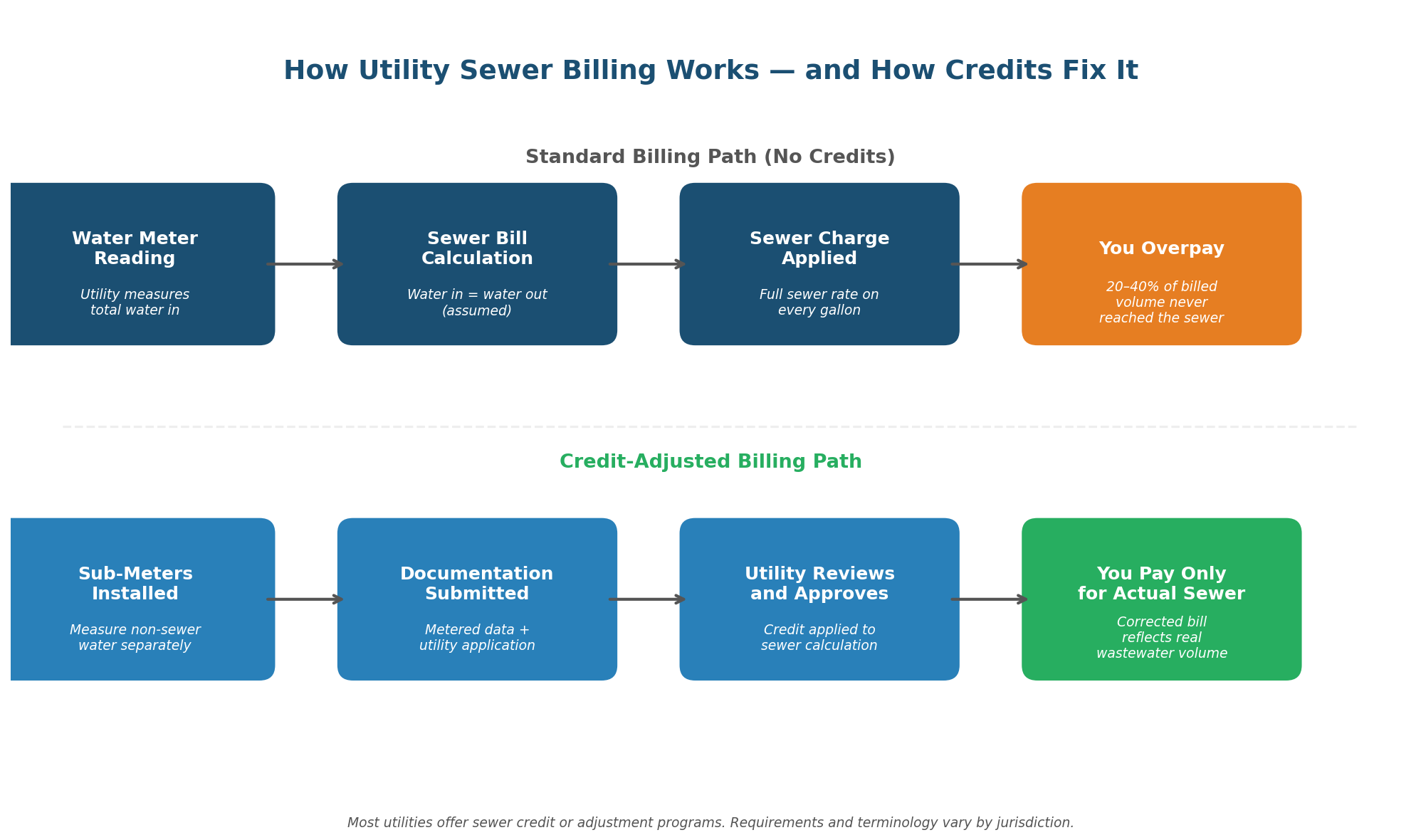
The Documentation Path: How to Prove Water Is Not Reaching the Sewer
Utilities are not going to correct the assumption on their own. They have no way of knowing what happens to water after it passes through the building’s water meter, so the responsibility for proving non-sewer water use falls on the building owner or their representative. This is not a complaint process or a negotiation.
It is a documented application supported by metered data. Many major U.S. utilities have a formal program for this, though the name varies: sewer credit program, sewer adjustment, sewer exemption, sewer fee refund, or simply a deduct meter program. The concept is the same: provide verifiable evidence that a portion of your water does not enter the sewer, and the utility adjusts your sewer charges accordingly.
The documentation path typically follows five steps.
1. Site assessment
A water usage audit evaluates the building’s water systems to identify all non-sewer water uses and estimate the volume of water that bypasses the sewer. This step determines whether the savings potential justifies the cost of metering and the effort of applying.
2. Meter installation
Install submeters on the water supply lines feeding non-sewer equipment. For cooling towers, this typically means a makeup water meter and a blowdown meter. The difference between makeup and blowdown represents evaporated water. Meters must meet utility specifications for type, accuracy, and installation location.
3. Data collection
Collect metered data over a period that satisfies the utility’s requirements. Some utilities accept a minimum of 30 days of data for an initial application. Others require 90 days or more. The data must be consistent, complete, and formatted to the utility’s specifications.
4. Application submission
Prepare and submit the credit application with supporting documentation. This typically includes the metered data, an engineering calculation or water balance showing the non-sewer volume, equipment specifications, a site plan or piping schematic, and the utility’s application form. Some utilities also require meter calibration certificates.
5. Utility review and approval
The utility reviews the submission, verifies that the metered water loss is genuinely non-sewer, and applies the credit to the account. Review timelines vary from a few weeks to several months depending on the utility. Once approved, the credit is applied to future sewer bills, and the building pays only for the water that actually reaches the sewer.
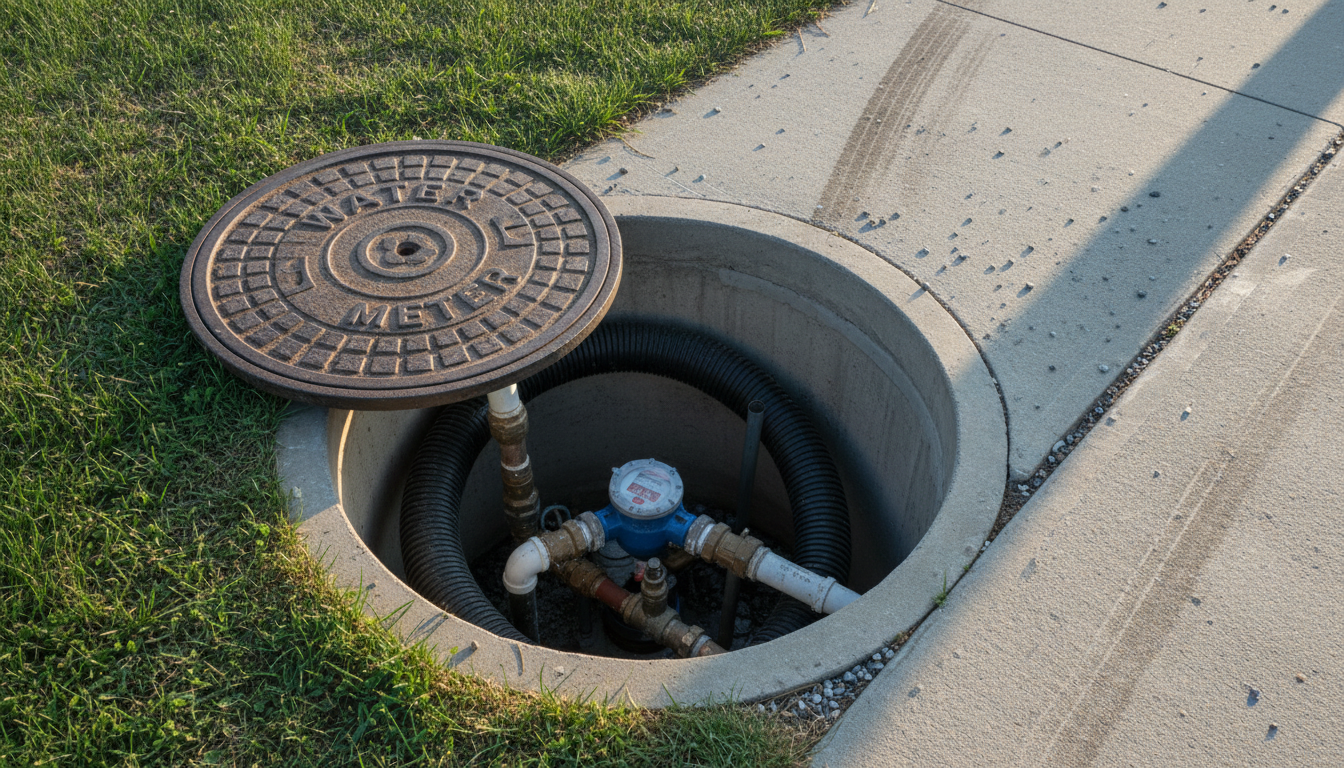
What Submetering Is and Why It Matters
Submetering is the installation of additional water meters on specific lines within a building to measure how much water goes to individual systems. In the context of sewer credits, submeters are installed on the supply lines feeding non-sewer equipment. For a full overview of how submetering supports credit applications, see our post on submetering for sewer credits.
The most common submetering configuration for sewer credits involves two meters on a cooling tower system: a makeup water meter (measuring total water supplied to the tower) and a blowdown meter (measuring water discharged from the tower to the sewer). The difference between the two readings is evaporated water, the volume that justifies the credit.
Submeters provide the quantitative evidence utilities need. Without metered data, credit applications rely on engineering estimates, which most utilities accept only as a supplement to actual measurements. Metered data is harder to dispute, easier to verify, and provides a more defensible basis for ongoing credits.
The meters themselves are standard commercial water meters. Installation costs vary depending on piping configuration, but the investment is modest relative to the annual savings a credit program delivers. In most cases, the metering investment pays for itself within the first year of credit recovery.
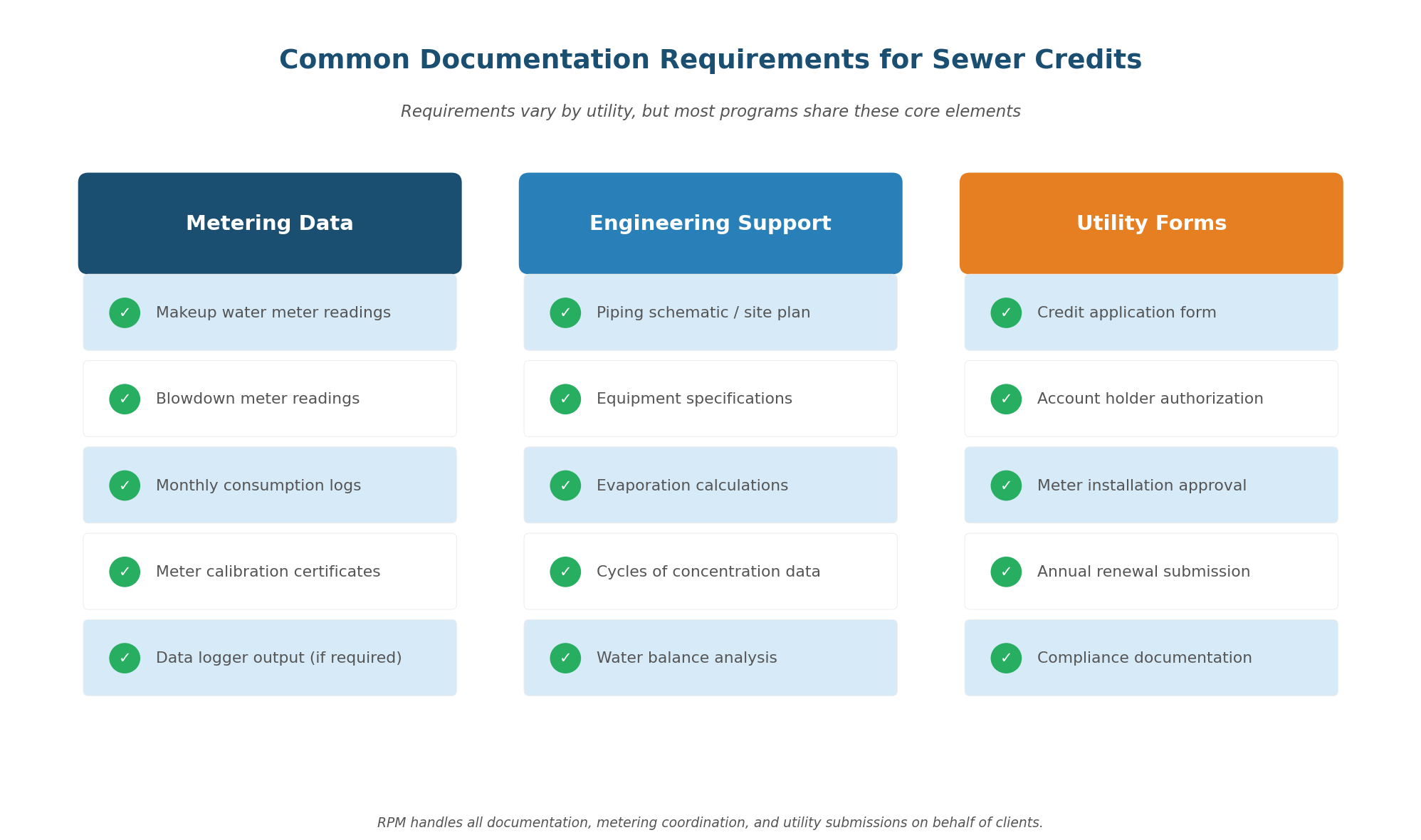
Common Documentation Requirements Across Jurisdictions
One of the challenges of sewer credit programs is that every utility has its own rules. There is no single national standard for credit applications, documentation formats, or program terminology. An organization with facilities in Dallas, Atlanta, and Phoenix will deal with three different programs, each with its own forms, timelines, and requirements.
That said, the core elements are consistent across most jurisdictions.
Metered data. Every program requires quantitative evidence of non-sewer water use. Submeter readings are the most widely accepted form of proof. Some utilities accept flow totalizer data from building automation systems as a supplement.
Engineering support. Most utilities require some form of engineering calculation showing the water balance: how much water enters the system, how much is discharged to the sewer, and how much is consumed or evaporated. For cooling towers, this typically involves documenting cycles of concentration, evaporation rates, and drift losses.
Utility forms. Each utility has its own application form or process. Some accept applications online. Others require mailed forms with original signatures. The application typically identifies the account, the non-sewer equipment, the meter locations, and the estimated non-sewer volume.
Ongoing compliance. Credits are not permanent once granted. Most utilities require periodic revalidation: annual meter readings, recertification of calculations, or renewed applications. Missing a compliance deadline can result in credits being suspended or revoked until documentation is resubmitted.
For help understanding the charges on your bill, the EPA’s guide to understanding your water bill is a useful starting point. Organizations managing multiple sites across different utilities face compounded complexity. Each site follows its own program rules, submission schedules, and compliance requirements. This is one of the primary reasons multi-site operators work with specialized firms rather than managing credit programs internally.
Sewer Credit, Sewer Exemption, and Rate Adjustment: What Is the Difference?
Utilities use different terms for the same basic concept, and the terminology can cause confusion. Understanding the distinctions helps when navigating program documentation.
A sewer credit reduces the volume used in the sewer credit calculation. The utility subtracts the documented non-sewer volume from the total water meter reading before applying the sewer rate. This is the most common structure. The building still pays the full water rate on all metered water, but sewer charges are calculated on a reduced volume.
A sewer exemption removes specific water uses from sewer billing entirely. Some utilities offer exemptions for irrigation meters that are on a separate service line from the building’s domestic water. The irrigation meter is excluded from sewer calculations by default because the utility recognizes that irrigation water does not enter the sewer. This approach avoids the need for an ongoing credit application, but it only works when the non-sewer water is on a physically separate meter from the start.
A rate adjustment modifies the per-unit sewer rate rather than the volume. This is less common, but some utilities apply a reduced sewer rate to accounts that can document significant non-sewer use. The economic effect is similar to a volume credit, but the mechanics differ.
Regardless of terminology, the principle is the same: the building provides documentation that a portion of metered water does not enter the sewer, and the utility adjusts billing to reflect actual wastewater volumes. For a broader overview of how these programs work, see our plain english guide to sewer credits.
Why Ongoing Monitoring Matters More Than a Single Filing
Getting a sewer credit approved is the beginning of the process, not the end. The difference between a well-managed credit program and a neglected one can be tens of thousands of dollars over time.
Credits require maintenance. Most utilities require annual revalidation of credit documentation. If a submission deadline is missed, credits can be suspended until the paperwork catches up. In some jurisdictions, lapsed credits cannot be recovered retroactively, meaning those months of overpayment are gone permanently.
Billing errors happen. Sewer credits are often applied manually by utility billing staff. Manual processes are prone to errors: a credit can be applied to the wrong meter, calculated using the wrong volume, or simply dropped from an account during a system update. Without someone monitoring the bills, these errors go unnoticed and the facility quietly reverts to overpaying.
Conditions change. Buildings add equipment, change operating hours, or replace cooling systems. Each change affects the non-sewer water volume and may require updated documentation. A credit that was accurate two years ago may understate the current opportunity, leaving savings on the table.
Monitoring creates operational value beyond billing. The same metering infrastructure that supports sewer credits also catches problems early. A stuck fill valve on a cooling tower can waste thousands of gallons before anyone notices. A slow leak in a makeup water line can run for months. Continuous monitoring turns metering data into an early warning system for equipment problems that would otherwise compound quietly.
For a deeper look at how monitoring protects both savings and equipment, see our post on evaporation credits explained.
Getting Started
If you manage a commercial building and have never examined how your sewer charges are calculated, the billing assumption is almost certainly working against you. The larger your facility, the more non-sewer water uses you have, and the higher your local sewer rates, the greater the overpayment.
The path to corrected billing follows a clear sequence: assess the opportunity, install metering, collect data, submit documentation, and manage the credit program over time. Utility bill optimization starts with understanding that the billing assumption driving your sewer charges was designed for simplicity, not accuracy.
RPM Water Equity Solutions handles every step of this process for commercial and institutional facilities nationwide. We evaluate your utility data, identify the savings opportunity, coordinate metering installation, prepare and submit all documentation, and manage the credit program on an ongoing basis. Our clients capture savings without needing to learn the details of their local utility’s program rules.
Ready to Find Out What You Could Save?
RPM Water Equity Solutions helps commercial facilities recover money lost to sewer billing assumptions. We handle the analysis, metering, documentation, and utility coordination so you don’t have to. All we need to get started is 12 months of water and sewer bills.
Request your free assessment today and we’ll show you exactly where you stand.
