Quick Answer
Your building likely qualifies for evaporation credits if it passes three tests: it has equipment that evaporates water (most commonly a cooling tower rated 100 tons or more), your utility calculates sewer charges from metered water use and offers a credit or adjustment program, and you can install submeters to document how much water evaporates instead of reaching the sewer. Commercial buildings using more than 50,000 gallons per month with water-cooled HVAC are typically strong candidates. Flat-rate sewer accounts, residential-only accounts, and buildings with refrigerant-based packaged rooftop units generally do not qualify. Smaller towers can still qualify, but the metering investment takes longer to pay back.
Evaporation credits can save commercial buildings thousands of dollars per year in sewer charges, but not every facility qualifies. Before you invest time in an application, here’s a quick self-assessment to determine whether your building is a candidate.
The Three Basic Qualifiers
At the most fundamental level, your building needs to meet three criteria to qualify for evaporation credits. If you’re new to the billing side of this, our plain-English guide to how sewer credits work covers the fundamentals.
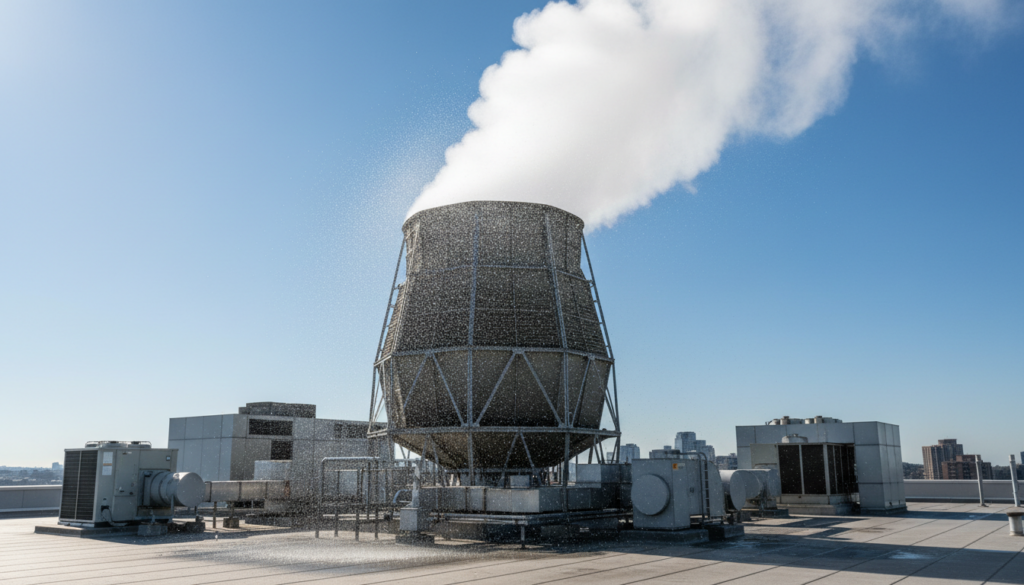
First, your building must have equipment that evaporates water. The most common qualifying equipment is a cooling tower — the large units on commercial rooftops that reject heat by evaporating water. But cooling towers aren’t the only qualifying equipment. Boilers that vent steam, industrial humidifiers, and certain manufacturing processes also consume water through evaporation. If water enters your building and leaves as vapor rather than flowing to the sewer, you have a potential qualifying use.
Second, your local utility must offer an evaporation credit or sewer adjustment program. Most large municipalities do, but not all. Some smaller utilities lack a formal program, though even they may grant adjustments on a case-by-case basis if you present compelling metering data. The EPA’s WaterSense program has been encouraging utilities nationwide to adopt water-efficient billing practices, which has expanded the availability of credit programs in recent years.
Third, you must be able to install metering to document the evaporation. Utilities don’t accept estimates or engineering calculations alone — they want metered data showing how much water enters your evaporative equipment and how much exits to the sewer. For cooling towers, this means meters on the makeup water line and the blowdown line.
Common Disqualifiers
Even if your building has evaporative equipment, certain situations may prevent you from qualifying. Buildings below a minimum water usage threshold (varies by city, but often around 50,000 gallons per month) may not be eligible. Residential-only accounts are typically excluded. Facilities already on flat-rate sewer billing — where the sewer charge is a fixed monthly fee rather than usage-based — can’t benefit from volume-based credits because there’s no volume to adjust.
Some cities also exclude buildings that are already receiving other water-related discounts or incentives. Check with your utility to understand how their programs interact.
Quick Eligibility Checklist
Run through these questions to assess your building’s eligibility. Do you have one or more cooling towers on your building? Is your cooling tower rated at 100 tons or more? Does your building use more than 50,000 gallons of water per month? Are your sewer charges calculated based on water consumption (not a flat fee)? Can you physically access the water supply pipes to your cooling tower for meter installation? Is your building located in a municipality that offers sewer credits? If you answered yes to all of these, your building is very likely a strong candidate.
For a more thorough assessment, our cooling tower readiness checklist walks through every technical and administrative consideration in detail.
What About Smaller Systems?
Buildings with cooling towers under 100 tons can still qualify, but the savings may be modest enough that the metering investment takes longer to pay back. The Department of Energy notes that even small cooling towers can evaporate significant volumes over a full cooling season, so don’t rule yourself out based on tonnage alone. The best approach is to estimate your potential savings using your actual sewer rates and compare that to the cost of meter installation.
Buildings with only residential-style rooftop HVAC units (packaged units that use refrigerant, not water) generally don’t have enough evaporative water loss to justify a sewer credit application. The credit opportunity is specific to water-cooled systems. For a deeper understanding of how cooling tower water consumption works, see our complete guide to evaporation credits.
Estimating Whether the Math Works for Your Building
A quick back-of-the-envelope calculation tells you whether an application is worth pursuing. A cooling tower at full load evaporates roughly 1.8 gallons per ton-hour, so a 300-ton tower running at 60 percent average load for a 2,000-hour cooling season evaporates on the order of 650,000 gallons. Multiply that volume by your sewer rate — commonly $3 to $12 per 1,000 gallons — and you have a rough annual savings figure of roughly $2,000 to $8,000 for a tower that size.
Your cycles of concentration matter too. Blowdown equals evaporation divided by cycles minus one, so a tower running at 4 cycles sends only a quarter as much water to the sewer as it evaporates — meaning around 75 to 80 percent of your makeup water may qualify for the credit. Compare your estimated first-year savings against typical metering costs and you’ll know quickly whether the payback period is measured in months or years.
Who Gets the Credit: Owners, Tenants, and Triple-Net Leases
Evaporation credits are applied to the utility account, so the account holder sees the savings first. In an owner-managed building, that’s straightforward. In a triple-net lease, where tenants reimburse operating expenses, the credit typically flows back to tenants through the annual expense reconciliation — which means property managers can present a credit program as a direct win for tenant relations and lease renewals.
If you’re a tenant who pays the water bill directly, you can usually pursue a credit yourself, but you’ll need the owner’s permission to install meters on building piping. Get that authorization in writing before scheduling any installation work, and clarify who owns the meters if the lease ends.
Not sure whether this applies to your building? Take the short Water Equity Quiz to see where you stand.
Ready to Find Out What You Could Save?
RPM Water Equity Solutions helps commercial facilities recover money lost to sewer billing assumptions. If your building has cooling towers, you may be paying sewer charges on water that never reaches the sewer system.
Request your free assessment today and find out how much you could recover.
When in Doubt, Get a Professional Assessment
If you’re on the fence about whether your building qualifies, a professional assessment can give you a definitive answer in days — not weeks of research. RPM evaluates your equipment, water use, and local utility programs to tell you exactly what credits you’re eligible for and how much you’d save. There’s no cost for the assessment and no obligation to proceed.
