Quick Answer: Sewer credit programs exist in most major metros, but the application forms, required documentation, approval timelines, and calculation methods differ significantly by utility. The core concept remains the same everywhere: you don’t use the water as sewage, so you don’t pay sewer charges on that volume. What changes is how you prove it and how quickly you receive credits.
One of the most common questions facility managers ask us is simple: “Does my city have sewer credits?” The answer is almost always yes, but that’s only half the story. Whether you operate a single facility in Dallas or manage a portfolio across five states, navigating sewer credit requirements means understanding what is universal across all utilities and what varies dramatically from one jurisdiction to the next.
This post walks through the sewer credit landscape by geography. We will explain the foundational elements that never change, dive into the variations that matter most, provide snapshots of major metro programs, and show how RPM helps clients navigate this complexity without getting lost in forms and timelines.
What Stays the Same Everywhere
Before we explore the differences, let us establish what is true in every jurisdiction that offers sewer credits. These universal principles form the backbone of every program, regardless of location.
The Billing Assumption Core
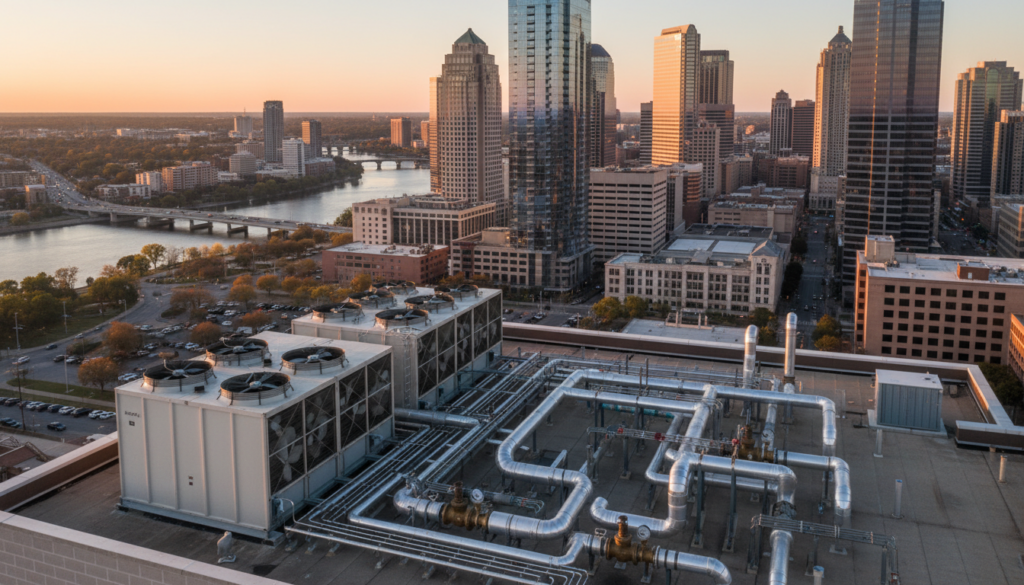
Every utility that charges sewer fees operates on a foundational assumption: most of the water your facility purchases becomes wastewater. For a typical office building or retail facility, this assumption is close to the truth. But for cooling towers, irrigation systems, evaporative coolers, or industrial processes, water leaves the system through evaporation or other non-sewage pathways.
Sewer credit programs exist to correct this billing assumption. You are not charged sewer fees on water that never enters the sewer system. This principle is universal. The Dallas Water Utilities Department operates on it. Houston applies it. Atlanta, Phoenix, Denver, and virtually every other major utility recognize the same logic.
Metering as the Universal Solution
Every sewer credit program requires the same fundamental proof: how much water did not enter the sewer system? The answer comes from one of two sources: a dedicated meter or detailed documentation showing water loss through evaporation.
Metering is the gold standard everywhere. If you have a sub-metering system on your cooling tower, irrigation line, or process water loop, you can document water use directly. Most utilities prefer this approach because it is objective and auditable. Properly installed and calibrated meters are rarely rejected by utilities. The documentation standards may differ, but the concept does not.
Documentation and Proof Concepts
When you cannot meter separately, all utilities ask for the same type of evidence: documentation showing water loss through evaporation. The specifics of what documentation they require will vary (more on that below), but the category of proof is consistent.
This might include cooling tower water balance calculations, equipment specifications, climate data, or process documentation. Every utility understands that some water leaves systems through evaporation. None reject the concept. The difference lies in how formal the documentation must be and who must prepare or certify it.
What Varies by Jurisdiction
Now for the layer of complexity that affects your timeline and your workload. These variations are significant, and they shape your application strategy in each city.
Application Forms and Submission Processes
Every utility requires an application or request for sewer credits, but the paperwork ranges from a simple one-page form to a multi-page process with supporting schedules. Some utilities accept email submissions. Others require in-person delivery or formal mail. Some have moved to online portals. Others still work from printed forms and physical files.
Dallas requires a Water Service and Meter Application form that is relatively straightforward. Houston has its own submission process with utility-specific documentation requirements. Phoenix applications differ again. If you manage multiple properties, you are managing multiple processes, multiple document templates, and multiple submission procedures.
This variation is purely procedural, but it affects your timeline. A simple form might get approval in three weeks. A complex application with extensive supporting documentation might take three months.
Approval Timelines and Review Standards
Some utilities have formal service level agreements for sewer credit approvals. Others work through them as staff capacity permits. There is no universal timeline.
As of recent program documentation, some Texas utilities aim for thirty-day reviews. Houston sometimes takes longer if additional documentation is required. Atlanta operates under a different timeline. Phoenix has its own process. Eastern utilities like those serving Atlanta may require more extensive engineering review before approval.
The variation in timelines is tied to staffing, documentation standards, and how busy the utility’s billing department is in any given month. Verify current approval timelines directly with your utility when you submit an application.
Rate Structures and Credit Calculations
Here is where the math gets different. All utilities credit you for sewer charges on water that did not enter the sewer system, but how they calculate the credit varies.
Some utilities deduct the sewer credit directly from your monthly bill at the sewer rate in effect that month. Others apply a different calculation that factors in treatment charges, stormwater fees, or other components bundled into sewer charges. A few utilities separate “sewer service charges” from “sewer usage charges” and credit only the usage portion.
The difference can be meaningful. If your sewer rate is $4 per thousand gallons in one city and $6 per thousand gallons in another, a cooling tower evaporating 50,000 gallons per month generates $800 in monthly credits in the first city and $1,200 in the second. Over a year, that is a $4,000 difference from the same equipment.
Required Documentation and Certification Standards
Some utilities accept manufacturer specifications for cooling towers. Others want actual cooling tower water balance calculations. Some require those calculations to be prepared or certified by a professional engineer. Others accept them from facility managers with the equipment documentation attached.
A few utilities have moved toward simplified documentation: “If you have a meter, send us the meter data.” Others maintain longer documentation checklists and may request additional information even after you submit an initial application.
This variation is practical but important. If your utility requires professional engineer certification, that adds cost and timeline. If it accepts facility manager documentation, the process is faster.
Renewal and Verification Requirements
Sewer credits are not set-it-and-forget-it approvals. Most utilities require periodic renewal or ongoing verification. But how often and what that process looks like varies significantly.
Some utilities verify credits annually. Others do so every three years. A few require no formal renewal if documentation remains valid and the meter or equipment has not changed. Some utilities want you to resubmit cooling tower balances every year (especially if the equipment is serviced). Others accept a single documentation package indefinitely until conditions change.
The EPA’s NPDES program governs municipal wastewater regulations which form the legal basis for sewer credit programs at the city level.
If you have equipment that will be replaced, upgraded, or modified, different utilities have different expectations for notification and documentation updates. Verify these renewal requirements directly with your utility to avoid unexpected delays or credit rejections.
Major Metro Program Snapshots
To make this geographic variation concrete, here are examples from some of the largest metros where facility managers frequently operate.
Dallas
Dallas Water Utilities offers sewer credits for water that does not enter the sewer system. For cooling tower water, they generally accept sub-metering with manufacturer specifications or cooling tower water balance calculations. The application process is relatively streamlined. As of recent program documentation, Dallas aims for timely processing. The sewer credit applies directly to usage charges at the rate in effect each billing cycle. Cooling tower equipment must be properly documented, and sub-meters must be properly installed and certified.
Dallas is one of the clearer programs because the utility has published guidance and maintains relatively consistent standards. This does not mean the approval is automatic, but the expectations are clear.
Houston
Houston operates a more complex utility structure. The city of Houston and surrounding utilities handle sewer credits through slightly different processes. For City of Houston proper, sewer credits are available, but the documentation requirements are more detailed than in Dallas. Evaporative cooling systems and cooling towers require specific engineering documentation.
Houston utilities may request cooling tower specifications, installation details, and ongoing monitoring protocols. The approval process can take longer than Dallas, and renewal requirements may be more stringent. As of recent program documentation, some Houston utilities are modernizing their online submission processes, but verification directly with your specific utility is essential.
Atlanta
Atlanta’s utility (Atlanta Department of Watershed Management) offers sewer credits but structures them within a different billing framework. Atlanta separates stormwater charges, sewer charges, and water charges more distinctly than some Texas utilities.
Sewer credits in Atlanta typically apply to the sewer service charge, not to stormwater. This means the credit may be lower than in jurisdictions where stormwater and sewer are combined. Documentation requirements are comparable to Houston: detailed engineering for cooling towers and evaporative systems. Approval timelines are similar as well. As of recent program documentation, Atlanta requires verification annually or when equipment changes.
Phoenix
Phoenix faces unique water challenges as a desert city, so sewer credit programs are very active there. Phoenix has strong incentives to encourage non-sewage water use documentation because water conservation is critical.
Phoenix allows sewer credits for evaporative cooling and irrigation water. The application process is relatively accessible. They accept sub-metering data and cooling tower calculations. However, Phoenix may require higher verification standards for climate-dependent calculations because the desert climate is so different from humid regions. Approval is typically efficient. As of recent program documentation, Phoenix renewals are annual.
Denver
Denver Water handles sewer credits through a process that emphasizes accuracy in meter installation and documentation. They require sub-meters to be installed to utility standards and certified. Evaporative cooling documentation must account for Colorado’s dry climate and elevation.
Denver’s sewer credit calculation is straightforward once the documentation is approved. Timelines are moderate. Renewal is periodic but not overly burdensome. As of recent program documentation, Denver accepts both sub-metering and engineering documentation, but sub-metering is preferred and streamlines approval.
How Multi-State Portfolios Navigate Different Requirements
If you manage facilities across multiple states or even multiple cities, you are managing multiple sewer credit programs with overlapping but distinct requirements. This is the reality for many larger facility managers and portfolio companies.
Standardizing Documentation Where Possible
The smart approach is to document your cooling towers and water systems once and translate that documentation to meet each jurisdiction’s specific requirements. Start with the most rigorous standard: a full professional engineering assessment of your cooling tower water balance.
A cooling tower water balance conducted by an engineer satisfies nearly every utility’s requirements. Once you have that report, you can extract sections, calculations, or supporting data to meet specific utilities’ checklists. You are not rewriting the entire assessment for each city. You are adapting the same foundation to each format.
Sub-metering is similar. If meters are installed and certified to the standards of the most rigorous jurisdiction, they typically satisfy all others. Install to the highest standard once, and you are compliant everywhere.
Coordinating Timelines Across Facilities
With multiple facilities in multiple jurisdictions, you face different approval timelines. Rather than submitting applications simultaneously to every utility, a smarter approach is to stagger submissions so you can learn from early approvals before submitting to utilities with more complex requirements.
If your Dallas application gets approved quickly with minimal documentation, you have a template for submission elsewhere. If your Houston application asks for additional information, you now know to prepare more detailed documentation for your Atlanta facilities before submitting there.
This staggered approach also reduces your administrative burden. One submission and follow-up per month is manageable. Five simultaneous submissions with different document checklists create bottlenecks.
Tracking Renewal Dates and Resubmission Requirements
With different renewal cycles in different cities, a portfolio management system is essential. Dallas might require renewal annually. Denver might require it every three years. Atlanta might accept indefinite approval unless equipment changes.
State water boards set local requirements; for example, the California State Water Resources Control Board maintains one of the most detailed sewer credit frameworks in the country.
Without a tracking system, you will miss renewal deadlines and utilities will silently stop crediting you. Most utilities do not send renewal reminders. They simply apply the change to your next bill. Your facility manager may not notice that a $50,000 annual credit has disappeared for two months.
A simple spreadsheet tracking each facility, each utility, the approval date, the renewal date, and the required documentation keeps you ahead of these deadlines. Better still, connect this tracking to your calendar system so reminders trigger 90 days before renewal is due.
Common Pitfalls When Applying Across Jurisdictions
Knowing what can go wrong helps you avoid these mistakes the first time.
Using One City’s Application Form in Another City
It seems logical to use the Dallas form in Houston or the Atlanta form in Denver. The underlying concept is the same. But each utility has specific forms, and utilities are picky about submissions using their official paperwork.
Submitting an application using the wrong form will likely be rejected or returned with a request to resubmit using the correct form. This costs you two to four weeks. Get the correct forms from each utility’s website or contact their billing department directly.
Assuming One Meter Installation Standard Works Everywhere
Sub-meter installation has technical standards, but those standards are not identical across all utilities. Some utilities have specific requirements about meter type, accuracy class, or certification. Installing a meter to Dallas standards may not satisfy Denver’s standards.
Before you install meters at multiple facilities, contact each utility and ask for their technical standards or requirements. A few dollars spent asking the question upfront avoids the expense of reinstalling meters later.
Submitting Incomplete Documentation Too Early
The urge to submit and get in line is understandable. But submitting incomplete documentation often triggers a rejection or a request for more information. This restarts the clock. You get back to the end of the queue.
Better to take two extra weeks assembling complete documentation than to submit incompletely and wait eight weeks for a request for more information, then eight more weeks for reconsideration. Ask the utility exactly what documentation they require before you submit. Provide everything at once.
Not Accounting for Rate Changes
Sewer rates change. If you calculated your potential credit based on last year’s rate, you may be surprised when the credit is lower than expected. Many utilities increase sewer rates every one to three years.
When you apply for sewer credits, use current rates. When you estimate savings from credits, use current rates and acknowledge that rates may increase in future years. This way, you are not surprised, and you are not promising savings based on outdated rate information to your stakeholders.
Assuming Equipment Specifications Automatically Qualify
A cooling tower’s design evaporation rate does not automatically qualify as your sewer credit. Some utilities want to verify that the equipment is actually operating at design specifications. Others want actual water balance calculations, not just manufacturer claims.
If you submit only manufacturer specifications without operational documentation, be prepared for the utility to ask for more. Planning for this upfront, and providing operational data alongside specifications, accelerates approval.
How RPM Manages Complexity for Multi-Site Clients
We work with facility managers and portfolio companies that operate across multiple states and multiple utilities. The complexity of navigating different sewer credit requirements is exactly the problem we solve.
Jurisdiction-Specific Application Strategy
For each facility, we identify the specific utility serving that location and pull that utility’s current requirements from their official sources. We do not assume. We verify directly with the utility or review their current documentation on file.
We build an application strategy customized to that utility’s preferences. For some utilities, that means prioritizing sub-metering. For others, it means assembling detailed engineering documentation. We match the application to the utility, not the other way around.
Standardized Documentation With Utility-Specific Customization
We assess your facilities’ cooling towers, irrigation systems, and process water use once. We prepare a comprehensive technical documentation package. Then we adapt that documentation to each utility’s specific checklist and format requirements.
This approach is efficient because you are not recreating documentation for each city. We are translating a single comprehensive assessment into multiple formats. It is also credible because every application is grounded in the same technical foundation.
Timeline Optimization
We know which utilities are quick and which ones take time. We also know which ones are likely to ask follow-up questions and which ones approve on the first submission. We use this knowledge to optimize your timeline.
Rather than submitting to all utilities simultaneously, we create a submission schedule that allows us to learn from early approvals and apply those lessons to later submissions. We also flag which applications are likely to require follow-up documentation and prepare for those requests proactively.
Ongoing Renewal and Verification Management
Once sewer credits are approved, they need to stay approved. We maintain a renewal tracking system for all your facilities and all your utilities. We alert you when renewals are due, prepare renewal documentation, and handle resubmissions to keep your credits active.
We also monitor for rate changes that affect your credit calculations and for utility program changes that might affect your documentation requirements. You are getting credits every month. We make sure you keep them.
Key Takeaways
Sewer credit programs are not one-size-fits-all, but they are also not completely random. The core concept is universal: document water that does not enter the sewer system and receive a credit on your sewer bill. The application process, required documentation, approval timeline, and credit calculation vary significantly by jurisdiction.
If you manage a single facility, understanding your utility’s specific requirements is critical. If you manage multiple facilities across multiple states, developing a systematic approach to documentation and application is essential.
The payoff is substantial. A facility with significant cooling tower water use or irrigation can save thousands of dollars per year in sewer charges. With 50,000 gallons per day evaporating from a cooling tower in a city with a $6-per-thousand-gallon sewer rate, you are looking at $9,000 per year in potential credits. Across a portfolio of ten such facilities, that is $90,000 annually.
Getting that credit means understanding what your utility requires, submitting complete documentation, and maintaining the approval through ongoing renewals and verifications.
If you would like to find out whether your facility qualifies for sewer credits, or if you manage multiple facilities across different jurisdictions and want professional guidance through the approval process, RPM offers a free evaluation with no obligation. We will assess your water use, evaluate your utility’s specific requirements, and show you exactly what documentation you need and what credits you could receive.
For more on how sewer credit programs work, see our guides on qualifying for sewer credits, submetering requirements, and Dallas-specific programs.
Ready to Find Out What You Could Save?
RPM Water Equity Solutions helps commercial facilities recover money lost to sewer billing assumptions. If your building has a cooling tower, chiller, or any system where water doesn’t return to the sewer, you may be overpaying every month.
Request your free assessment today and find out how much you could recover.
