Quick Answer
A makeup water meter is a submeter installed on the fresh-water line that feeds your cooling tower, measuring every gallon the tower draws to replace water lost to evaporation, blowdown, and drift. It goes on the makeup line itself — usually in the mechanical room near the tower — with five to ten pipe diameters of straight pipe upstream so readings stay accurate. Commercial makeup lines typically run 1.5 to 4 inches, and the meter must match the pipe size. The meter matters because it is the primary evidence for a sewer credit application: 60 to 90 days of documented makeup data, ideally paired with a blowdown meter, is what utilities require before they stop billing sewer charges on evaporated water.
If you’ve started exploring sewer credits for your cooling tower, you’ve probably encountered the term “makeup water meter” — and you may be wondering what exactly it measures and where it goes. This small piece of equipment is the cornerstone of your sewer credit documentation, and understanding it helps you make smarter decisions about installation and monitoring.
What Makeup Water Is
Makeup water is simply the fresh water that enters your cooling tower to replace the water lost to evaporation, blowdown, and drift. Every gallon that leaves the tower through these three mechanisms must be replaced to maintain proper water levels. The city water supply provides this replacement water through a dedicated pipe called the makeup water line, and the meter installed on this line measures the total volume of fresh water your tower consumes.
Think of it like a bathtub with a slow drain. The water level drops continuously, and a float valve opens to add fresh water. The makeup water meter measures how much fresh water flows through that valve over time. The U.S. Department of Energy identifies makeup water metering as a fundamental requirement for effective cooling tower water management.
Where It’s Installed
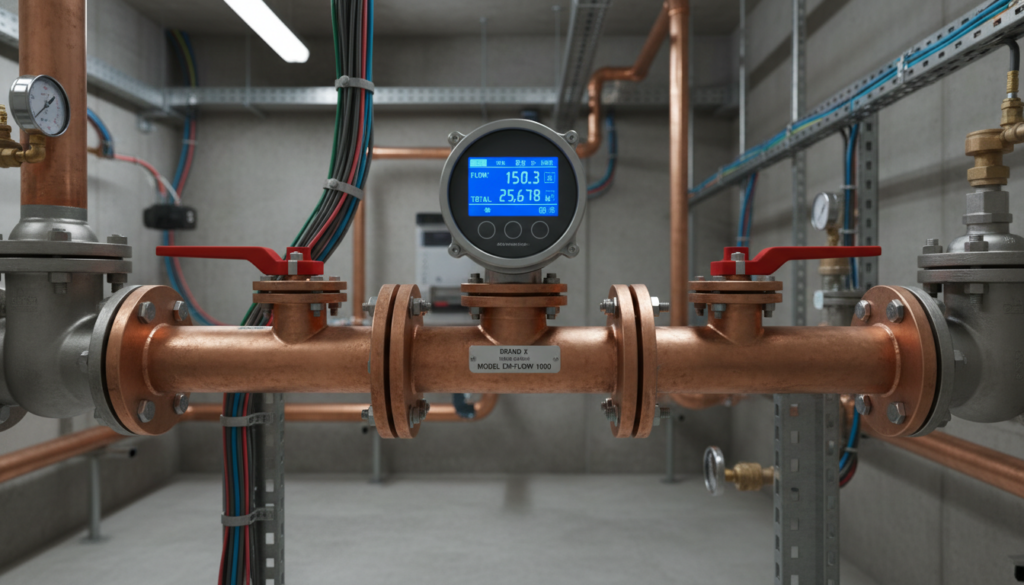
The makeup water meter is installed on the pipe that feeds fresh city water to your cooling tower, typically in the mechanical room near the tower or in the pipe chase where the water line branches off from the building’s main supply. The ideal location is as close to the tower as practical, but far enough upstream to provide the straight pipe runs that most meters need for accurate readings — usually five to ten pipe diameters of straight pipe upstream and two to three diameters downstream.
For most commercial cooling towers, the makeup water line is 1.5 to 4 inches in diameter. The meter must match this pipe size. If your tower has multiple makeup connections (some large installations do), you’ll need a meter on each one to capture total makeup flow.
Installation typically requires a licensed plumber and takes a few hours to a full day, depending on accessibility and whether the building water system needs to be shut down during the work. If a system shutdown is unacceptable, an ultrasonic clamp-on meter can be installed without cutting into the pipe — though insertion and inline meters generally provide better long-term accuracy.
Why It Matters for Sewer Credits
The makeup water meter provides the primary data point for your sewer credit application. When you tell the utility “my cooling tower evaporates X gallons per month,” the metering data is your proof. Specifically, the calculation works like this: evaporation equals makeup water minus blowdown minus drift. If you also meter the blowdown line, you can calculate evaporation precisely. If you only meter makeup, you can estimate evaporation using your known cycles of concentration — but having both meters gives you the strongest case.
Utilities want to see consistent, documented data — not back-of-napkin estimates. A properly installed makeup water meter with 60 to 90 days of baseline readings gives your application the credibility it needs for approval. The EPA’s WaterSense program recommends submetering all major water end-uses in commercial buildings as a standard practice for both conservation and billing accuracy.
Meter Types for Makeup Water
Three meter technologies are commonly used for cooling tower makeup lines. Mechanical turbine meters are the most affordable and work well for steady flow rates — they’re accurate and reliable but have moving parts that eventually wear. Electromagnetic (mag) meters have no moving parts and handle varying flow rates better, making them ideal for towers with fluctuating loads. Ultrasonic meters clamp onto the outside of the pipe and require no pipe cutting, but they’re more expensive and can be sensitive to pipe condition and flow profile.
For sewer credit purposes, any properly installed and maintained meter type is acceptable. Choose based on your budget, your pipe conditions, and whether a system shutdown is practical during installation.
Accuracy, Calibration, and Upkeep
A meter is only as good as its accuracy record. Commercial water meters are built to American Water Works Association (AWWA) standards, which generally require registration within 1.5 percent of actual flow when new. Utilities lean on those standards when reviewing credit applications, and many require a calibration certificate at installation plus recalibration every one to three years. Keep every certificate — at renewal time, current calibration paperwork is often the difference between an automatic approval and a suspended credit.
Plan for modest ongoing attention. Mechanical meters drift as internal parts wear, and they typically under-read as they age — which, for a makeup meter, understates your evaporation and shrinks your credit. Check meter readings against your monthly utility bill for consistency, verify the register advances smoothly at normal flow, and keep any upstream strainer on a cleaning schedule. If a meter fails calibration, replace it promptly and document the swap; gaps in the data record are one of the most common reasons utilities delay renewal approvals.
What Installation Typically Costs
For a standard commercial makeup line, expect roughly $1,500 to $5,000 installed for an inline or insertion meter, depending on pipe size, access, and whether the water system can be shut down during the work. Ultrasonic clamp-on meters avoid pipe cutting but carry higher hardware costs. Adding a data logger or remote-reading capability typically adds a few hundred to a couple thousand dollars — worth it in most cases, because automated readings create the continuous record utilities trust most. Measured against typical credit values of $500 to $5,000 per month, the metering investment usually pays for itself within the first year.
Curious what continuous visibility looks like in practice? See how RPM’s 24/7 cooling tower monitoring works.
Ready to Find Out What You Could Save?
RPM Water Equity Solutions helps commercial facilities recover money lost to sewer billing assumptions. If your building has cooling towers, you may be paying sewer charges on water that never reaches the sewer system.
Request your free assessment today and find out how much you could recover.
The Foundation of Your Savings
A makeup water meter is a small investment that serves as the foundation for ongoing sewer credit savings. Without it, you have no documented proof of how much water your cooling tower consumes — and without proof, you can’t claim credits. If your tower doesn’t have a dedicated meter today, installing one is the essential first step toward reducing your sewer costs.
