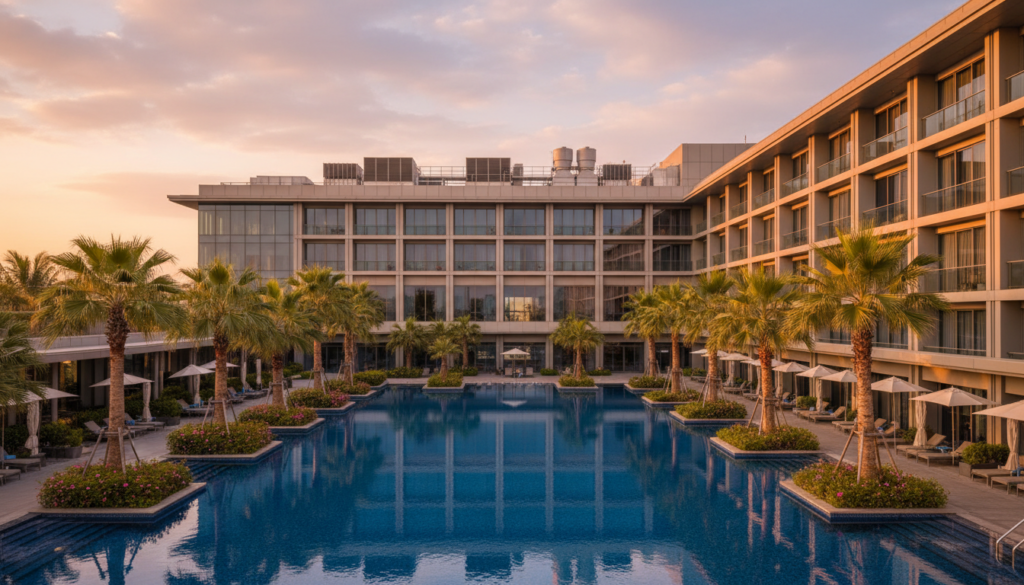
Hotels are some of the largest commercial water consumers in any city — between guest rooms, laundry operations, pools, cooling towers, and landscaping, a full-service hotel can use hundreds of thousands of gallons per month. Yet many hotel operators focus their sewer credit efforts exclusively on cooling towers and miss other qualifying water uses that could significantly increase their savings.
Which Hotel Water Uses Qualify?
The qualifying principle for sewer credits is simple: any water that can be documented as not reaching the sewer system is potentially eligible for a credit. For hotels, the most common qualifying uses beyond cooling towers include landscape irrigation (water absorbed by soil or evaporated from sprinkler systems), pool evaporation and splash-out (water that leaves the pool through evaporation, which is substantial in outdoor and indoor heated pools), cooling tower evaporation (the largest single source for most full-service hotels), and kitchen steam losses (steam from commercial kitchens that vents to the atmosphere).
Laundry water is a more nuanced case. The water used in commercial laundry machines does go to the sewer — it’s discharged as wastewater after the wash and rinse cycles. So standard laundry water generally does NOT qualify for sewer credits. However, if the hotel uses a laundry water recycling system that reclaims and reuses a portion of the rinse water, the recycled portion may qualify in some jurisdictions because it reduces the volume of water discharged to the sewer. Check with your specific utility for their policy on recycled water.
The Pool Evaporation Opportunity
Pool evaporation is often overlooked by hotel operators because the volumes seem small compared to cooling towers. But a standard hotel outdoor pool (roughly 15,000 to 25,000 gallons capacity) can evaporate 3,000 to 8,000 gallons per month depending on climate, sun exposure, and whether a pool cover is used. An indoor heated pool evaporates less but still loses significant water to the air handling system. Multiple pools — as found in many resort properties — multiply these losses accordingly.
The EPA’s WaterSense program documents pool evaporation rates as a significant component of commercial water consumption, and most utilities that offer sewer credits accept pool evaporation data as a qualifying non-sewer water use.
Documenting pool evaporation typically requires a meter on the pool’s makeup water line — similar to a cooling tower makeup water meter. The makeup volume minus any water drained to the sewer for maintenance equals the evaporation credit. Some utilities also accept engineering calculations based on pool surface area and local evaporation rates.
Combining All Sources Into One Application
The smartest approach for hotels is to inventory ALL non-sewer water uses and combine them into a single sewer credit application. A full-service hotel might qualify for credits on cooling tower evaporation (100,000+ gallons per month), landscape irrigation (30,000 to 50,000 gallons per month during growing season), pool evaporation (5,000 to 10,000 gallons per month), and kitchen and laundry steam venting (5,000 to 15,000 gallons per month).
Combined, these non-sewer uses could total 150,000 to 200,000 gallons per month. At a sewer rate of $8 per thousand gallons, that’s $1,200 to $1,600 per month in potential credits — $14,400 to $19,200 per year. The Department of Energy’s water management guidelines recommend identifying and metering all significant water end-uses, not just the largest one.
Hotels Have a Unique Advantage
Hotels have an advantage over many other commercial buildings when pursuing sewer credits: they have multiple qualifying water uses that, combined, represent a large percentage of total water consumption. A hotel that only pursues cooling tower credits is leaving money on the table. The additional metering needed for pool and irrigation credits is modest — typically one meter per additional water use, at a cost of $500 to $2,000 each.
For multi-property hotel operators, the savings multiply across the portfolio. A management company with 20 properties each saving $15,000 per year in sewer credits is recovering $300,000 annually — a meaningful contribution to the bottom line.
Ready to Find Out What You Could Save?
RPM Water Equity Solutions helps commercial facilities recover money lost to sewer billing assumptions. If your building has cooling towers, you may be paying sewer charges on water that never reaches the sewer system.
Request your free assessment today and find out how much you could recover.
Every Gallon Counts
Hotels use water in more ways than almost any other commercial building type. Every non-sewer gallon you can document is a gallon you shouldn’t be paying sewer charges on. Start with your cooling tower, but don’t stop there — your pool, your landscaping, your kitchen equipment, and potentially your laundry system all contribute to the total savings opportunity. A comprehensive approach to sewer credits is what separates hotels that save a little from hotels that save a lot.
