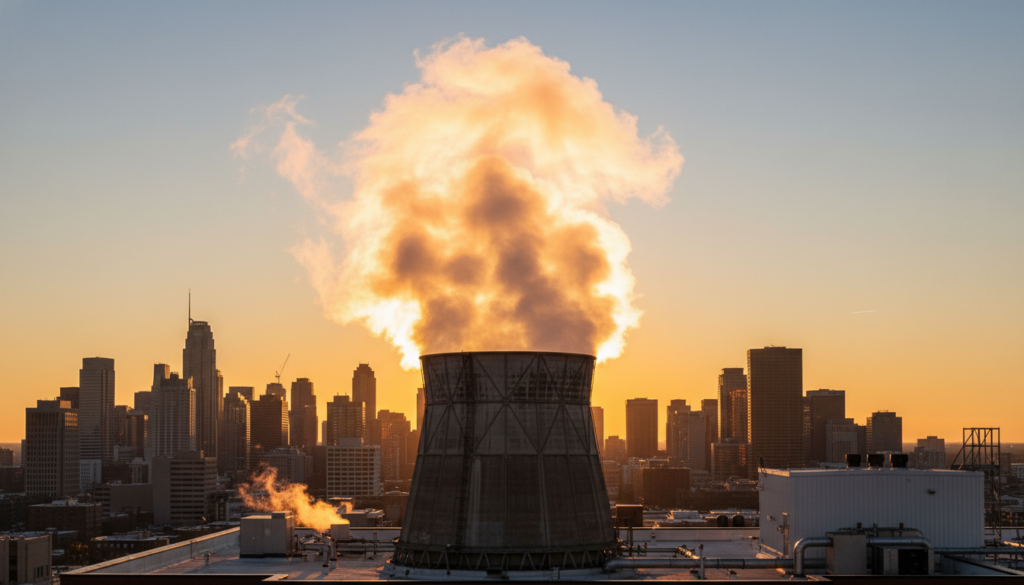
For a closer look at where all that water actually goes, see our analysis of cooling tower water loss and its hidden costs.
Evaporation Credits Explained: A Complete Guide for Commercial Facilities

Quick answer for busy professionals:
Evaporation credits are utility billing adjustments that account for water lost to evaporation before it ever reaches the sewer system. In facilities with cooling towers, boilers, or other evaporative equipment, a substantial share of incoming water is released into the atmosphere as vapor rather than discharged as wastewater. Without proper metering and documentation, utilities bill for that evaporated water as if it were sewage, resulting in recurring overpayment.
Evaporation credits correct this by reducing sewer charges to reflect actual wastewater volumes, often delivering thousands of dollars in annual savings with a typical return on investment within six to twenty four months.
Water evaporates. That is a simple physical fact, but its financial implications are routinely overlooked.
In commercial and industrial facilities, cooling towers, boilers, steam systems, and other equipment consume large volumes of water that are released into the atmosphere as vapor. That water never enters the sanitary sewer system. Yet in most cases, the utility still bills for it as if it does.
Most utilities calculate sewer charges based on total potable water delivered to a facility. They assume all water in equals all wastewater out. For facilities with significant evaporative processes, that assumption can overstate sewer volumes by 20%, 40%, or more. The result is a structural mismatch between what facilities actually discharge and what they are billed for.
Evaporation credits exist to correct that mismatch. They are not a loophole, a subsidy, or a one-time rebate. They are a legitimate billing mechanism that aligns sewer charges with actual wastewater flow. When properly documented and maintained, they produce recurring savings year after year.
What Is an Evaporation Credit?
An evaporation credit is a utility billing adjustment that excludes water proven to have been lost to evaporation from sewer volume calculations. The concept is closely related to sewer credits, but while “sewer credit” is a broad term covering any water diverted from the sewer system (including irrigation and process use), evaporation credits focus specifically on water that becomes vapor.
New to sewer credits altogether? Start with our plain-English guide to sewer credits for the full picture.
The most common source of evaporative loss in commercial facilities is the cooling tower. Cooling towers work by passing water over a heat exchange surface and using airflow to evaporate a portion of that water, which removes heat from the remaining supply. This process is continuous and by design consumes water that never reaches a drain.
Other common sources include evaporative condensers, steam boilers, humidification systems, and certain industrial processes where water is heated or exposed to air. In all of these cases, the water transitions from liquid to vapor and leaves the facility through the atmosphere rather than through the sewer.
When a facility installs submeters to measure this evaporative loss and submits the data to the utility in the required format, the utility can reduce sewer billing by the documented amount. That reduction is the evaporation credit.
Where Does the Water Go?
Understanding evaporation credits starts with understanding the water cycle inside a commercial building. Not all water that enters a facility follows the same path, and the differences matter for billing.
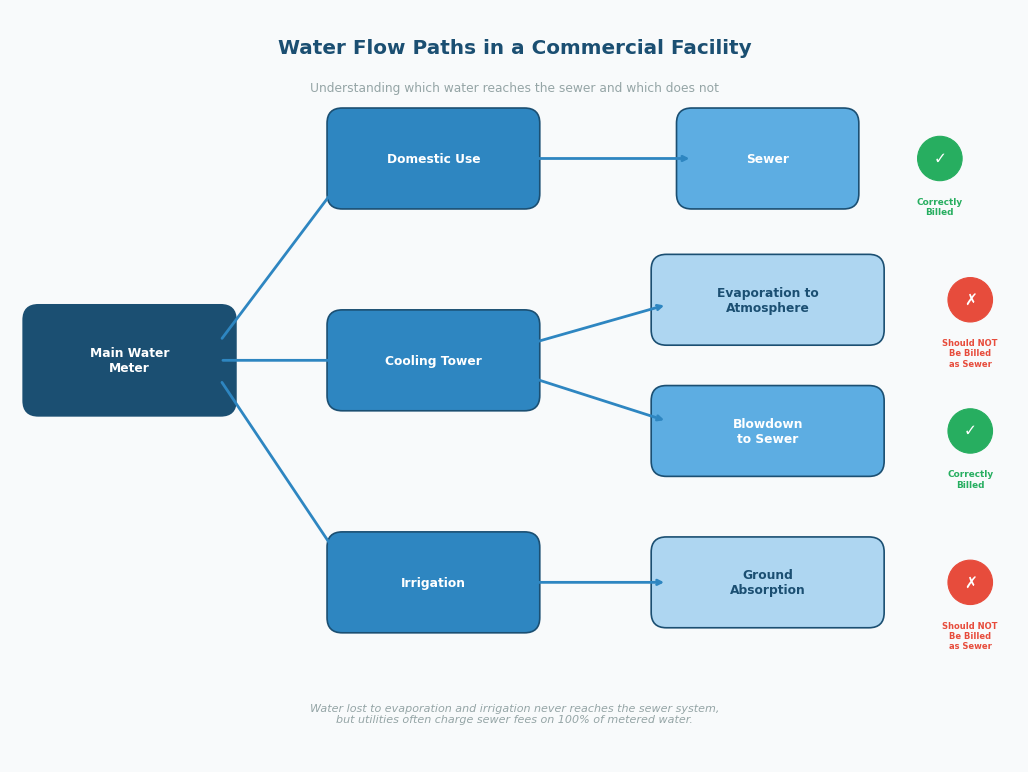
In a typical commercial building with cooling systems, water follows several distinct routes after it enters through the main meter. Some flows to restrooms, kitchens, and other fixtures and exits through the sanitary sewer as wastewater. This water is correctly billed as sewer volume.
But a significant share goes to the cooling tower, where it serves a specific mechanical purpose. As warm water cascades through the tower, a portion evaporates into the atmosphere, following the same physical process the USGS describes in its overview of evaporation and the water cycle. This is not waste or inefficiency. It is how cooling towers are engineered to operate. The evaporated water is gone. It does not flow to a drain, a sewer line, or a treatment plant.
The remaining water in the cooling tower system concentrates dissolved minerals and must periodically be discharged and replaced. This discharge, called blowdown, does enter the sewer. Makeup water replaces both the evaporated water and the blowdown water. The key distinction is that only the blowdown portion should be billed as sewer volume, not the evaporated portion.
Similar dynamics apply to steam boilers, where water is converted to steam and may vent to the atmosphere, and to irrigation systems, where water is absorbed by soil and vegetation rather than returned to the sewer.
Why Evaporation Credits Matter
The financial impact of unclaimed evaporation credits is often larger than facility managers and finance teams expect.
Recurring cost reduction. Unlike a one-time rebate or a capital improvement that delivers savings through efficiency, evaporation credits produce ongoing reductions in sewer charges month after month, year after year. As long as the evaporative equipment operates and the metering remains in place, the savings continue.
Compounding value as rates increase. Sewer rates tend to rise over time. Because evaporation credits reduce the volume of water subject to sewer charges, the dollar value of the credit grows as rates increase. A credit that saves $15,000 this year may save $17,000 or $18,000 in a few years without any change in water usage.
Equivalent revenue impact. For many organizations operating at typical commercial margins of 3 to 5 percent, $1 in operating cost reduction requires the equivalent of $20 to $30 in additional sales to generate the same bottom line impact. A facility saving $10,000 per year in sewer charges through evaporation credits is achieving the profit equivalent of $200,000 to $300,000 in new revenue.
Improved budget accuracy. When sewer bills reflect actual wastewater volumes rather than assumed volumes, finance teams can forecast utility costs with greater confidence. Unexplained variability in water and sewer bills often shrinks once evaporation is properly accounted for.
Retroactive recovery. Many utilities allow evaporation credits to be applied to prior billing periods when valid historical data is provided. This means facilities can potentially recover overpayments from previous months or years, not just reduce future bills.
How Evaporation Credits Work
Securing evaporation credits follows a structured process. While the specifics vary by utility, the general framework is consistent.
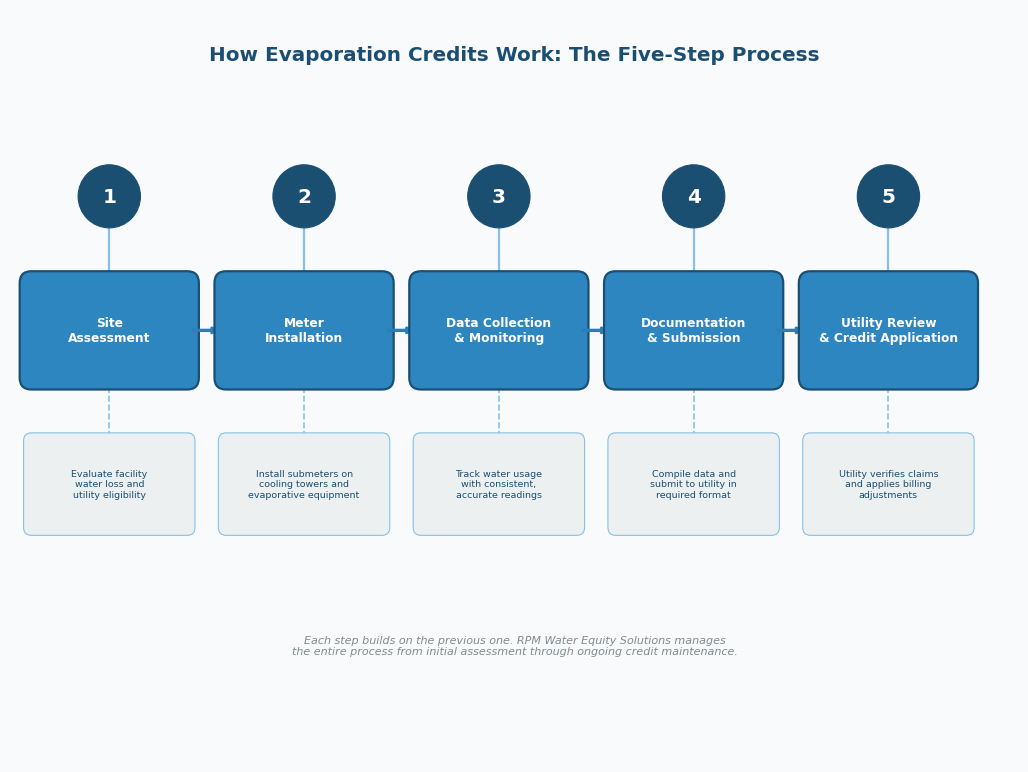
1. Site assessment and feasibility analysis
The process begins with evaluating whether a facility has significant evaporative water loss and whether the local utility offers a credit program. Not every utility provides evaporation credits, and program requirements differ by jurisdiction. Key factors include the volume of water used by evaporative equipment, local sewer rates, utility program availability, and the cost of metering installation.
2. Meter installation and configuration
Utilities require submeters to measure the volume of water directed to evaporative equipment. Meters are typically installed on the makeup water line feeding the cooling tower, boiler, or other evaporative system, consistent with the metering practices outlined in the Department of Energy’s BMP 10 cooling tower management guidelines. Most utilities require two submeters: one on the makeup line and a second on the blowdown line. Some require a third meter on the tower drain.
The meters must meet utility specifications for type, accuracy, and billing units. Some utilities furnish their own meters so readings are compatible with their automated reading systems. Others require customer purchased meters that match the utility’s units (gallons or cubic feet). Proper placement and configuration are critical, since a meter installed in the wrong location or recording in the wrong units can affect both credit amounts and credibility with the utility.
3. Data collection and monitoring
Once meters are in place, data must be collected consistently over time. Most utilities require regular meter readings, whether monthly, quarterly, or annually. Continuous monitoring systems that transmit data automatically provide more reliable records and can also identify anomalies such as equipment leaks, stuck valves, or unexpected usage spikes.
This monitoring step is not just an administrative requirement. RPM’s monitoring data regularly surfaces problems that would otherwise go undetected, and the operational value often extends well beyond billing credits. Facilities that track water flow through evaporative systems frequently discover equipment problems they would not have found otherwise. A frozen makeup line detected within three days through daily submeter readings saved one facility an estimated $3,700 in water costs. A zero reading on a blowdown meter in Houston revealed a line completely blocked with sand and dirt. Another zero reading in Fort Worth uncovered a failed fill valve that had put the tower in continuous overflow.
4. Documentation and submission
Collected data must be organized and submitted in the format the utility requires. This typically includes historical water and sewer bills, meter logs covering defined reporting periods, system descriptions or diagrams showing where evaporative equipment sits in the water flow, and calibration certificates for customer owned meters. Clear, complete documentation reduces review cycles and minimizes the risk of delays or rejected applications.
5. Utility review and credit application
The utility reviews the submitted documentation to verify that the measured water loss is genuinely evaporative and that all program requirements have been met. Once approved, credits are applied to future sewer bills. In many cases, retroactive adjustments are also available for prior billing periods if historical data supports them.
Ongoing compliance is usually required. Utilities may request periodic revalidation, updated calibration certificates, or continued meter readings to keep the credit active. If reporting lapses, credits can be suspended. One Florida facility lost over $20,000 in credits over a sixteen month period after the manager who handled submissions retired and the reporting simply stopped.

Common Sources of Evaporative Water Loss
Not all evaporative losses are equal in scale or credit potential. The following are the most common sources in commercial and industrial facilities.
Cooling towers. By far the largest source of evaporative loss in most commercial buildings. A single cooling tower can evaporate hundreds of thousands of gallons per year depending on capacity, climate, and operating hours. Cooling towers are the primary driver of evaporation credit programs and represent the most common case for credit approval.
Evaporative condensers. Similar to cooling towers in function, evaporative condensers reject heat through water evaporation. They are common in refrigeration systems, particularly in grocery stores, cold storage facilities, and food processing plants.
Steam boilers. Boilers that vent steam to the atmosphere rather than returning condensate to the system produce evaporative losses. The credit potential depends on the volume of steam lost and the facility’s sewer rates.
Humidification systems. Large commercial humidifiers that inject water vapor into HVAC systems consume water that becomes airborne and never reaches the sewer. Credit potential varies but can be meaningful in healthcare, data center, and manufacturing environments where humidity control is critical.
Irrigation systems. While not technically evaporative in the same sense, irrigation water is absorbed by soil and vegetation and does not enter the sewer system. Many utilities treat irrigation as a qualifying use for sewer credits alongside evaporative losses.
Who Qualifies
Evaporation credit programs are available in many, but not all, utility jurisdictions across the United States. Eligibility depends on several factors.
The facility must have equipment or processes that produce significant evaporative water loss. Cooling towers are the most common qualifier, but boilers, condensers, humidifiers, and irrigation systems may also qualify depending on local rules.
The local utility must offer an evaporation or sewer credit program. Program availability, requirements, and terminology vary widely by city, county, and utility district. Some utilities have well established programs with clear application processes. Others require negotiation or formal appeals. In one case, a California water utility’s customer service department stated over the phone that no credits were allowed. A written appeal to the Utility Director resulted in approval and expected annual savings of over $30,000 for a single building.
The facility must be willing to install and maintain submeters that meet utility specifications. Meter requirements differ by utility, and the cost of installation is typically borne by the facility, though the investment is generally modest relative to the savings it enables. Equipment costs are relatively low, with return on investment typically between six and twenty four months.
Organizations that operate multiple facilities across different utility jurisdictions face additional complexity. Each site may have different metering requirements, submission formats, reporting intervals, and credit calculation methods. Managing this at scale is one of the reasons many organizations partner with a water management consultancy rather than attempting to administer programs internally.
How to Estimate Savings
The basic formula for estimating evaporation credit savings is simple.
Evaporated Volume = Makeup Water Volume − Blowdown Volume
Savings = Evaporated Volume × Local Sewer Rate
The evaporated volume is the portion of total water consumption that can be documented as evaporative loss, calculated by subtracting the blowdown (water discharged to sewer) from the total makeup water (water fed to the cooling system). The local sewer rate is the per unit charge for wastewater service.
For a facility with a cooling tower that evaporates 500,000 gallons per year in a jurisdiction where the sewer rate is $8 per 1,000 gallons, the estimated annual savings would be $4,000. In jurisdictions with higher sewer rates or facilities with larger cooling systems, savings can reach $20,000, $30,000, or more. One national retailer realized over $460,000 in annual savings across 85 sites with cooling towers. A single cold storage warehouse reduced annual sewer costs from 97% of water costs to 51%.
However, the real world calculation is rarely that simple. Sewer rates often include tiered pricing, minimum charges, and ancillary fees. Evaporative volumes fluctuate with weather, equipment load, and operating schedules. Meter accuracy, reporting compliance, and utility specific rules all influence the final credit amount.
We provide a savings calculator to help organizations quickly assess potential savings and decide whether it makes sense to investigate further. For a precise analysis, most organizations benefit from a professional assessment that accounts for the full range of variables affecting their specific sites.
LEED and Sustainability Benefits
Beyond direct cost savings, evaporation credit programs can support broader sustainability and certification goals.
Installing submeters on cooling towers contributes toward earning up to two points under LEED for Existing Buildings: Operations and Maintenance water metering credits. Continuous metering of cooling tower water usage with data logging supports documentation requirements for these credits. For facilities pursuing or maintaining LEED certification, evaporation credit metering serves a dual purpose: reducing utility costs while simultaneously earning sustainability credits.
The data generated through evaporation credit monitoring also supports ESG reporting, water stewardship commitments, and internal sustainability targets. Facilities that can demonstrate precise water tracking and waste reduction have a stronger position when reporting to stakeholders, regulators, or certification bodies.
Why Ongoing Management Matters
Evaporation credits are not a set it and forget it solution. The difference between a well managed program and a neglected one can be tens of thousands of dollars per year.
Credits are often calculated and posted to utility bills manually. Meter reading errors and billing errors can reduce savings from thousands of dollars per year to a fraction of what they should be. One Rhode Island site received just $401 in annual credits until the billing was reviewed and corrected to over $4,000. Regular billing audits across nine sites for one national client produced an additional $32,000 in recovered savings over twelve months.
Reporting lapses are another common risk. If a monthly meter reading submission is missed, credits can be lost for two consecutive months. When the person responsible for submissions leaves the organization without a transition plan, programs can go dormant entirely. Continuous monitoring systems that automate data collection and transmission reduce this risk significantly.
Active management also creates operational value beyond billing. The same metering infrastructure that supports evaporation credits can detect cooling tower overflows, stuck float valves, frozen lines, and other equipment failures. These problems often go unnoticed until they cause visible damage or appear as unexplained spikes on the water bill. Catching them early through daily or hourly monitoring protects equipment, prevents water waste, and avoids costly repairs.
Getting Started
Pursuing evaporation credits does not have to be complicated. The first step is understanding whether your facility uses water in ways that produce meaningful evaporative loss and whether your local utility offers a credit program.
RPM Water Equity Solutions specializes in evaluating, securing, and managing evaporation credit programs for commercial and institutional facilities across the United States. We handle the site assessment, meter coordination, documentation, utility submissions, and ongoing compliance so our clients can capture savings without needing to become experts in water billing or local utility rules. We currently manage over 250 sites across 36 states, delivering over $3,000,000 in annual savings.
Not sure whether this applies to your building? Take the short Water Equity Quiz to see where you stand.
Ready to Find Out What You Could Save?
RPM Water Equity Solutions helps commercial facilities recover money lost to sewer billing assumptions. We handle the analysis, metering, documentation, and utility coordination so you don’t have to. All we need to get started is 12 months of water and sewer bills.
Request your free assessment today and we’ll show you exactly where you stand.
