
How Is a Sewer Bill Calculated? What Commercial Buildings Overpay
Quick answer for busy professionals:
Somewhere in your monthly utility bill is a line item for sewer service. For most commercial buildings, that charge is calculated using a simple formula: total water delivered multiplied by the local sewer rate. The utility assumes that every gallon of water coming in goes out as wastewater.
For many facilities, that assumption is significantly wrong.
The root cause is a flawed billing model. We dig deeper into the assumptions utilities make and where they break down.
Cooling towers evaporate hundreds of thousands of gallons per year. Irrigation systems send water into the ground. Boilers consume water as steam. None of this water reaches a drain, but every gallon of it is billed as treated wastewater.
A midsize commercial building with cooling towers can overpay $5,000 to $15,000 per year. Larger facilities and multi-site portfolios can see overpayments of $30,000 to $50,000 or more annually. These are not theoretical numbers. They are the kinds of results RPM sees routinely when analyzing real utility data for commercial clients. If you manage or oversee a commercial building’s operating budget, this is money you should know about.
How Sewer Billing Actually Works
Most people never think about how their sewer bill is calculated. The mechanics are simple, but the implications for commercial buildings are significant.
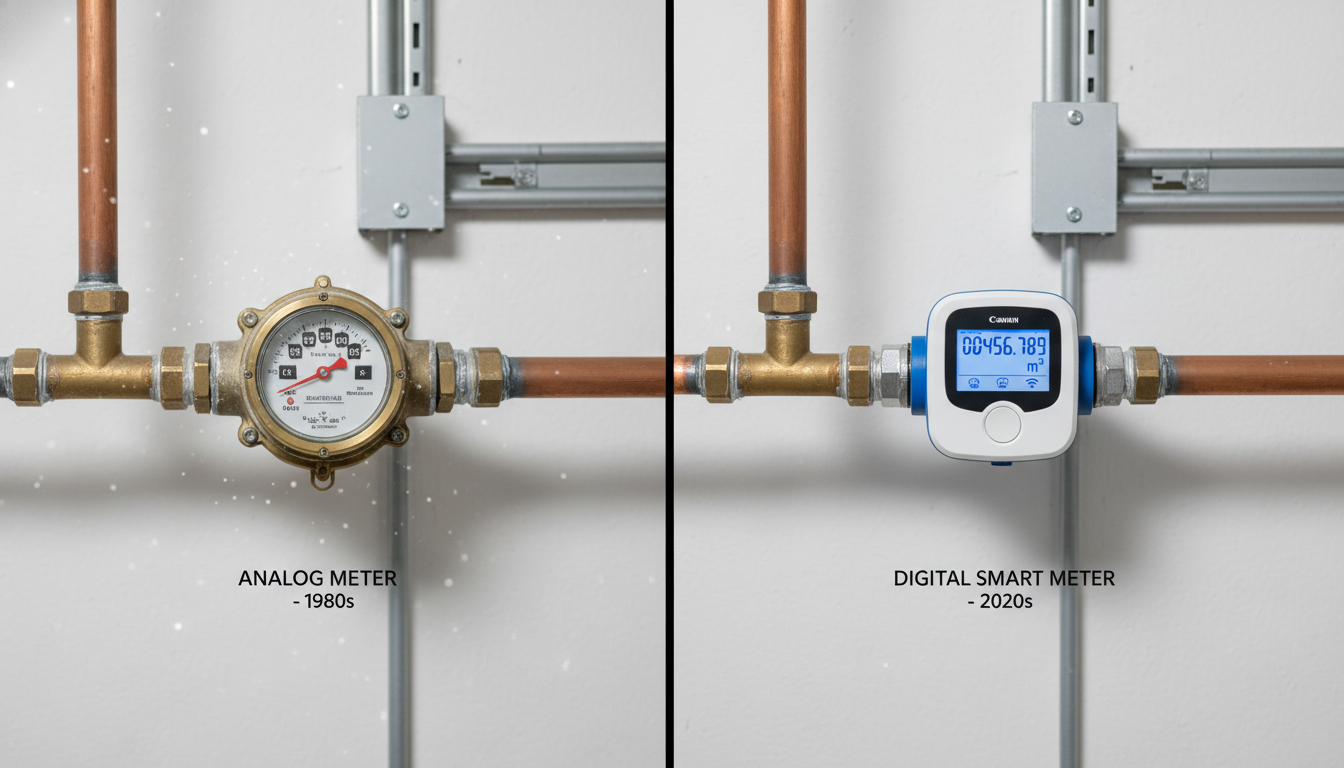
Unlike water, sewer flow is almost never metered directly. Installing meters in sewer lines is expensive, technically difficult, and rarely done for individual commercial accounts. Instead, utilities use a proxy: they measure how much water comes into your building through the water meter and assume the same volume exits as wastewater.
This approach is called the “water in equals water out” assumption, and for residential properties, it is reasonably accurate. Most water used in a home does end up in the sewer: showers, toilets, sinks, dishwashers, and laundry all discharge to the sanitary sewer system.
For commercial buildings, the picture is different. A significant share of water consumption goes to systems that consume, evaporate, or divert water before it ever reaches a drain. The utility has no way of knowing this from the water meter alone. Without documentation showing where water actually goes, the billing assumption stands, and the facility pays full sewer rates on every gallon.
The scale of this mismatch is large. According to the U.S. Environmental Protection Agency, commercial and institutional buildings account for approximately 17 percent of publicly supplied water in the United States, and a meaningful share of that volume goes to systems that never discharge to the sewer. The billing gap is not a niche issue affecting a few unusual buildings. It is a structural feature of how sewer billing works across the country.
This is not a billing error in the traditional sense. The utility is applying its published rate methodology correctly. The problem is that the methodology does not account for how commercial buildings actually use water. Correcting it requires the building owner to provide documentation of non-sewer water use. Until that documentation is submitted, the overcharge continues.
Why the Assumption Is Wrong for Most Commercial Buildings
The gap between assumed and actual sewer discharge grows with the complexity of a building’s water systems. The more ways a facility uses water outside of standard plumbing fixtures, the larger the overpayment.
Cooling towers are the single largest source of non-sewer water loss in most commercial facilities. They reject heat by evaporating water, and the evaporated volume never enters the sewer. A 500 ton cooling tower can lose 400,000 to 600,000 gallons per year to evaporation alone. For a detailed breakdown of where that water goes, see our post on cooling tower water loss.
Irrigation systems send water directly into the landscape. Commercial properties with significant landscaping, athletic fields, or green spaces can use tens of thousands of gallons per month during the growing season, none of which reaches the sewer.
Boilers and steam systems consume water that is converted to steam and either vented or lost through the distribution system. In facilities with large heating plants, boiler makeup water can represent a substantial non-sewer volume.
Process water in manufacturing, food service, laboratory, and industrial applications is often consumed, evaporated, or disposed of separately from the sanitary sewer. Depending on the operation, process water volumes can be significant.
Humidification systems in data centers, hospitals, and climate-controlled facilities add moisture to indoor air. This water evaporates into the building environment and never reaches the sewer. The EPA’s WaterSense program highlights these non-sewer uses as key opportunities for commercial water efficiency.
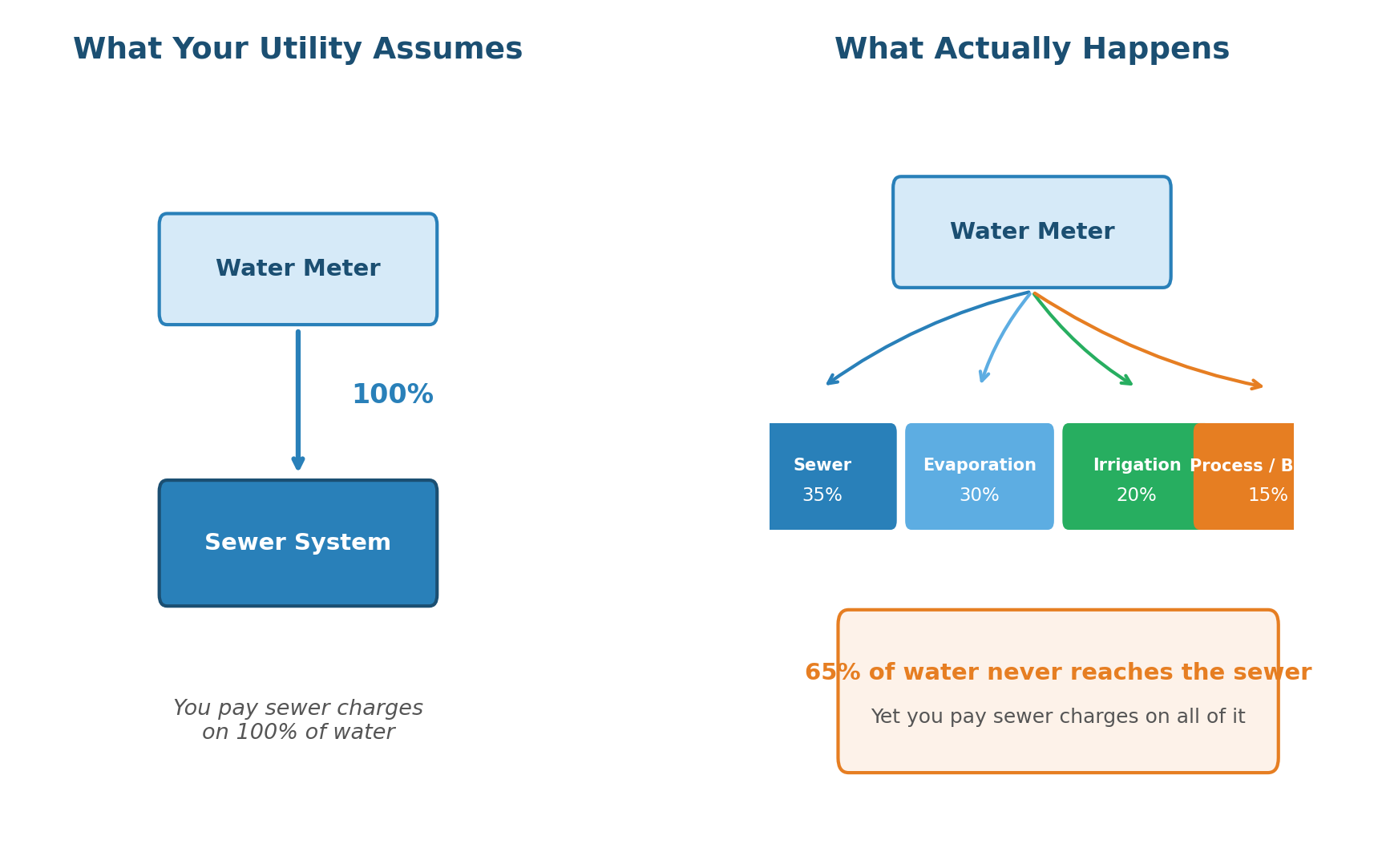
When you add up the non-sewer water from these sources, it is common for 20 to 40 percent of a commercial building’s total water consumption to bypass the sewer system entirely. That percentage translates directly into overpayment on the sewer portion of the utility bill.
Real Savings Ranges by Facility Type
RPM has managed sewer credit programs across thousands of facilities over three decades. The savings ranges below reflect what we see most often, assuming moderate sewer rates of $6 to $12 per thousand gallons.
Not sure what sewer credits are or how they work? Our plain-English sewer credits guide covers the basics.
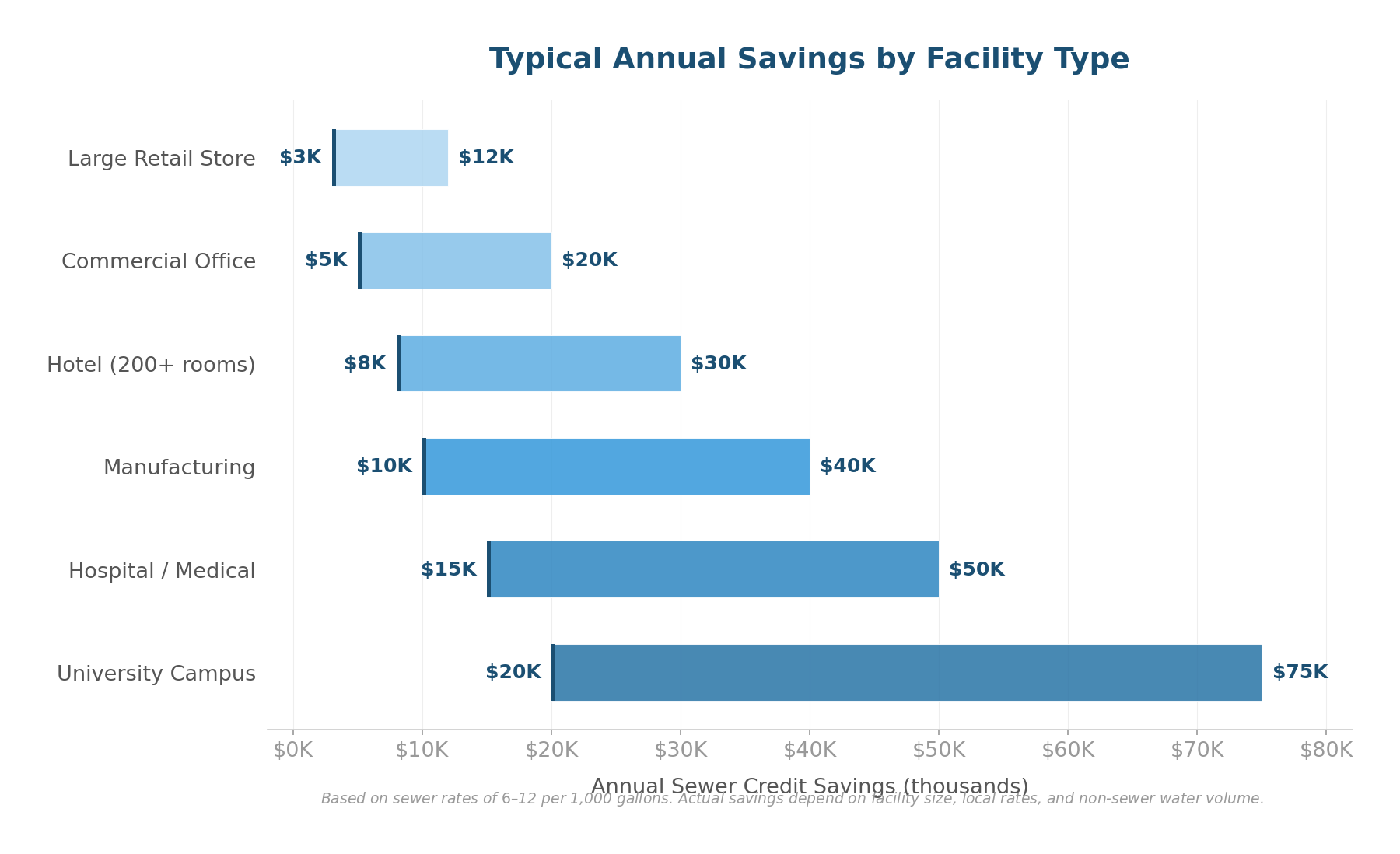
Facilities in jurisdictions with higher sewer rates will see proportionally higher savings. Multi-site organizations with portfolios of 10, 50, or 100+ locations can aggregate these savings into annual recoveries of $100,000 to over $1 million.
The American Water Works Association has documented that commercial and industrial water rates, including sewer, have increased at an average of 3 to 5 percent per year in recent years. Data from the USGS Water Use in the United States report confirms that commercial water consumption remains substantial nationwide. That means the savings from a credit program grow over time as rates rise, making early implementation more valuable than waiting.
How to Find Out if Your Building Qualifies
Determining whether your facility qualifies for sewer credits is not complicated, but it does require looking at a few specific factors.
Do you have non-sewer water uses? If your building has cooling towers, irrigation, boilers, process water, or other systems that consume or divert water away from the sewer, there is likely an opportunity. The larger the non-sewer volume, the larger the savings.
Does your utility offer a credit program? Most major U.S. utilities offer some form of sewer credit, adjustment, or exemption program. The specific name, application process, and requirements vary by jurisdiction, but the concept is widely available. For more detail on how credit programs work, see our plain english guide to sewer credits.
Can you document the non-sewer water? Utilities require proof that water is not entering the sewer. This typically means sub-metering on non-sewer water lines, engineering calculations, or a combination of both. The documentation standards vary by utility, but the principle is consistent: you need verifiable data showing how much water bypasses the sewer system.
If you can answer yes to these three questions, your facility is a candidate for a credit program. The question is not whether savings exist, but how much.
One-Time Refund vs. Ongoing Credit Program
A one-time refund recovers what you overpaid last year. An ongoing credit program makes sure you stop overpaying every year after that. The difference matters more than most facility managers realize.
A one-time refund or retroactive credit recovers past overpayments based on historical data. Some utilities allow retroactive adjustments covering 12 to 36 months of prior billing. This can produce a meaningful lump sum recovery, but once the refund is applied, the value stops unless the credit is maintained going forward.
An ongoing credit program establishes a permanent adjustment to sewer billing based on documented, metered non-sewer water use. The credit is applied every billing cycle, reducing sewer charges continuously. This is where the real value lies. An ongoing program turns a one-time correction into a durable financial asset that compounds over years as sewer rates continue to rise.
The most effective approach combines both: retroactive recovery of past overpayments plus ongoing credit management that ensures the adjustment stays in place. This requires continuous monitoring to provide the data utilities need for periodic revalidation, which is why a managed program outperforms a one-time audit.
Consider the difference over a five year period. A one-time refund might recover $15,000 in past overpayments. An ongoing credit program recovering $8,000 per year delivers $40,000 over the same period, plus the retroactive component. The longer the program runs, the greater the cumulative advantage of ongoing management over one-time corrections.
For a deeper look at how evaporation specifically drives these credits, see our guide on evaporation credits explained.
How to Evaluate the Opportunity
The fastest way to estimate your savings potential is to look at three numbers: your annual water consumption, your local sewer rate, and a reasonable estimate of your non-sewer water percentage.
Annual Sewer Overpayment = Annual Water Volume x Non-Sewer Percentage x Sewer Rate
For a building consuming 2 million gallons per year with 30 percent non-sewer water and a sewer rate of $10 per thousand gallons, the math is simple: 2,000,000 x 0.30 x $0.01 = $6,000 per year. For a building consuming 10 million gallons per year under the same assumptions, the overpayment is $30,000 annually.
These are rough estimates. Actual savings depend on precise metering, local program rules, and utility rate structures that can include tiered pricing, minimum charges, and seasonal adjustments. But the quick calculation is useful for determining whether the opportunity warrants a closer look.
RPM provides a savings calculator that uses your actual utility data to produce a more refined estimate. If the initial numbers suggest meaningful savings, a free assessment can confirm the opportunity and outline the path from current billing to corrected billing.
Getting Started
If you manage a commercial building and have never looked at whether your facility overpays on sewer, the odds are strong that it does. Utility bill optimization starts with understanding that the billing assumption driving your sewer charges is designed for simplicity, not accuracy, and it systematically overcharges buildings with non-sewer water uses.
Evaluating the opportunity does not require any upfront investment. RPM Water Equity Solutions provides free assessments that analyze your utility data, evaluate your non-sewer water sources, and estimate the savings available through a credit program. We handle the metering, documentation, utility coordination, and ongoing management so your team can focus on running the building, not decoding water bills.
Want a number for your own building? Try the Water Savings ROI Calculator for a quick estimate based on your own figures.
Ready to Find Out What You Could Save?
RPM Water Equity Solutions helps commercial facilities recover money lost to sewer billing assumptions. We handle the analysis, metering, documentation, and utility coordination so you don’t have to. All we need to get started is 12 months of water and sewer bills.
Request your free assessment today and we’ll show you exactly where you stand.
