Deduct Meters and Submetering for Sewer Credits
Quick answer for busy professionals:
Sewer credits exist to correct a billing assumption. Utilities assume that all water entering a commercial building exits through the sewer. For buildings with cooling towers, irrigation, boilers, or process water, that assumption overstates wastewater volumes by 20 to 40 percent. Correcting the overstatement requires documented proof that a portion of metered water never reaches the sewer.
For federal water measurement and metering standards, the DOE’s FEMP BMP 10 guidelines detail submetering requirements for cooling systems.
EPA WaterSense guidance on commercial building water management recommends submetering as a best practice for tracking water use.
That proof comes from submetering. The term describes water meters installed on specific supply lines within a building to measure how much water goes to individual systems. In the sewer credit context, submeters on cooling tower makeup and blowdown lines are the most common application. The data these meters generate becomes the foundation of the credit application.
This post explains what submetering is in the context of sewer credits, what meters you need and where they go, how utilities use the data to calculate credits, common installation considerations, and why ongoing monitoring improves both accuracy and compliance. For a broader overview of how sewer credits work, see our post on how to qualify for sewer credits.
What Is Submetering in the Context of Sewer Credits?
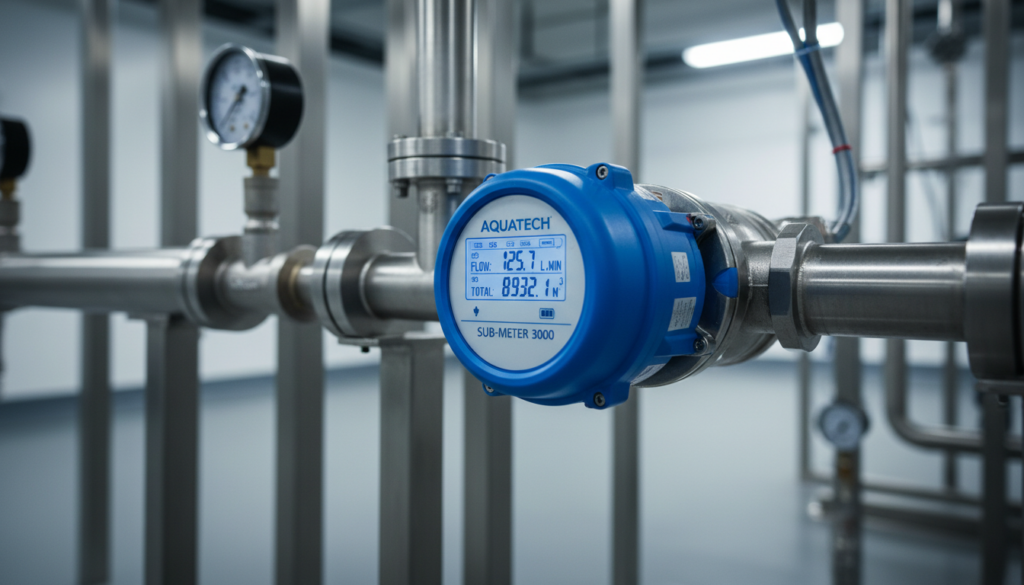
Submetering is the installation of additional water meters on specific supply lines to measure water consumption in individual systems or zones. Every commercial building already has a main water meter, typically located near the building entry or the property line, which the utility owns and reads regularly.
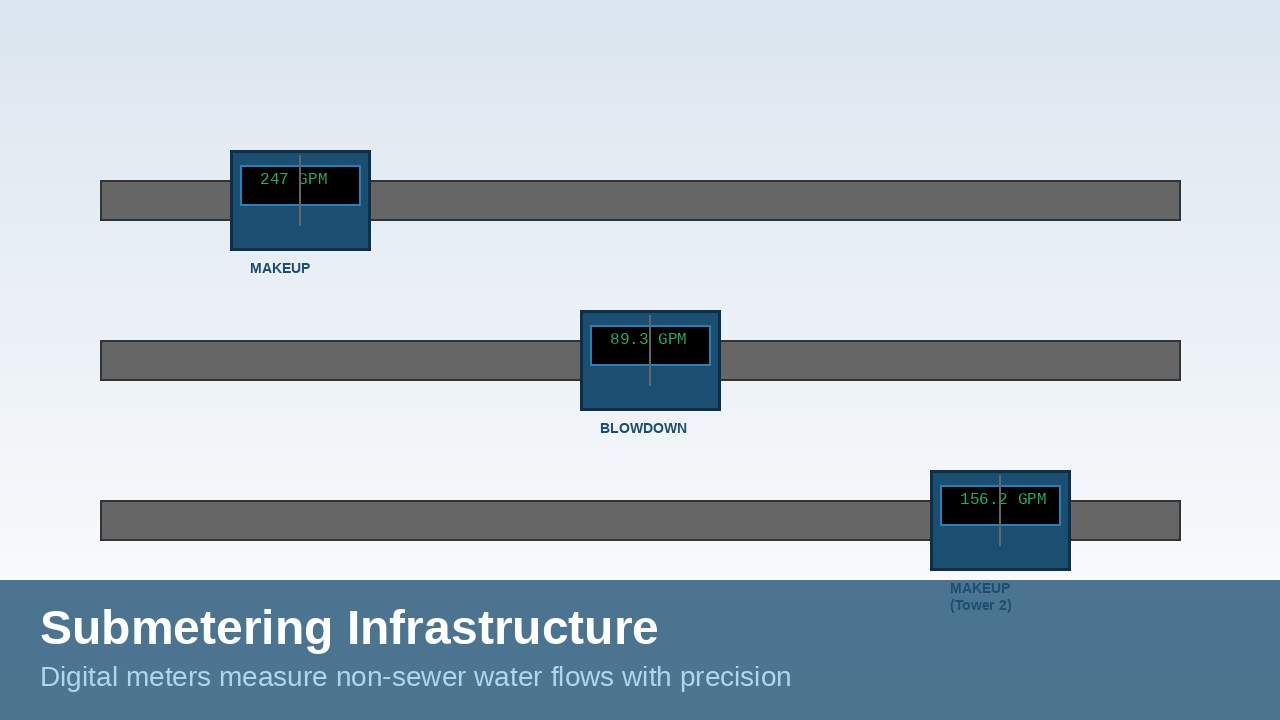
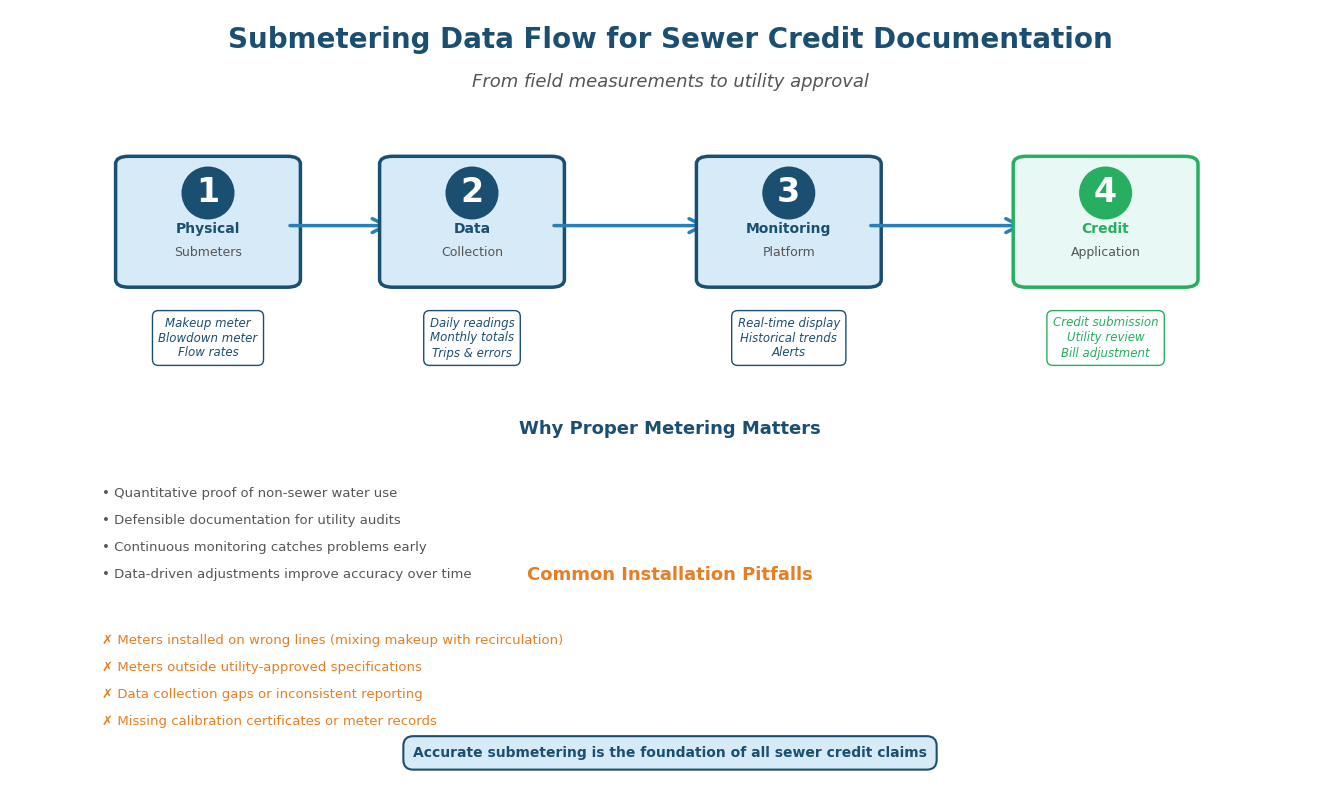
Submeters are building-owned meters installed downstream of the main meter. They measure flow on specific lines: a makeup meter on the cooling tower fill line, an irrigation meter on the landscape supply line, a boiler makeup meter on the steam system supply, or any other line delivering water to equipment that does not discharge to the sewer.
The utility does not install or own these submeters. Buildings are responsible for their purchase, installation, maintenance, and data collection. The data generated by submeters becomes the evidence that supports the sewer credit application. For a deeper explanation of how water moves through cooling towers and where evaporation happens, see our post on evaporation credits explained.
In sewer credit programs, submetering is not optional. Utilities will not calculate or approve credits based on estimates or assumptions alone. They require actual metered data.
Makeup Meters: What They Measure and Where They Go
A makeup meter measures the total volume of water supplied to a cooling tower. Makeup water is fresh water added to replace water lost to evaporation and blowdown. The meter is installed on the supply line between the building’s main water service and the cooling tower fill pipe.
The meter location is critical. It must measure all water entering the cooling tower system before it reaches the tower basin. If the meter is installed on a recirculation line, it will capture recirculated water along with fresh makeup, rendering the data unusable for credit calculations. Most utilities specify in their credit program documentation exactly where this meter should be located.
Makeup meters in cooling tower applications typically measure flow rates between 1 and 50 gallons per minute, depending on tower size and operating mode. For a midsize office building with a 500-ton cooling system operating during warm months, daily makeup water volumes can easily exceed 10,000 gallons. The meter must be sized to read accurately across the full range of likely flow rates.
The meter must also be suitable for continuous operation. Cooling tower supply lines are not always clean; water may contain suspended solids or occasional debris. Turbine meters are popular for this application because they tolerate slightly rough water better than other types, though straining is still recommended. Utilities typically specify the meter type and manufacturer in their credit program rules.
Blowdown Meters: What They Measure and Why They Matter
A blowdown meter measures the volume of water discharged from a cooling tower to the sanitary sewer. Blowdown is intentional discharge of concentrated water from the tower basin to control mineral buildup. Without blowdown, minerals in the recirculated water would concentrate to levels that damage the tower and degrade heat transfer performance.
The meter is installed on the blowdown discharge line after it leaves the cooling tower basin and before it enters the sewer. Like the makeup meter, the location is critical. The meter must measure all water leaving the tower, not just a portion of the discharge. If the meter is on a branch line or bypass, the data will not represent total blowdown volume.
Blowdown rates vary depending on water quality, tower operating hours, and climate. In some regions with high mineral content in incoming water, blowdown may run continuously at 10 to 20 gallons per minute. In regions with soft water, blowdown may cycle periodically and average far less volume. The meter must accurately measure whatever range of flows is typical for the facility.
Blowdown meters are essential to the credit calculation. Without a blowdown meter, utilities cannot verify the difference between makeup and evaporation. A facility cannot claim that 2 million gallons of water evaporated without proving how much water discharged as blowdown. The blowdown meter provides that proof.
How Evaporation Is Calculated from Makeup and Blowdown
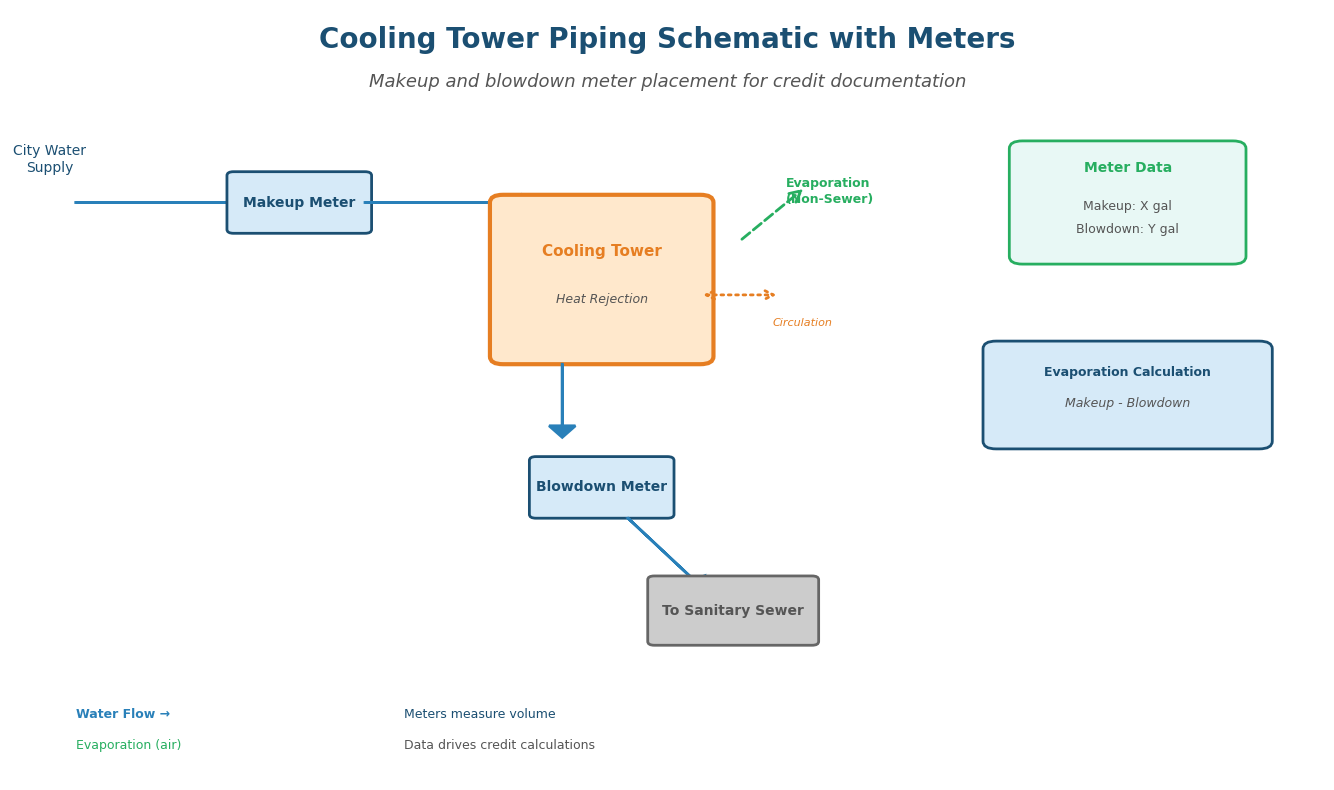
Evaporated water is the volume that justifies the sewer credit. It is calculated as a simple subtraction: makeup water volume minus blowdown volume equals evaporated water volume.
The formula is: Evaporation equals Makeup minus Blowdown. All three terms are in gallons (or other consistent units) measured over the same time period, typically one month.
Here is why this calculation works. Water enters the cooling tower through the makeup meter. Some of that water evaporates into the air and never reaches the sewer. Some water is intentionally discharged through the blowdown line as measured by the blowdown meter. The rest goes nowhere because it already evaporated. Therefore, the difference between what enters and what leaves is what evaporated.
An example: if a cooling tower receives 1 million gallons of makeup water in a month and discharges 400,000 gallons of blowdown, the evaporated volume is 600,000 gallons. That full 600,000 gallons is water that never entered the sewer, so it qualifies for a sewer credit. The utility subtracts 600,000 gallons from the main water meter reading before calculating the sewer charge.
This calculation is only valid if both meters are accurate and installed correctly. If the makeup meter is oversized and sluggish at low flows, it will undercount during light load periods and understate evaporation. If the blowdown meter is on a branch line and misses some discharge, it will understate blowdown volume, overstating evaporation. The quality of the credit depends entirely on the quality of the metering data.
Meter Types and Specifications for Commercial Applications
Commercial water meters fall into three broad categories: displacement meters, velocity meters, and electromagnetic meters. Each has advantages and disadvantages in the context of cooling tower monitoring.
Displacement meters (piston or rotary) are very accurate at low and medium flow rates and are less sensitive to water quality issues. They are widely used in residential and small commercial applications. For cooling tower makeup lines, they work well when flow rates are stable and moderate. Their primary disadvantage is that they are mechanical and require occasional maintenance.
Velocity meters (turbine) measure flow by the rotational speed of an internal rotor. They are durable, suitable for larger flow rates, and tolerate slight water quality variations better than displacement meters. They are commonly specified for makeup and blowdown lines in cooling tower applications. Turbine meters require good straining to prevent debris from affecting the rotor.
Electromagnetic meters have no moving parts and work by measuring electrical conductivity of flowing water. They are extremely durable and accurate but are more expensive than mechanical meters. They are sometimes used in applications where water quality is variable or where a maintenance free meter is required.
Utilities typically specify one or two preferred meter types in their credit program documentation. Some utilities accept only specific manufacturers or models. Before purchasing meters, confirm the utility’s requirements. An expensive meter that does not meet the utility’s specifications will not be accepted for the credit application.
All commercial meters used for credit documentation must have accuracy ratings of plus or minus 2 percent or better. The meter should be sized so that the expected flow rate during operation falls within the meter’s best accuracy range, typically the middle 30 to 70 percent of the meter’s maximum rated flow.
Data Collection and Reporting Requirements
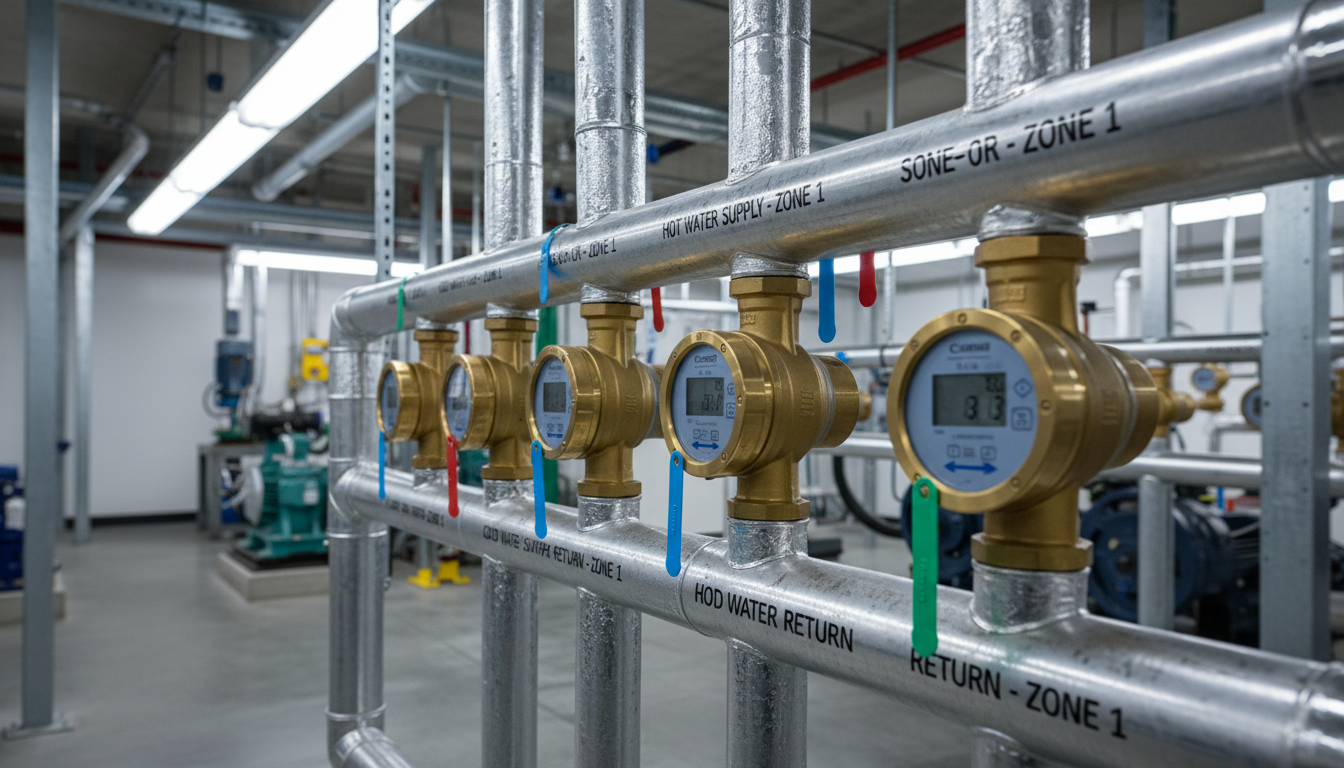
Utilities vary widely in what they require for data collection and reporting. A small utility in a rural area might accept 30 days of meter readings. A large utility serving a major city might require 90 days of continuous data. Some utilities accept data from building automation systems; others require manual meter readings recorded by trained personnel.
Most utilities publish the specific data requirements in their credit program documentation or in the application form itself. Common requirements include: minimum duration of data collection (typically 30 to 90 days), frequency of readings (daily to monthly), data format (electronic spreadsheet or printed form), certification or signature requirements, and meter calibration documentation.
The data must be consistent and complete. Missing readings, illegible recordings, or gaps in the collection period are common reasons utilities reject initial applications. If a facility collects data for 90 days but has no readings for one week in the middle of the period, the utility might ask for the complete 90 days to be recollected.
Once data collection begins, it typically continues indefinitely. Even after a credit is approved and applied to the utility account, most programs require annual revalidation with updated meter readings. This ongoing data requirement is one reason why facilities invest in automated monitoring systems rather than relying on manual meter readings. Automated systems eliminate the burden of monthly manual readings and ensure utilities receive consistent, high-quality data year after year.
Common Installation Considerations and Pitfalls
Poor meter placement is the most common installation error. Makeup meters installed on recirculation lines, blowdown meters on branch discharge lines, or meters positioned where water does not flow consistently will generate data the utility cannot use. Before installation begins, verify the correct piping location with the utility’s documentation or ask for clarification.
Meters installed too close to fittings or elbows can give inaccurate readings. Water flow is turbulent near fittings, and turbulence affects meter accuracy. Most meter manufacturers recommend a minimum distance (typically three to five pipe diameters) of straight pipe upstream of the meter and one to two pipe diameters downstream before any fitting. Poor meter placement is a leading cause of data rejection.
Undersizing or oversizing meters is another common problem. A makeup meter sized for flows up to 100 gallons per minute but operating at only 5 to 10 gallons per minute will read inaccurately at low flow. An undersized meter that reaches maximum capacity and cannot read higher flows will miss data during peak periods. The meter must be matched to the actual operating range of the system.
Failing to strain the water supply before it enters the meter degrades meter accuracy over time. Debris lodges in the meter mechanism, causing sluggish readings and drift errors. Installing a screen or strainer upstream of the meter is standard practice and often specified by the utility.
Missing or incomplete calibration documentation is a paperwork issue but a real one. Most utilities require a meter calibration certificate or test report showing that the meter meets accuracy specifications. This certificate comes from the meter manufacturer or a certified testing facility. Without it, the utility may not accept the meter data.
Letting meters sit unused for long periods before data collection begins can introduce error. If a new meter is installed but not put into service for several weeks, the mechanism may stick or behave erratically during the first days of operation. It is best to allow a meter to run for a few days after installation before beginning formal data collection for the credit application.
How Ongoing Monitoring Improves Accuracy and Compliance
A single submission of meter data satisfies the initial credit application, but utilities are increasingly requiring ongoing monitoring to maintain credits. The reasons are practical: conditions change, equipment degrades, and manual data is error prone.
Continuous monitoring catches equipment problems early. A stuck fill valve on a cooling tower can cause excessive makeup water consumption within days. A failing makeup meter can start drifting in accuracy. A buildup of mineral deposits can change blowdown patterns. Continuous monitoring displays these changes in real time, allowing facility managers to investigate and correct problems before they compound.
Monitoring data supports credit recalculation. As buildings modify equipment or operating hours, the non-sewer water volume changes. Annual monitoring data allows utilities to recalculate credits with current operating conditions rather than relying on older estimates. A facility that added a second cooling tower or extended operating hours into fall might qualify for higher credits if the monitoring data documents the increased evaporation.
Automated data collection eliminates manual recording errors. Manual meter reading introduces opportunities for misreading, transcription errors, or missing entries. Automated systems read meters electronically and transmit data to a cloud platform, eliminating transcription errors and ensuring continuous coverage.
Ongoing monitoring supports audit defense. If a utility audits the credit program, continuous monitoring data demonstrates that the facility took the program seriously and collected data consistently. Scattered, incomplete, or manually recorded data raises red flags. Utilities are more confident in credits supported by clean, continuous monitoring data.
For a fuller explanation of how monitoring supports water management in cooling towers, see our post on how RPM Water monitoring works.
Why Accurate Submetering Is the Foundation of Every Credit Application
Utilities will not grant credits based on assumptions or engineering estimates alone. They require metered evidence. The meters you install, where you install them, and the data quality they deliver are the foundation on which the entire credit program rests.
A well-designed submetering configuration with properly specified meters installed in correct locations, maintained consistently, and read automatically will generate data that utilities trust and support. A poorly configured setup will delay approvals, raise utility questions, and create compliance headaches.
The investment in proper metering is modest relative to the credits it enables. A cooling tower submetering setup with makeup meter, blowdown meter, installation, and calibration typically costs between $3,000 and $8,000, depending on piping complexity. Most facilities recover that investment within the first year of credit operation. That ROI makes submetering one of the highest-value building water efficiency upgrades available.
Getting Started with Submetering for Your Facility
If your facility operates cooling towers, irrigation, boiler systems, or other non-sewer water uses, submetering is the critical first step toward a sewer credit program. The steps are clear: identify which systems need metering, confirm the utility’s technical specifications, install meters in correct locations, collect data over the required period, and submit the application.
Many facility managers and finance teams attempt to design and implement metering programs themselves. What often seems straightforward (install a few meters) becomes complex quickly. Meter sizing, piping location, utility specifications, data format, and application timing all require attention to detail. A single mistake in meter placement or specification can delay approvals by months or invalidate the entire submission.
RPM Water Equity Solutions handles every step of this process for commercial and institutional facilities nationwide. We evaluate your utility data, identify the savings opportunity, design the metering configuration for your facility, manage the installation, collect and validate the data, prepare and submit the application, and manage the ongoing monitoring and compliance. Our clients capture savings without needing to navigate their local utility’s program rules or worry about technical specifications.
If you want to find out whether your facility is overpaying for sewer and what a submetering program could save, a free site assessment is the simplest starting point. Request your free evaluation and we will review your facility, utility data, and equipment to tell you what we find.
Ready to Find Out What You Could Save?
RPM Water Equity Solutions helps commercial facilities recover money lost to sewer billing assumptions. If your building has a cooling tower, chiller, or any system where water doesn’t return to the sewer, you may be overpaying every month.
Request your free assessment today and find out how much you could recover.
