Quick Answer
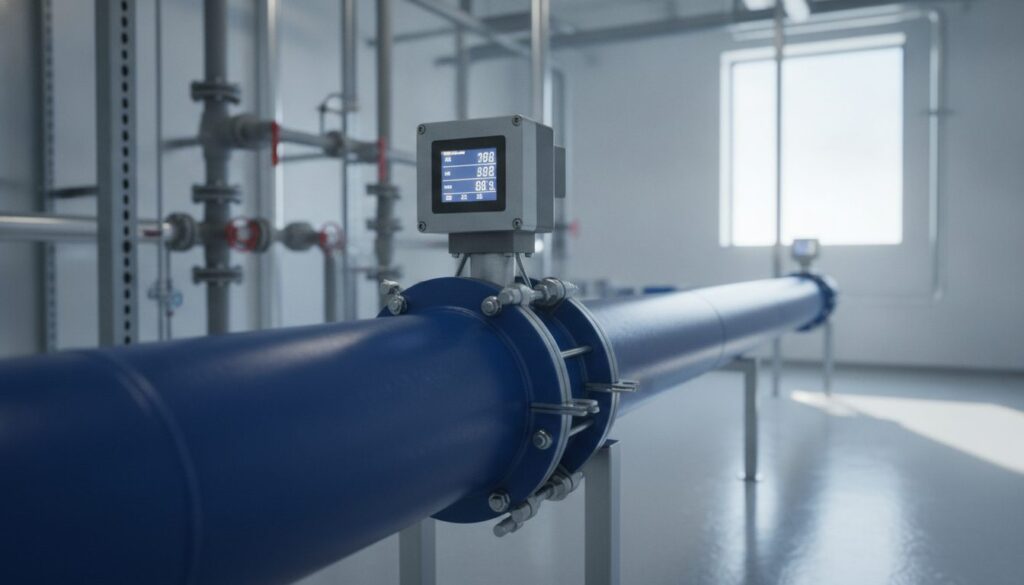
Water submetering means installing dedicated meters on specific lines inside your facility, downstream of the utility’s master meter. For a data center, 2 meters matter most: cooling tower makeup and cooling tower blowdown. Together they let you calculate evaporation (makeup minus blowdown), compute Water Usage Effectiveness (WUE), catch leaks and stuck valves within hours instead of billing cycles, and document sewer credits that remove evaporated water from your sewer bill. Meters should meet American Water Works Association (AWWA) standards; AWWA C700 requires displacement meters to register within ±1.5% of actual flow at normal and high flows. In RPM’s project experience, installed cost typically runs $3,000 to $8,000 per metering point, and when a sewer credit follows, the hardware often pays for itself within the first year.
What Is Water Submetering?
Your utility bills from a single master meter at the property line. A submeter is any additional meter you install downstream of it to measure one specific system: a cooling tower, an irrigation zone, a single building on a campus. EPA’s WaterSense at Work guidance on metering and submetering (2023) recommends submetering water-intensive activities because it lets operators track usage against benchmarks, verify utility bills, identify leaks, and measure the results of efficiency projects.
Few activities are more water-intensive than evaporative cooling. Across the US, data centers directly consumed about 66 billion liters of water (roughly 17 billion gallons) in 2023, according to Lawrence Berkeley National Laboratory’s 2024 United States Data Center Energy Usage Report. Our pillar guide to how much water a data center uses breaks down where those gallons go. Submetering is how you get that same visibility for your own site.
Submeters also carry a billing function. The same EPA guidance notes that some wastewater utilities offer a sewer credit or deduction, based on deduct meter data, for water that never enters the sanitary sewer. For an evaporative-cooled data center, that describes most of the water purchased.
What to Meter at a Data Center
Start with the 2 meters that define your cooling water balance, then add points as your reporting needs grow.
| Metering point | What it measures | Why it matters |
|---|---|---|
| Cooling tower makeup | All water fed to the tower basin | The baseline for evaporation math, WUE, and leak detection |
| Cooling tower blowdown | Water drained to the sewer to control mineral buildup | Proves how little of your intake actually reaches the sewer |
| Domestic and office lines | Restrooms, kitchens, showers | Separates people-water from process water in reporting |
| Humidification | Water added to hold data hall humidity setpoints | Small but real consumption that refines WUE |
| Irrigation | Landscape watering | Often credit-eligible, since it never reaches the sewer |
Notice that evaporation is not on the list. Evaporation is calculated, not metered. EPA’s WaterSense at Work cooling tower guidance gives the water balance: makeup equals evaporation plus blowdown plus drift plus leaks, and drift and leaks are negligible in a tight system. So evaporation is simply makeup minus blowdown, which is why those 2 meters carry so much weight.
The Department of Energy agrees. Its Federal Energy Management Program cooling tower guidance says it plainly: “Install flow meters on make-up and blowdown lines. Check the ratio of make-up flow to blowdown flow.” That ratio is your cycles of concentration, the single most useful health indicator for cooling tower water use.
Meter Types and Accuracy Standards
Common meter technologies
- Positive displacement: a piston or nutating disc physically captures each unit of water. Accurate at low and medium flows, well suited to smaller makeup lines.
- Turbine (velocity): measures flow speed through a rotor. Handles the higher, steadier flows of larger makeup lines.
- Electromagnetic: no moving parts and indifferent to suspended solids, which makes it a strong choice for blowdown lines carrying concentrated minerals and treatment chemicals.
- Ultrasonic: also no moving parts, measuring flow with sound waves. Some utilities specify ultrasonic or electromagnetic meters for drain-line service.
Accuracy: what the standards require
EPA’s metering guidance is direct on this point: utility-grade water meters manufactured and installed for domestic water service by a water utility in the United States must comply with AWWA standards, and it points to AWWA Manual M6 for selection, installation, testing, and maintenance. Private submeters installed for management rather than utility billing are not subject to that requirement — but utilities generally expect credit-documentation submeters to meet the same standards. For displacement meters, AWWA Standard C700 requires registration between 98.5% and 101.5% of actual flow at normal and high flows, an accuracy band of ±1.5%, widening to 97% to 101% at the specified low flow.
Utilities then layer their own specifications on top. Austin Water maintains an approved meter list for its evaporative loss program and requires calibration testing by authorized companies. Seattle Public Utilities requires submeters that register in cubic feet and transmit reads remotely, and specifies ultrasonic or electromagnetic meters on drain lines. The lesson: get your utility’s specification in writing before you buy hardware.
Cellular and Remote Monitoring
A submeter read manually once a month protects you slowly, at best. A stuck makeup valve or a failed conductivity controller can run for weeks between reads, wasting water around the clock the entire time. Remote monitoring closes that gap: a cellular endpoint or data logger pushes interval reads, hourly or every 15 minutes, to a dashboard that flags anomalies within hours.
Continuous data also strengthens credit documentation. A gap-free record of makeup and blowdown is far easier for a utility to accept than a handful of manual readings, and it satisfies the periodic revalidation most programs require. This is the architecture behind RPM’s tower monitoring service, and our post on how RPM water monitoring works shows what the data looks like in practice.
What Submeter Data Unlocks
WUE you can actually report
Water Usage Effectiveness, the industry metric introduced by The Green Grid consortium, is defined in LBNL’s 2024 report as the data center’s total water consumption divided by IT equipment energy, reported in liters per kWh. Without a makeup meter, site WUE is an estimate. With metered makeup and blowdown, it is a number you can defend to customers, investors, and journalists.
Sewer and evaporation credits
Metered makeup and blowdown volumes are the evidence utilities require before they remove evaporation from your sewer bill. We cover the money side in our guide to evaporation credits for data centers and the general process in our submetering for sewer credits guide.
Leak detection and operational control
EPA’s guidance highlights meter data as the way to spot anomalies such as sizeable leaks and long-term drift in consumption. FEMP adds the operational habit: log makeup and blowdown quantities, conductivity, and cycles of concentration, and read the meters regularly so problems surface quickly.
ESG and disclosure reporting
Water disclosure requests from customers, investors, and local governments keep growing, and data centers are among the most heavily scrutinized asset classes. Metered gallons turn those disclosures from modeled estimates into audited facts.
Installation Considerations
- Get utility approval first. Approved meter lists, register units, and output requirements vary by utility. Austin publishes an approved meter list; Seattle requires cubic-foot registers with remote-transmit modules. Buying the wrong meter means buying twice.
- Size for the flow, not the pipe. EPA warns that oversized meters fail to register low flows and undersized meters cause pressure loss and noise. Match the meter to the actual flow profile of the line.
- Install strainers. EPA recommends a strainer on every meter and submeter, because debris and sediment degrade accuracy.
- Respect straight-run requirements. Most meters need several pipe diameters of straight run upstream and downstream to read accurately. Follow the manufacturer’s installation sheet.
- Trap drain-line meters. Seattle requires an inverted P-trap on drain-line submeters to keep the meter flooded and prevent air from registering false consumption. It is good practice everywhere.
- Plan for calibration. Utilities expect periodic calibration testing with certificates on file. Put it on the maintenance calendar at install time.
- Budget realistically. In RPM’s project experience, commercial installations typically run $3,000 to $8,000 per metering point installed. When a sewer credit follows, the hardware often pays for itself within the first year of credit operation.
More on data center water
- How Much Water Does a Data Center Use? Numbers & Benchmarks
- Data Center Cooling Water: Where Millions of Gallons Go
- Evaporation Credits for Data Centers: Sewer Savings
- How Data Centers Can Cut Water and Sewer Costs
- What Is WUE? Water Usage Effectiveness Explained
Ready to Find Out What You Could Save?
Without submeters, a data center with evaporative cooling pays sewer charges on water that never reaches the sewer and has no way to prove it. RPM designs, installs, and monitors utility-approved metering.
Request your free assessment today and find out how much you could recover.
Meter First, Then Manage
You cannot manage, report, or get credit for water you do not measure. Two well-chosen submeters on makeup and blowdown turn a data center’s largest utility blind spot into hard data that cuts bills and de-risks disclosures. As utilities and regulators sharpen their focus on data center water use, the facilities with meters already in the ground will be the ones setting the terms.
