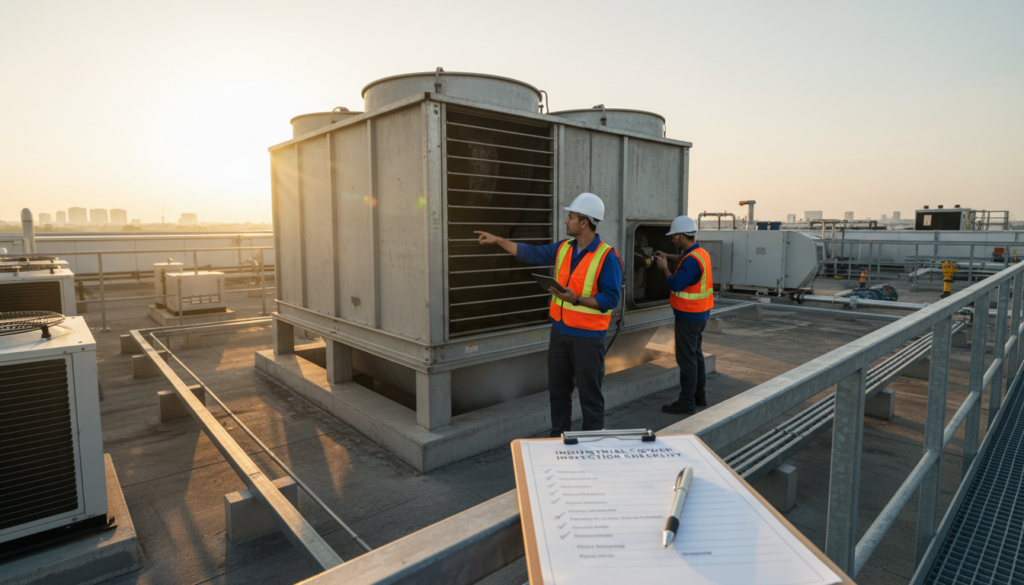
Quick answer for busy professionals: Most facilities with cooling towers over 100 tons, accessible piping, and a cooperative utility are good candidates. However, readiness spans five dimensions: equipment condition, documentation quality, utility program availability, operational capacity, and budget alignment. This checklist helps you assess all five before engaging with a credit program.
Why Cooling Tower Readiness Matters
Evaluating whether your facility is ready for a sewer credit program is fundamentally different from asking whether you are eligible. Eligibility is about meeting utility requirements. Readiness is about whether your facility can actually succeed in the program, capture the promised savings, and sustain compliance over time.
A cooling tower that technically qualifies for credits but lacks proper sub-metering, accurate baseline documentation, or management commitment often underperforms. Worse, you might discover after months of implementation that your utility’s monitoring requirements exceed your team’s capacity, or that your actual water consumption patterns don’t match the program’s assumptions.
This post walks through a structured readiness assessment across five key dimensions. You will identify specific barriers, understand what your results mean, and determine next steps before committing resources.
Equipment Readiness: Does Your Cooling System Meet Basic Requirements?
Cooling Tower Condition and Type
Your cooling tower must be in operating condition and appropriate for credit programs. The type matters: recirculating systems with quantifiable water loss are prime candidates, while once-through systems typically do not qualify because they do not recirculate. Open-loop systems are more favorable than closed-loop systems because evaporative loss is easier to measure and demonstrate.
Equipment age is less critical than functionality. A twenty-year-old tower in good condition outperforms a new tower with poor maintenance. Check for visible damage, scaling, algae growth, or corrosion that suggests baseline operation is uncertain or water loss calculations unreliable. Programs need confidence that your current consumption represents true baseline operation.
The Department of Energy’s cooling tower management guidelines outline operational requirements that align with sewer credit program eligibility.
Review your tower’s design tonnage and current operating load. Most utilities require towers over 50 to 100 tons to justify the monitoring infrastructure. Smaller systems may not meet the cost-benefit threshold for credit programs.
Piping Access and Sub-Metering Feasibility
Credit programs depend on accurate measurement. Your piping must be accessible for meter installation, and your system design should allow for isolated measurement of cooling tower water consumption. If your makeup water supply is commingled with other building water uses (toilets, irrigation, kitchens), sub-metering becomes more complex and sometimes infeasible.
Walk the piping from your water main to the cooling tower. Are there accessible taps where a meter can be inserted? Are there valves that allow isolation for testing? Does the piping layout require significant rework to accommodate a meter? Retrofitting sub-metering in a congested mechanical room with cast iron underground lines and limited above-grade access introduces cost and delay.
Some programs accept alternative measurement methods, such as flow estimates calculated from tower operating hours and design specifications, but sub-metering is the gold standard and often required. Understanding sub-metering requirements for your specific utility is a critical early step.
Electrical Considerations
Modern water monitoring systems depend on power and data connectivity. Ensure your cooling tower or its immediate vicinity has electrical access for sensors, data loggers, or telemetry equipment. Battery-powered sensors exist but have limitations on reporting frequency and lifespan.
Data transmission also matters: programs increasingly require real-time or near-real-time reporting to cloud-based portals. Confirm that your facility has wireless connectivity (cellular or WiFi) in the mechanical room, or that Ethernet runs exist. A tower in a basement or on a remote rooftop without network coverage creates transmission delays and monitoring gaps.
Documentation Readiness: Can You Prove Your Baseline?
Water Billing and Usage Records
Credit programs calculate savings by comparing water consumption after implementation to a baseline period (typically twelve to twenty-four months of historical usage). You must be able to produce uninterrupted water bills covering this baseline period. Gaps in billing, missing records, or consumption spikes due to temporary conditions (filling pools, fire suppression testing, temporary construction) complicate baseline establishment.
Compile three years of water bills if available. Many utilities will not go back more than seven years; if your building changed ownership or management, previous records may be lost. If you cannot locate baseline data, programs may require an extended period of current monitoring to establish a new baseline, delaying credit accrual.
Digital archives are preferable to paper. If your utility only provides paper bills, photograph or scan them and organize them chronologically. Legible, organized records signal to programs that you take data seriously.
Building Plans and Equipment Specifications
Programs often require as-built mechanical plans showing cooling tower size, capacity, system type, and makeup water supply configuration. Original design documents establish the cooling system’s intended purpose and design water consumption.
If original plans are unavailable, programs may accept schematic diagrams you create, equipment nameplate information, or engineering estimates. However, original plans carry more credibility and are less subject to interpretation. Store any available plans in digital format and note their source and revision date.
Utility Account Information
Gather your water utility account number, sewer discharge account number (if separate), service address, account history, and any prior correspondence about water or sewer charges. Some utilities charge separately for water supply and sewer treatment. Credit programs target sewer fees, so understanding your utility’s rate structure is essential.
Confirm your building’s sewer classification (commercial, industrial, institutional). Some utilities offer limited credit programs to certain customer classes, so your sector matters.
Utility Readiness: Does Your Local Utility Offer a Credit Program?
Program Availability
Not all utilities offer cooling tower credit programs. Some municipalities have policies that prohibit credits, while others prioritize different conservation measures. A few utilities offer robust programs; many offer none. Before investing in readiness, confirm that your utility has an active program accepting new participants.
Contact your utility’s conservation or rate department directly. Ask whether cooling tower water loss reduction is eligible for credits or rebates. Request their formal program guidelines, application forms, and list of current participants if available. A utility with ten or more active cooling tower participants is more likely to have refined processes and clear expectations than one with only one or two.
Program Requirements
Each program has unique rules. Common requirements include minimum water savings (50,000 to 500,000 gallons per month), specific sub-metering standards, data reporting frequency, and verification processes. Some programs require third-party audits; others rely on manufacturer estimates.
Study your utility’s program guidelines closely. Does it specify a minimum cooling tower size? Does it require baseline verification or accept design-based estimates? How long is the credit period (one year, five years, perpetual)? Are participants subject to annual audits? Understanding qualification paths for your specific utility shapes your readiness planning.
Operational Readiness: Can Your Team Support This?
Maintenance Team Capacity
Credit programs introduce new responsibilities. Your maintenance team must monitor water consumption, record readings, maintain monitoring equipment, and respond to data gaps or equipment failures. A facility with a full-time engineer can typically absorb these tasks. A facility with a part-time contract maintenance provider or an outsourced facility management company may struggle to meet real-time monitoring demands.
Assess your team’s current workload and expertise. Do they have training in sub-meter reading and basic data interpretation? Are they comfortable using cloud-based reporting portals? If your facility relies heavily on outsourced support, clarify whether your service provider will take on monitoring responsibilities or whether your facility will bear that burden.
Data Reporting and Compliance
Programs require regular data submission: some monthly, some quarterly. Your team must understand the reporting deadline, submission format (spreadsheet, web portal, email), and the implications of late or incorrect submissions. Some utilities penalize missed reporting by suspending credits until data is current.
Establish a clear internal process: who reads the meter, who logs the data, who submits reports, and who verifies accuracy before submission? A documented procedure prevents miscommunication and missed deadlines. Consider assigning a primary and backup person so that vacation or staff turnover does not disrupt compliance.
Automated monitoring systems like RPM Water can reduce manual burden by collecting data continuously and flagging anomalies, but you must still review data for reasonableness and submit required reports.
Budget Readiness: Understanding the Investment Model
Typical Costs
Implementing a cooling tower credit program involves several cost categories. Sub-metering hardware (meter, installation, connections) typically costs $2,000 to $8,000. Water monitoring software or automated data collection adds $500 to $3,000 annually. Engineering support for baseline analysis and program application often costs $1,000 to $3,000.
If your cooling tower requires upgrades to meet baseline efficiency standards or to improve system reliability, those costs are separate. A new drift eliminator, fan upgrade, or fill media replacement might range from $10,000 to $50,000, depending on tower size and condition.
Expected Savings and Payback
Savings depend on baseline water consumption, credit rate, program duration, and system improvements. A facility with a large cooling tower (400-plus tons) in a humid climate might achieve 50,000 to 200,000 gallon-per-month savings. At a sewer credit rate of $4 to $8 per 1,000 gallons, annual savings range from $2,400 to $19,200.
Payback periods vary. A simple sub-metering retrofit with no tower improvements might pay back in one to two years. A project requiring substantial equipment upgrades might take five to seven years. Confirm your utility’s program duration: if credits are granted for only three years, a seven-year payback is not practical.
Be conservative in savings estimates. Use actual historical water data, not manufacturer curves or engineering guesses. Site-specific factors such as humidity, seasonal variation, and operational patterns influence real-world performance.
Self-Assessment Checklist
Use the following checklist to score your readiness. Check each item that applies to your facility.
Equipment Readiness (Five Items)
- Cooling tower is in good operating condition with no major visible damage.
- Cooling tower capacity exceeds 100 tons or your utility has accepted smaller systems.
- System is recirculating (not once-through) and has measurable evaporative loss.
- Piping from main supply to cooling tower is accessible for meter installation.
- Electrical power and data connectivity are available or feasible near the cooling tower.
Documentation Readiness (Five Items)
- You have at least twenty-four months of uninterrupted water billing records.
- Water bills are organized, legible, and in digital format.
- You have original mechanical plans or detailed schematic diagrams of the cooling system.
- You can identify your water utility account number and sewer classification.
- You have equipment nameplate data or specifications for your cooling tower.
Utility Readiness (Five Items)
- Your water utility offers an active cooling tower water loss credit program.
- Your facility’s size and type meet the utility’s program eligibility criteria.
- Your utility has published program guidelines available for review.
- The utility’s monitoring or sub-metering requirements are feasible for your system.
- The utility’s credit rate and program duration align with your cost-benefit expectations.
Operational Readiness (Five Items)
- Your maintenance team or facility manager has capacity for new monitoring responsibilities.
- Your team is comfortable reading sub-meters and interpreting water consumption data.
- Your facility has a documented process for data collection and reporting.
- Your team or service provider can meet the utility’s reporting schedule (monthly, quarterly, annual).
- You have assigned primary and backup personnel for ongoing program compliance.
Budget Readiness (Five Items)
- Capital budget for sub-metering and monitoring setup is available or approved.
- Annual operating budget can cover data management, reporting, and minor maintenance.
- Expected annual savings exceed setup costs divided by payback target (e.g., two to three years).
- Your facility’s budget cycle aligns with the utility’s credit application and payment schedule.
- You have confidence in your cost and savings estimates based on actual facility data.
What Your Results Mean
Twenty to Twenty-Five Items Checked: Ready to Move Forward
Your facility has strong readiness across all dimensions. You have the equipment, documentation, utility support, operational capacity, and budget to succeed in a credit program. Your next step is formal engagement: contact your utility to request an application, or work with a water management partner to develop a detailed implementation plan. You are positioned to begin benefits capture within three to six months.
Fifteen to Nineteen Items Checked: Mostly Ready With Minor Gaps
You have solid readiness but need to resolve one or two specific barriers. For example, you might be missing baseline documentation (solvable by gathering older bills or creating current baseline over three months), or your utility requires sub-metering you do not yet have (solvable with a $2,000 to $4,000 investment). Prioritize the highest-impact gaps and create a six to nine month remediation timeline before formal application.
Ten to Fourteen Items Checked: Barriers to Address Before Program Entry
You have some readiness foundation but multiple gaps that could undermine program success. Your cooling tower may need upgrades, documentation is incomplete, or your team lacks the operational bandwidth. Do not apply for credits until you address at least three to four gaps. Develop a nine to eighteen month action plan that sequences improvements: first securing documentation and confirming utility eligibility, then addressing equipment or operational issues, then applying. Planning and preparatory work now prevents false starts and cost overruns.
Fewer Than Ten Items Checked: Not Ready at This Time
Significant readiness gaps make program participation impractical in the near term. Your facility may lack a utility program option, have equipment that does not meet program standards, or have operational constraints (understaffed facility management, no capacity for data monitoring). Revisit the assessment in twelve to twenty-four months. Improvements to your cooling tower reliability, team staffing, or utility policy may open the door later. In the interim, focus on other water efficiency measures that do not require credit program participation, such as cooling tower optimization or makeup water system improvements.
The EPA WaterSense program for commercial buildings provides complementary guidance on water-efficient cooling operations.
Key Takeaways
- Readiness spans five dimensions: equipment condition, documentation completeness, utility program availability, operational team capacity, and financial alignment.
- Equipment readiness hinges on cooling tower condition, system type, piping accessibility, and monitoring infrastructure feasibility.
- Documentation readiness requires historical water billing records, mechanical plans, and clear utility account information.
- Utility readiness depends on whether your local water utility offers an active credit program and whether your facility meets program criteria.
- Operational readiness requires team capacity for data collection, monitoring, and compliance reporting; outsourced facilities may need to clarify service provider roles.
- Budget readiness depends on honest cost estimates and conservative savings projections based on actual facility data, not industry averages.
- A self-assessment checklist helps identify specific barriers and prioritize remediation actions before formal program application.
- Scores of twenty to twenty-five items indicate immediate readiness; scores below ten suggest waiting and addressing gaps strategically over one to two years.
Ready to Find Out If You Qualify?
If your assessment shows you are ready or mostly ready, the next step is a detailed facility evaluation. RPM Water Equity Solutions offers a free cooling tower readiness assessment that verifies your equipment, reviews your documentation, and confirms utility program eligibility specific to your location. We provide a clear action plan and honest timeline for moving forward. Schedule your free evaluation at Request your free assessment today to take the next step toward qualifying for sewer credits and reducing water costs.
Ready to Find Out What You Could Save?
RPM Water Equity Solutions helps commercial facilities recover money lost to sewer billing assumptions. If your building has a cooling tower, chiller, or any system where water doesn’t return to the sewer, you may be overpaying every month.
Request your free assessment today and find out how much you could recover.
