Quick Answer
A sewer credit is a utility billing adjustment that removes sewer charges for water that never reaches the sewer system — most commonly cooling tower evaporation, landscape irrigation, and boiler losses. Utilities normally bill sewer service on every gallon of water you purchase, assuming it all goes down the drain. A sewer credit corrects that assumption with submeter data proving how much water leaves your building by other paths. To get one, you install meters (typically on the cooling tower makeup and blowdown lines), collect 60 to 90 days of baseline data, and apply through your utility. Commercial buildings with cooling towers typically cut sewer charges by 15 to 30 percent, with the first adjusted bill arriving three to six months after metering begins.
If your commercial building has cooling towers, boilers, or significant irrigation, you’re almost certainly paying sewer charges on water that never reaches the sewer system. A sewer credit fixes that — and the savings can be substantial.
The Simple Explanation
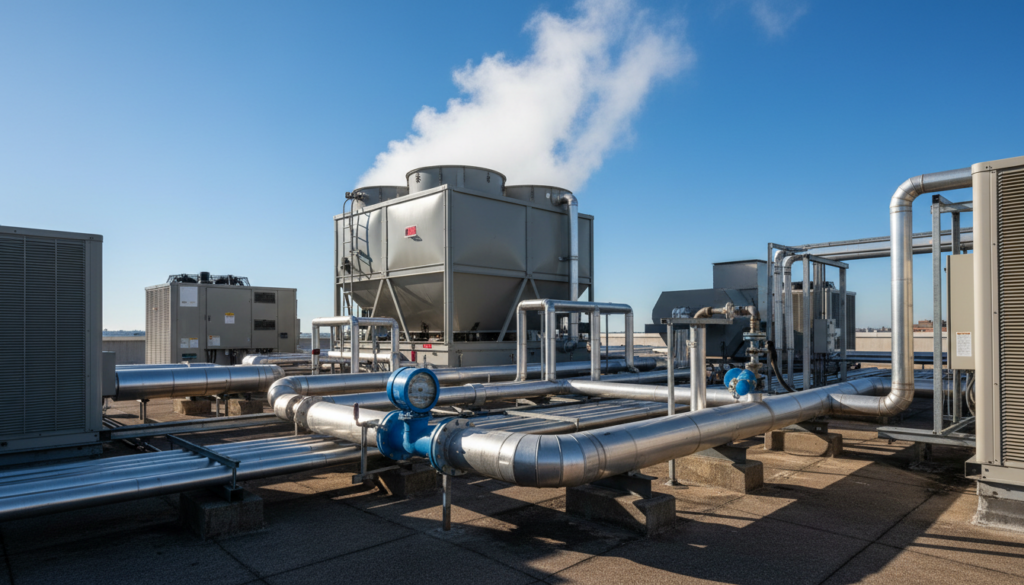
A sewer credit is an adjustment to your utility bill that reduces sewer charges based on documented water that doesn’t flow to the sewer. Most municipalities calculate your sewer bill by assuming that every gallon of water you purchase eventually goes down the drain. For a residential home, that’s roughly accurate. For a commercial building with a cooling tower evaporating thousands of gallons per month into the atmosphere, it’s wildly wrong.
Sewer credits correct this assumption by letting you prove — with metering data — how much water leaves your building through evaporation, irrigation absorption, or other non-sewer paths. Your sewer charges are then calculated only on the water that actually reaches the sewer system. For a complete walkthrough of how sewer credits work — programs, metering, applications, and renewals — see our plain-English guide.
How the Billing Assumption Creates Overpayments
Here’s a simplified example. A mid-size office building purchases 500,000 gallons of water per month. The city charges $8.50 per thousand gallons for sewer service, so the monthly sewer bill is $4,250. But the building’s cooling tower evaporates 150,000 gallons per month — water that goes into the atmosphere, not the sewer. Without a sewer credit, the building pays sewer charges on all 500,000 gallons. With a sewer credit, sewer charges apply to only 350,000 gallons, dropping the bill to $2,975. That’s $1,275 per month in savings — over $15,000 per year.
According to the U.S. Environmental Protection Agency, water and sewer rates have been rising faster than inflation across the country, making these savings increasingly significant over time.
What Qualifies for a Sewer Credit?
The most common qualifying water uses in commercial buildings include cooling tower evaporation (typically the largest single source), boiler steam losses, landscape irrigation that soaks into the ground, and process water consumed in manufacturing. The key requirement is that you can document the volume with a submeter or other approved measurement method.
The U.S. Department of Energy’s Best Management Practice 10 provides guidelines for cooling tower water management that align closely with what most utilities require for credit applications.
The Basic Process
Applying for sewer credits generally follows five steps. First, confirm your local utility offers a sewer credit or evaporation credit program — most large municipalities do. Second, install submeters on your non-sewer water uses, typically on the cooling tower makeup line and blowdown line. Third, collect baseline data for 60 to 90 days to document your water use patterns. Fourth, submit the application with your metering data and supporting documentation. Fifth, receive adjusted billing going forward.
The timeline from first meter installation to first adjusted bill is typically three to six months, depending on your utility’s processing speed. Once approved, the credits continue as long as you maintain your meters and submit periodic renewal data.
Metering Requirements: What Utilities Expect
Utilities approve credits based on data quality, so meter selection and installation matter. Most programs expect commercial-grade meters that meet American Water Works Association (AWWA) accuracy standards — generally registering within 1.5 percent of actual flow across the meter’s rated range. The meter must match the pipe size of your makeup line (typically 1.5 to 4 inches on commercial cooling towers) and be installed with adequate straight pipe runs upstream and downstream so turbulence doesn’t distort readings.
Many utilities also require a calibration certificate at installation and periodic recalibration — commonly every one to three years. Keep those certificates on file; a credit can be suspended if you can’t produce current calibration documentation at renewal time. Metering the blowdown line in addition to the makeup line strengthens your application considerably, because the difference between the two readings is your documented evaporation rather than an engineering estimate.
Common Pitfalls That Delay or Shrink Credits
Most rejected or delayed applications trace back to a handful of avoidable mistakes. Submitting estimates instead of metered data is the most common — utilities want measurement, not calculations from equipment nameplates. An unrepresentative baseline period is another: 30 days of winter data won’t support a credit sized for summer operation, when evaporation can run two to three times higher.
Watch for missed renewal deadlines as well. Most programs require annual or periodic revalidation, and a lapsed renewal usually means the credit stops until the paperwork catches up — often with no retroactive recovery. Finally, equipment problems like a stuck blowdown valve or an overflowing basin send extra water to the sewer and quietly shrink the credit you actually receive, so fix operational issues before you collect baseline data.
Questions to Ask Your Utility Before You Apply
A 10-minute call with your utility’s billing or engineering department can save you months. Ask: Does the utility offer a formal sewer credit or evaporation credit program, or does it handle requests case by case? What meter types and accuracy standards are accepted? How many days of baseline data are required? Is blowdown metering mandatory or optional? How often must the credit be renewed, and what documentation does renewal require? Is the credit applied automatically each month, or do you have to submit readings?
Get the answers in writing where you can. Program rules vary widely between municipalities, and the utility’s written requirements become your checklist for a clean, first-pass approval.
If you’d like to understand the full scope of evaporation credits in more detail, our complete guide to evaporation credits covers every nuance. For a deeper look at how billing assumptions create these overpayments, see our article on utility billing assumptions vs. reality.
Not sure whether this applies to your building? Take the short Water Equity Quiz to see where you stand.
Ready to Find Out What You Could Save?
RPM Water Equity Solutions helps commercial facilities recover money lost to sewer billing assumptions. If your building has cooling towers, you may be paying sewer charges on water that never reaches the sewer system.
Request your free assessment today and find out how much you could recover.
The Bottom Line
Sewer credits aren’t a loophole or a special deal — they’re a correction to a billing assumption that doesn’t reflect how commercial buildings actually use water. If your building evaporates, irrigates, or otherwise consumes water that never reaches the sewer, you deserve to pay sewer charges only on the water that does. The process is straightforward, the savings are real, and the only question is how long you want to keep overpaying before you apply.
