Quick Answer
The most reliable sign of a cooling tower leak is an unexplained increase in makeup water consumption — a 10 to 15 percent jump with no matching change in heat load, occupancy, or weather almost always means water is escaping somewhere. Visible clues include water staining on the basin or the mechanical room floor, corrosion streaks on the tower shell, and a blowdown valve that never fully closes. The stakes are real: a leak of just 5 gallons per minute wastes over 200,000 gallons per month — roughly $3,000 monthly at combined water and sewer rates of $15 per thousand gallons. A submeter on the makeup line, checked against your normal baseline, is the fastest way to confirm or rule out a leak.
A leaking cooling tower doesn’t always announce itself with a puddle on the mechanical room floor. Many leaks are subtle — a slow drip from a corroded basin, a hairline crack in a fill panel, or a valve that doesn’t seat properly. Left undetected, even a small leak can waste thousands of gallons per month and quietly inflate your water and sewer bills.
The Warning Signs
The most reliable indicator of a cooling tower leak is an unexplained increase in makeup water consumption. If your tower’s water usage jumps without a corresponding increase in heat load, building occupancy, or ambient temperature, something is wrong. A 10 to 15 percent increase in makeup water that can’t be explained by operational changes almost always points to a leak somewhere in the system.
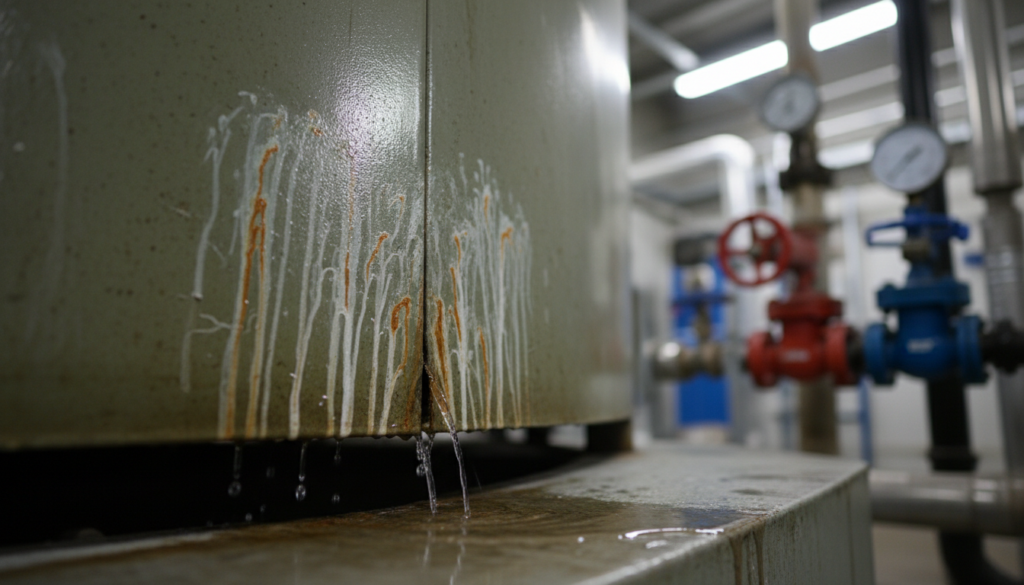
Other warning signs include visible water staining on the tower basin, around pipe connections, or on the mechanical room floor below the tower. Corrosion streaks running down the exterior of the tower shell are another telltale sign — water is escaping through a crack or joint and leaving mineral deposits behind as it evaporates on the outside surface.
The U.S. Department of Energy’s cooling tower management guidelines recommend regular visual inspections specifically because small leaks can persist for months before they’re noticed through billing alone.
Common Leak Locations
Cooling tower leaks tend to occur in predictable places. The basin is the most common culprit — years of water exposure, chemical treatment, and thermal cycling take a toll on basin seals and coatings. Overflow pipes that are set too low or have failed float valves can discharge treated water directly to the drain without anyone realizing it. Pipe connections, especially at the makeup water line and blowdown line, develop leaks at joints and valves over time.
Distribution nozzles and spray headers can crack or become misaligned, sending water outside the fill media and down the exterior of the tower. And don’t overlook the blowdown valve itself — a blowdown valve that’s stuck partially open will continuously discharge water to the sewer, which shows up as excess water consumption but not as a visible leak.
How Submetering Catches Leaks Early
The fastest way to detect a cooling tower leak is with a dedicated submeter on the makeup water line. When you’re monitoring makeup water flow in real time, a leak shows up immediately as an unexplained deviation from baseline consumption. Without a submeter, you might not notice the problem until your next quarterly utility bill review — by which time you’ve already wasted tens of thousands of gallons.
Real-time monitoring takes this a step further. A continuous water monitoring system can alert you within hours when consumption patterns shift. If your tower normally uses 80,000 gallons per month and suddenly starts pulling 95,000 gallons with no change in building load, you get an alert — not a surprise bill three months later.
According to the EPA’s WaterSense program for commercial buildings, fixing leaks in cooling systems is one of the highest-impact water conservation measures available, often reducing total building water consumption by 5 to 15 percent.
A Simple Water Balance Test You Can Run This Week
You don’t need special instruments to check whether your tower’s consumption makes sense — just your makeup meter readings and a little arithmetic. A cooling tower has three legitimate ways to lose water: evaporation, blowdown, and drift. Evaporation runs roughly 1.8 to 2 gallons per minute per 100 tons of actual cooling load. Blowdown depends on your cycles of concentration: at 4 cycles, blowdown is about one-third of evaporation. Drift on a modern tower with intact drift eliminators is a rounding error — typically under 0.005 percent of recirculation flow.
Add expected evaporation and blowdown for the period, then compare the total against what your makeup meter actually recorded. If metered makeup exceeds the expected total by more than about 10 percent, something is leaking, overflowing, or draining that shouldn’t be. Run the check monthly — after the first couple of passes, the math takes about 15 minutes.
The Overnight Shutoff Test
When the balance check flags a problem, an overnight test can isolate it. With the tower offline and fans and pumps stopped, record the makeup meter reading and mark the basin water level at the end of the day, then check both in the morning. A basin level that dropped with no equipment running points to a basin or piping leak. A makeup meter that advanced overnight means a float valve or fill solenoid is letting water in — often paired with an overflow quietly sending the excess to the drain. A few dye tablets in the basin will confirm whether water is reaching the overflow line.
What a Leak Costs You
The cost of a cooling tower leak goes beyond the wasted water. Every gallon that leaks out must be replaced with treated makeup water, which means higher chemical treatment costs. And because most utilities charge sewer based on total water consumption, you’re also paying sewer charges on every leaked gallon — water that went straight to the ground or down a drain rather than through your building’s sewer system. A leak of just 5 gallons per minute — which looks like barely more than a fast drip — adds up to over 200,000 gallons per month. At combined water and sewer rates of $15 per thousand gallons, that’s $3,000 per month in unnecessary charges.
Curious what continuous visibility looks like in practice? See how RPM’s 24/7 cooling tower monitoring works.
Ready to Find Out What You Could Save?
RPM Water Equity Solutions helps commercial facilities recover money lost to sewer billing assumptions. If your building has cooling towers, you may be paying sewer charges on water that never reaches the sewer system.
Request your free assessment today and find out how much you could recover.
Find It Before It Finds Your Budget
Cooling tower leaks are common, progressive, and expensive — but they’re also detectable and fixable. Regular visual inspections, dedicated submetering, and real-time monitoring are your three lines of defense. If you haven’t checked your tower’s water consumption against its expected baseline recently, now is the time. The leak you catch today could be saving you thousands by next month.
