Quick Answer
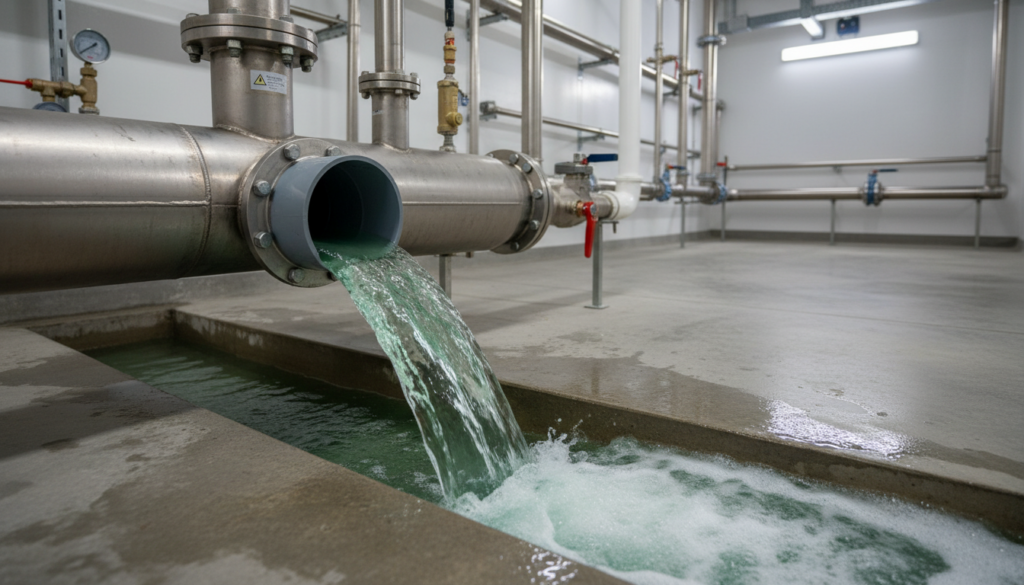
Cooling tower blowdown is water intentionally drained from the tower basin to control the mineral concentration left behind by evaporation. Blowdown flows through a drain line into the sanitary sewer, so it is correctly billed for sewer service. Evaporation, by contrast, leaves the tower as vapor and never reaches the sewer — yet most utilities bill sewer on 100 percent of the water you purchase. In a typical tower, blowdown is 20 to 40 percent of makeup water and evaporation is 50 to 80 percent, depending on cycles of concentration. Metering both the makeup and blowdown lines proves exactly how much water evaporates, and that metered evidence is what utilities require before granting a sewer credit on the evaporated portion.
If you’re exploring sewer credits for your commercial building, you’ll quickly encounter the term “blowdown.” It’s the single most important concept in understanding why your sewer bill is higher than it needs to be — and why metering blowdown is the foundation of every sewer credit application.
What Is Blowdown?
Blowdown is the intentional discharge of water from your cooling tower basin to the drain. As your tower operates, water evaporates to reject heat from your building. But when water evaporates, the dissolved minerals — calcium, magnesium, silica, and others — stay behind. Over time, those minerals concentrate to levels that cause scaling, corrosion, and biological growth. Blowdown removes a portion of this concentrated water and replaces it with fresh makeup water, keeping mineral levels in a safe operating range.
Think of it as draining part of your pool and refilling it with clean water to dilute the chemicals. It’s a necessary maintenance function that keeps your cooling system running efficiently.
Where Does Blowdown Water Go?
This is the critical question for sewer credits. Blowdown water flows from the cooling tower basin through a drain line to your building’s sewer connection. It does reach the sewer system, and it should be included in your sewer charges. This is what makes it fundamentally different from evaporation.
Evaporation is water that leaves the top of the cooling tower as vapor — it goes into the atmosphere and never touches the sewer. Blowdown is water that leaves the bottom of the tower through a drain — it goes to the sewer just like water from a sink or toilet. Understanding this distinction is the entire basis of cooling tower sewer credits, as the Department of Energy explains in its cooling tower management guidelines.
Why Metering Blowdown Is Essential
Your utility charges sewer based on total water purchased. But your cooling tower uses two types of water: evaporation (non-sewer) and blowdown (sewer). To claim credits for evaporation, you need to prove exactly how much water reaches the sewer versus how much evaporates. That’s where blowdown metering comes in.
With a meter on both the makeup line (total water into the tower) and the blowdown line (water out to sewer), you can calculate evaporation precisely: Evaporation = Makeup − Blowdown − Drift. Since drift losses are negligible in modern towers (typically less than 0.005 percent of circulation rate), the practical calculation simplifies to Evaporation ≈ Makeup − Blowdown.
This metered data is what your utility needs to approve a sewer credit. Without it, you’re asking them to take your word for it — and utilities don’t do that. For a detailed look at how submeters work in this context, see our submetering guide.
Typical Blowdown Rates
In a well-managed cooling tower, blowdown typically accounts for 20 to 40 percent of total makeup water, depending on the cycles of concentration at which the tower operates. At 3 cycles, about 50 percent of makeup water becomes blowdown. At 6 cycles, it drops to about 20 percent. The remaining makeup water — 50 to 80 percent — evaporates.
This means that for a tower using 100,000 gallons of makeup water per month at 6 cycles, approximately 80,000 gallons evaporate (qualifying for sewer credits) and 20,000 gallons go to blowdown (correctly charged for sewer). According to EPA WaterSense data, cooling towers are among the largest single water consumers in commercial buildings, making these proportions financially significant.
How Cycles of Concentration Control Your Blowdown Volume
Cycles of concentration (CoC) is the ratio of dissolved minerals in your tower water compared to the fresh makeup water. Run at 2 cycles and the tower water is twice as concentrated as makeup; run at 6 cycles and it’s six times as concentrated. The higher the cycles, the less blowdown you send to the drain for every gallon evaporated — which means less water purchased and a smaller correctly-billed sewer volume.
Most towers are controlled by a conductivity sensor that opens the blowdown valve automatically when dissolved solids climb past a setpoint. Where you can safely set that point depends on your makeup water chemistry — hardness, silica, and chlorides set the practical ceiling — and on your water treatment program. Moving a tower from 3 to 6 cycles cuts blowdown roughly in half, which is why utilities and energy programs treat cycle optimization as the first water-efficiency step for cooling towers. If your treatment vendor can’t tell you your current cycles of concentration, that’s a conversation worth having this week.
Blowdown Varies With the Seasons — and So Should Your Credit
Cooling load drives evaporation, and evaporation drives blowdown. In July, a fully loaded tower in a hot climate may evaporate several times more water than it does in a mild April, and the blowdown volume scales with it. A tower that’s essentially idle from November through February may send almost nothing to the drain in winter.
This seasonality matters for sewer credits in two ways. First, a credit based on continuous metered data automatically tracks the swings — you get a large credit in peak season when the dollars are biggest. Second, it’s why utilities are skeptical of flat annual estimates: a single-number guess either overstates winter evaporation or understates summer evaporation. Monthly meter reads from the makeup and blowdown lines settle the question with data, and they also flag problems early — a blowdown valve stuck open can quietly triple your water and sewer costs for months before anyone notices it on a bill.
What Happens Without a Blowdown Meter?
If you only have a makeup water meter but no blowdown meter, some utilities will accept an engineering estimate of evaporation based on your tower specifications and local climate data. However, most prefer metered data, and your credit amount will typically be larger with actual measurements than with estimates (which utilities tend to discount conservatively). Two meters give you the strongest possible application. Our article on cooling tower water loss breaks down these water flows in full detail.
Curious what continuous visibility looks like in practice? See how RPM’s 24/7 cooling tower monitoring works.
Ready to Find Out What You Could Save?
RPM Water Equity Solutions helps commercial facilities recover money lost to sewer billing assumptions. If your building has cooling towers, you may be paying sewer charges on water that never reaches the sewer system.
Request your free assessment today and find out how much you could recover.
Blowdown Is the Key
Once you understand the blowdown vs. evaporation distinction, the logic of sewer credits becomes obvious. Your building pays sewer charges on every gallon of water — but a large percentage of that water never sees the sewer. Metering blowdown proves exactly where the water goes, and that proof is what unlocks your savings. If your tower doesn’t have a blowdown meter yet, that’s the first investment to make.
