Quick Answer
For the physical installation of a water submeter, you need a licensed commercial plumber — they cut the pipe, set the meter with proper fittings and straight-pipe runs, and verify flow direction and leak-free operation. An engineer is only required in two situations: when your utility requires a professional engineer (PE) to stamp the sewer credit application or metering drawings, or when the installation involves complex piping changes to the building’s water distribution. Typical costs run $500 to $1,500 for professional installation, plus $1,500 to $3,000 for engineering review in cities that require a PE stamp. Check your utility’s written requirements before any work starts — meter type, placement, and certification rules vary by jurisdiction, and an installation that doesn’t match them can sink your credit application.
You’ve decided to install submeters on your cooling tower to pursue sewer credits — good decision. But now you need to figure out who does the work. Do you call a plumber? A mechanical engineer? Both? The answer depends on your local utility’s requirements and the complexity of your installation, but for most commercial buildings, the process is simpler than you might expect.
The Short Answer
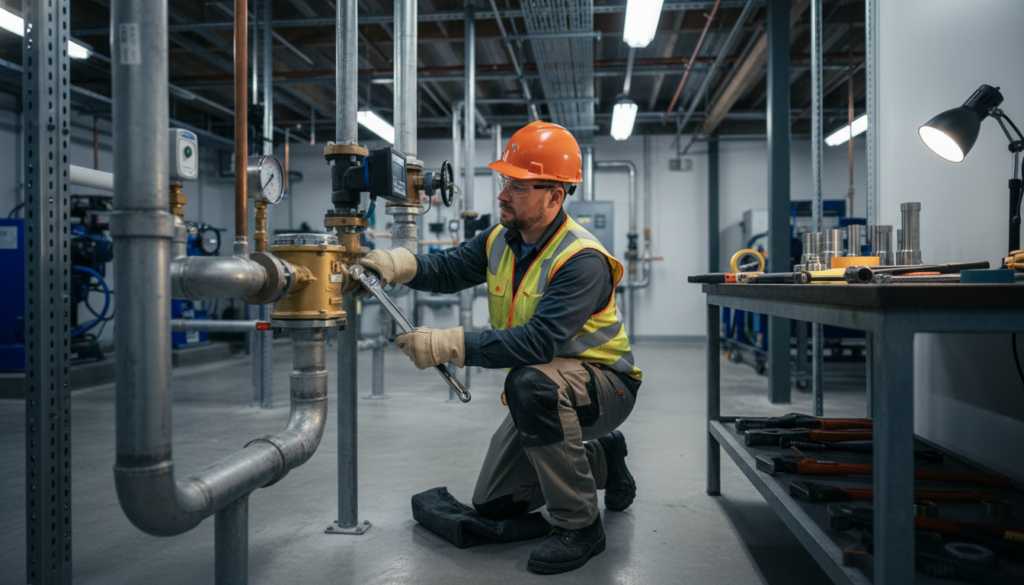
For the physical installation of the meter itself, you need a licensed plumber. They’ll cut into the pipe, install the meter body with appropriate fittings, ensure proper flow direction and straight-pipe requirements are met, and verify there are no leaks. This is skilled plumbing work that requires someone who understands commercial water systems, pipe sizing, and local plumbing codes.
An engineer’s involvement is typically needed only in two scenarios: when your local utility requires a professional engineer (PE) to stamp the sewer credit application or submeter documentation, or when the installation involves complex piping modifications that affect building water distribution. For a straightforward meter installation on an existing cooling tower makeup line, engineering involvement is usually optional — helpful for planning, but not required for the physical work.
When You Need an Engineer
Some municipalities require a licensed professional engineer to certify your submeter installation as part of the sewer credit application. This typically means the engineer provides a stamped drawing showing the meter location relative to the building’s plumbing system, certifies that the meter specifications are appropriate for the expected flow rates, and signs off on the accuracy of the metering arrangement. This doesn’t mean the engineer physically installs the meter — they review and certify the installation.
Cities that require engineering certification include some of the larger municipalities where sewer credit programs involve substantial dollar amounts. The EPA’s WaterSense program notes that submetering requirements vary significantly by jurisdiction, which is why checking your specific utility’s requirements before starting any work is essential.
If you’re managing a building in a city that requires engineering signoff, budget $1,500 to $3,000 for the engineering review and certification. This is separate from the plumbing installation cost. Some mechanical engineering firms that specialize in commercial water systems can handle both the engineering review and the plumbing coordination as a single scope of work, which streamlines the process.
Finding the Right Plumber
Not every plumber has experience with commercial submeter installations. Look for a licensed commercial plumber — not a residential specialist — with experience in mechanical room work. Ideally, they’ll have installed water meters before and understand the straight-pipe requirements that affect meter accuracy. Ask whether they’ve done cooling tower submeter installations specifically.
A good commercial plumber will review your piping layout before providing a quote, identify any access challenges or pipe modifications needed, recommend a meter type and size based on your pipe diameter and expected flow rates, and schedule the work to minimize building disruption — including whether a system shutdown is needed.
The DIY Question
Some facility managers consider installing submeters themselves to save on labor costs. This is strongly discouraged for several reasons. First, most jurisdictions require a licensed plumber for any modification to a commercial water system. Second, improper installation can produce inaccurate readings that undermine your sewer credit application. Third, if a self-installed meter causes a water leak or system problem, your building insurance may not cover the damage. The Department of Energy recommends professional installation for all water metering equipment in commercial and institutional buildings.
The exception is ultrasonic clamp-on meters, which mount on the outside of the pipe without cutting into it. Some facility managers with mechanical aptitude install these themselves, though having a professional verify the installation ensures the readings are accurate.
Installation Details That Affect Meter Accuracy
Whoever does the work, a handful of technical details determine whether your meter produces credit-worthy data. The biggest is straight-pipe requirement: most meter types need an unobstructed run of straight pipe upstream and downstream of the meter — commonly 5 to 10 pipe diameters upstream and 2 to 5 downstream — so turbulence from elbows, valves, and tees doesn’t distort readings. In a crowded mechanical room, finding that run is often the hardest part of the job.
Sizing matters just as much. A meter sized to the pipe rather than to the actual flow range can under-register at low flows, which quietly costs you credit volume. Ask your installer to size the meter from your expected minimum and maximum makeup flow, not just pipe diameter. Utilities generally expect registration accuracy consistent with AWWA cold-water meter standards, so specify a meter with documented accuracy — typically within plus or minus 1.5 percent — and keep the manufacturer’s calibration certificate with your application file.
Finally, plan the meter’s orientation and access during the quote walk-through. Registers should be readable without a ladder, remote-reading outputs (pulse or encoder) should be wired at installation time if you plan to log data automatically, and isolation valves on either side of the meter make future calibration or replacement a one-hour job instead of a shutdown event.
Questions to Ask Before Anyone Opens a Pipe
Five questions prevent most bad installations. Ask your utility: Do you require a PE stamp, a specific meter type, or a pre-approval inspection before installation? Ask your plumber: Have you installed cooling tower submeters before, and will the location you’re proposing meet the meter manufacturer’s straight-pipe specification? Ask your meter supplier: What calibration documentation ships with the meter, and what is the recommended recalibration interval? Ask yourself: Will the building need a water shutdown, and which tenants need notice? And ask everyone: Who is responsible if the installed meter fails the utility’s inspection?
Getting these answers in writing before work begins costs nothing. Discovering after installation that your utility only accepts a specific meter class — or wanted to inspect the open pipe — can mean doing the job twice.
Ready to Find Out What You Could Save?
RPM Water Equity Solutions helps commercial facilities recover money lost to sewer billing assumptions. If your building has cooling towers, you may be paying sewer charges on water that never reaches the sewer system.
Request your free assessment today and find out how much you could recover.
Get It Done Right the First Time
The cost difference between a professional submeter installation and a DIY approach is typically $500 to $1,500 — a small fraction of the annual sewer credit savings the meter will unlock. Hire a licensed commercial plumber, check whether your utility requires an engineer’s stamp, and get the installation done properly. The sooner your meter is running and collecting data, the sooner you can submit your credit application and start saving.
