Quick Answer
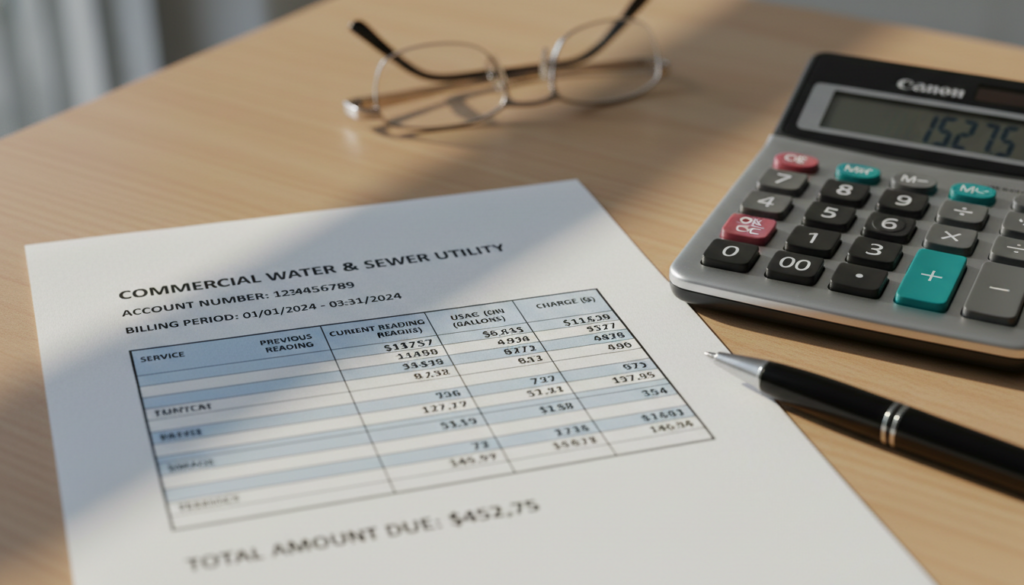
A commercial water and sewer bill has two core charges: a water charge for the treated water delivered to your building, and a sewer charge for wastewater treatment — plus a fixed base charge tied to your meter size and, often, stormwater or infrastructure surcharges. The detail that matters most: in most cities, the sewer charge is calculated as a percentage of the water you purchase, on the assumption that nearly all of it reaches the sewer. Sewer rates typically run 1.2 to 2 times the water rate, so sewer is often the largest single line item. To read your bill, identify the billing units (usually CCF — 748 gallons — or thousands of gallons), confirm the meter reads are actual rather than estimated, and compare the sewer volume to the water volume. Any gap between what you buy and what actually reaches the drain is a savings opportunity.
If you’ve ever looked at your commercial water and sewer bill and wondered what half the line items mean, you’re not alone. Commercial utility bills are notoriously opaque — packed with surcharges, tier calculations, and coded abbreviations that make it hard to understand exactly what you’re paying for. But understanding your bill is the first step toward reducing it.
The Two Main Charges
Every commercial water and sewer bill has two primary components: the water charge and the sewer charge. The water charge covers the cost of treated water delivered to your building — you’re paying for the water itself plus the infrastructure to deliver it. The sewer charge covers the cost of treating your wastewater at the municipal treatment plant — you’re paying for the infrastructure and processing to clean the water before it’s discharged.
Here’s the critical detail that most facility managers miss: in most cities, your sewer charge is calculated as a percentage of your water consumption. The utility assumes that nearly all the water you purchase eventually flows into the sewer system. For many commercial buildings — especially those with cooling towers, boilers, or irrigation — this assumption is wrong, and it’s costing you money every month.
Common Line Items Explained
Beyond the basic water and sewer volumetric charges, your bill likely includes a base or service charge — a fixed monthly fee that covers meter maintenance and account administration, regardless of how much water you use. This charge varies by meter size; a two-inch commercial meter might carry a base charge three to five times higher than a residential meter.
You may also see tiered rate structures, where the per-gallon price increases as your consumption rises. Some cities use block rates (fixed price within each tier), while others use inclining block rates (the price per gallon increases with each block). There may be additional surcharges for stormwater management, infrastructure improvement, or regulatory compliance — these are typically small fixed fees but they add up.
The EPA’s guide to understanding water bills provides a helpful overview of common billing structures and explains why rates vary so dramatically between cities.
Where the Savings Hide
The biggest savings opportunity on most commercial water and sewer bills is the sewer charge itself. If your building has any significant water use that doesn’t go to the sewer — cooling tower evaporation, landscape irrigation, boiler steam losses — you’re paying sewer charges on water that the treatment plant never receives. This is exactly what sewer credits are designed to fix.
Other common savings opportunities include meter size verification — if your meter is larger than your actual peak demand requires, you’re paying an unnecessarily high base charge. Billing errors are more common than you’d expect; a study referenced by the EPA’s WaterSense program found that commercial billing discrepancies occur in a meaningful percentage of accounts, often due to misread meters or incorrect rate classifications.
Review your bill for the sewer-to-water ratio. If your sewer charge equals or exceeds your water charge — which is common, since sewer rates are typically 1.2 to 2 times higher than water rates — the potential savings from sewer credits become even more significant. A building paying $5,000 per month in sewer charges that qualifies for a 30 percent credit saves $1,500 per month, or $18,000 per year.
Decode the Units Before You Do Any Math
The single most common mistake in bill review is misreading the units. Most utilities bill in CCF (hundred cubic feet), and 1 CCF equals 748 gallons. Others bill in thousands of gallons (kgal), and a few use cubic meters. If you compare this month’s bill to a benchmark without converting units, your numbers can be off by a factor of seven or more.
Also check the read type printed next to the meter reading. An “actual” read means someone (or an automated system) recorded the meter; an “estimated” read means the utility guessed based on your history. A string of estimated reads followed by one actual read often produces a catch-up bill that lands in a higher rate tier than the water would have cost if billed monthly — a correctable error worth disputing. Finally, confirm the meter number on the bill matches the meter on your wall. Transposed accounts happen, especially in multi-building campuses and after utility billing-system migrations.
A 30-Minute Monthly Bill Audit
You don’t need an analyst to catch most billing problems. Once a month, run this checklist:
- Compare water volume to the same month last year. Weather-driven swings are normal; a 20 percent jump with no change in occupancy or cooling load usually means a leak, a stuck fill valve, or a meter issue.
- Check the sewer-to-water ratio. If sewer volume equals 100 percent of water volume and you have a cooling tower, boiler, or irrigation, you are likely overpaying.
- Verify your rate class. Buildings get misclassified — a commercial account billed on an industrial rate schedule, or vice versa, can pay thousands more per year.
- Look at the base charge against your meter size. A 3-inch meter serving a building whose peak demand fits a 2-inch meter carries a permanently inflated fixed charge.
- Scan for new surcharges. Utilities add and adjust stormwater, infrastructure, and compliance fees regularly; each one is worth a quick check to confirm it applies to your property type.
Log the numbers in a simple spreadsheet. Three months of data establishes a baseline; twelve months reveals the seasonal pattern that makes anomalies obvious at a glance.
Build a Bill Review Habit
Don’t just file your water bill and forget it. Establish a monthly review process that tracks total water consumption against building occupancy and weather data. Sudden increases in consumption that don’t correlate with higher cooling loads or occupancy may indicate leaks, stuck valves, or meter problems. A real-time water monitoring system automates this comparison and flags anomalies before they become expensive surprises.
Ready to Find Out What You Could Save?
RPM Water Equity Solutions helps commercial facilities recover money lost to sewer billing assumptions. If your building has cooling towers, you may be paying sewer charges on water that never reaches the sewer system.
Request your free assessment today and find out how much you could recover.
Knowledge Is Savings
Your commercial water and sewer bill contains more savings opportunities than most facility managers realize. The first step is understanding what each charge means and how it’s calculated. The second step is questioning the assumptions — especially the assumption that all your water ends up in the sewer. If you haven’t reviewed your bill line by line recently, set aside 30 minutes this month to do it. The savings you find might surprise you.
