Quick Answer
A cooling tower should be thoroughly cleaned at least twice per year — once before the cooling season starts and once after it ends. Towers that run year-round in warm climates should be cleaned quarterly, and towers in high-debris environments (construction zones, agricultural areas, heavy pollen) may need more frequent attention. Cleaning matters for both cost and compliance: a scaled, fouled tower can use 10 to 20 percent more water than a clean one at the same heat load, and documented cleaning schedules are a core requirement of Legionella water management programs under ASHRAE Standard 188. A proper cleaning includes draining and desludging the basin, pressure washing the fill, cleaning the distribution deck and nozzles, and reapplying chemical treatment before refill.
A dirty cooling tower isn’t just an aesthetic problem — it’s a performance problem, a compliance risk, and often a hidden source of unnecessary water waste. If your facility hasn’t established a regular cleaning schedule, you’re likely spending more on water, chemicals, and energy than you need to.
The Short Answer
Most cooling tower experts recommend a thorough cleaning at least twice per year — once before the cooling season begins and once after it ends. For towers that operate year-round in warm climates, quarterly cleaning is the standard recommendation. Buildings in areas with heavy airborne debris (construction zones, agricultural areas, or high-pollen environments) may need even more frequent attention.
The U.S. Department of Energy’s Best Management Practice 10 emphasizes that regular tower cleaning is fundamental to maintaining both water efficiency and cooling performance. A tower operating with fouled fill, scaled heat exchange surfaces, or a debris-laden basin works harder and wastes more water than a clean one.
What Happens When You Skip Cleaning
When a cooling tower goes too long without cleaning, several problems compound. Scale buildup on fill media and heat exchange surfaces reduces the tower’s thermal efficiency, forcing it to work harder — which means more fan energy and more water consumption. Biological growth, including algae in sun-exposed areas and biofilm on submerged surfaces, reduces water flow through the fill and creates health risks. Sediment accumulation in the basin provides a nutrient-rich environment for bacteria, including Legionella, and can clog blowdown valves and strainers.
The water waste connection is direct. A scaled cooling tower can use 10 to 20 percent more water than a clean one operating at the same heat load. For a tower consuming 100,000 gallons per month, that’s 10,000 to 20,000 gallons of unnecessary water consumption — water you’re paying for twice (once as water, once as sewer charges). If you’re already receiving sewer credits, a dirty tower is reducing the efficiency of those credits by increasing your total water consumption relative to your cooling output.
What a Thorough Cleaning Includes
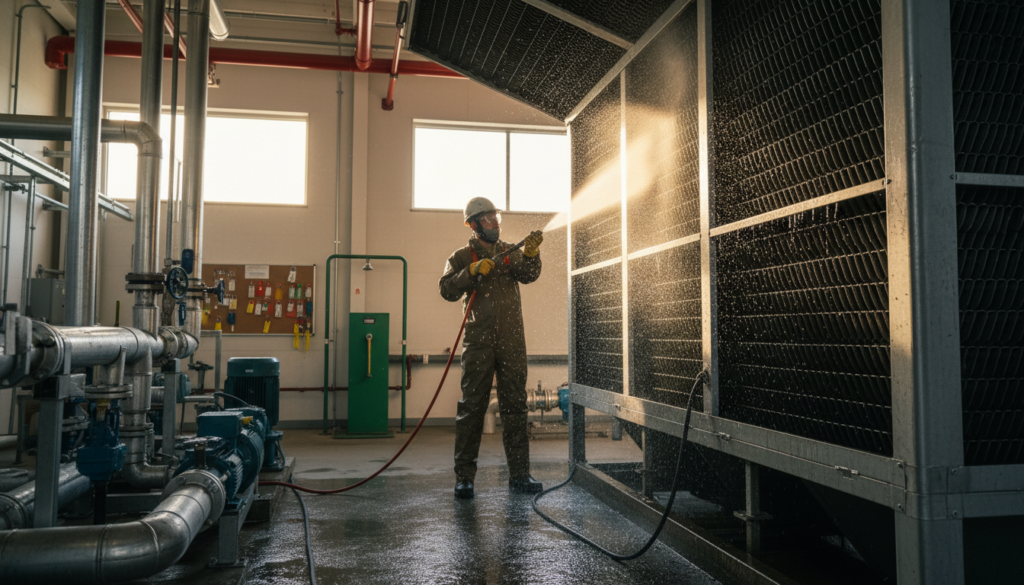
A proper cooling tower cleaning goes beyond hosing off the visible surfaces. It includes draining the basin completely and removing accumulated sediment, pressure washing the fill media to remove scale and biological growth, inspecting and cleaning the distribution deck and nozzles, cleaning or replacing drift eliminators, inspecting the basin coating for cracks or deterioration, flushing all blowdown and makeup water piping, and a fresh application of chemical treatment before refilling.
This is also the right time to inspect submeters and monitoring equipment. If your facility uses submeters for sewer credit documentation, verify that the meters are reading accurately during the cleaning shutdown. A meter that has drifted out of calibration will produce inaccurate data for your credit renewal.
Cleaning and Legionella Compliance
Cooling tower cleaning is a core requirement of any Legionella water management plan. The CDC’s guidance on Legionella water management specifically calls out cooling tower maintenance as a critical control point. ASHRAE Standard 188, which many jurisdictions now mandate, requires documented cleaning schedules as part of a building’s water management program. Skipping scheduled cleanings doesn’t just waste water — it can put your building out of compliance.
Curious what continuous visibility looks like in practice? See how RPM’s 24/7 cooling tower monitoring works.
Building a Cleaning Calendar That Sticks
The facilities that stay on schedule treat tower cleaning like elevator inspections: fixed dates, assigned owners, and documentation for every event. Anchor your calendar to the cooling season. Schedule the pre-season cleaning 2 to 4 weeks before design-day loads arrive, so the tower starts the season with clean fill and a fresh chemical baseline. Schedule the post-season cleaning immediately after shutdown, before sediment hardens in the basin.
Between full cleanings, add lighter monthly checks: skim the basin for debris, inspect strainers, confirm the blowdown valve cycles properly, and look for visible algae or scale lines on the fill. These 20-minute inspections catch problems while they’re still hose-and-brush fixes instead of drain-and-pressure-wash projects. Log every inspection and cleaning with the date, who performed it, and what was found — that log is exactly what a health inspector or your water management program auditor will ask to see.
What Cleaning Typically Costs — and What It Returns
For a mid-size commercial tower, professional cleaning typically runs $1,500 to $5,000 per event depending on tower size, access, and how much sediment has accumulated. Larger multi-cell towers can cost more, and towers that have gone years without service often carry a premium for the first restorative cleaning.
Set that against what fouling costs you. A tower consuming 100,000 gallons per month that runs 10 to 20 percent over baseline because of scale is wasting 10,000 to 20,000 gallons monthly — billed once as water and again as sewer charges in most cities. Add higher fan and pump energy from degraded heat transfer, plus increased chemical demand, and two cleanings per year typically pay for themselves before you factor in compliance risk at all. Cleaning is one of the few maintenance line items where the return shows up directly on the next utility bill.
Ready to Find Out What You Could Save?
RPM Water Equity Solutions helps commercial facilities recover money lost to sewer billing assumptions. If your building has cooling towers, you may be paying sewer charges on water that never reaches the sewer system.
Request your free assessment today and find out how much you could recover.
Clean Towers Save Money
The cost of regular cooling tower cleaning is modest compared to the costs of neglect. A cleaner tower runs more efficiently, uses less water, requires less chemical treatment, and keeps you on the right side of health regulations. Build the twice-a-year minimum into your facility maintenance calendar and treat it as non-negotiable. Your water bills, your energy bills, and your compliance record will all benefit.
